The phone screen is the single most important filter in your hiring process. A well-run 20-minute call can save your team dozens of hours in wasted interviews with candidates who were never going to work out. Yet most hiring managers wing it, asking random questions and making gut-feel decisions.
This guide gives you a structured approach to phone screening with 40+ proven questions organized by category, plus scoring tips and red flags to watch for.
Quick Tool: Need phone screen questions fast? Try our free Phone Screen Questions Template to generate role-specific questions instantly.
#What Is a Phone Screen?
A phone screen is a brief, initial conversation with a candidate—typically 15 to 30 minutes—designed to verify basic qualifications before investing time in a full interview. It sits between the resume review and the formal interview in your hiring pipeline.
Phone screens are not interviews. Their purpose is to filter, not to deeply evaluate. You're answering one core question: Should this person move to the next round?
#Why Phone Screens Matter
- Save interview time. A 20-minute call prevents a 60-minute interview with the wrong candidate.
- Verify what resumes can't tell you. Communication skills, enthusiasm, and salary alignment don't show up on paper.
- Improve candidate experience. Candidates prefer a quick call over silence or a lengthy take-home assignment as a first step.
- Reduce cost per hire. Fewer wasted interviews means lower hiring costs across the board.
#How to Structure a Phone Screen
Consistency matters. Use the same structure for every candidate applying to the same role. Here's a proven format:
| Phase | Duration | Purpose |
|---|---|---|
| Introduction | 2-3 min | Set the tone, explain the process |
| Role overview | 3-5 min | Briefly describe the position and company |
| Candidate questions | 10-15 min | Ask your screening questions |
| Candidate's questions | 3-5 min | Let them ask about the role |
| Next steps | 1-2 min | Explain timeline and process |
Total: 20-30 minutes
#Before the Call
- Review the candidate's resume and application for 2-3 minutes
- Prepare your questions in advance (or use our Phone Screen Questions Template to generate them)
- Have a scorecard ready
- Block time so you won't be rushed
#Phone Screen Questions by Category
#Role Fit Questions
These verify the candidate has the baseline qualifications for the position.
-
Walk me through your relevant experience for this role.
- Listen for: Specific examples, not vague summaries. Do their skills match the job requirements?
-
What's your understanding of what this role involves?
- Listen for: Whether they've read the job description and understand the core responsibilities.
- Red flag: Completely wrong assumptions about the role.
-
What specific skills or tools from the job description do you have direct experience with?
- Listen for: Honest self-assessment. Candidates who say "I know everything" rarely do.
-
Describe a typical day in your current (or most recent) role.
- Listen for: Overlap with your open position. If their day-to-day is completely different, the transition may be difficult.
-
What would you consider your strongest professional skill?
- Listen for: Alignment with what the role actually needs.
-
Is there anything in the job description you feel less confident about?
- Listen for: Self-awareness and honesty. Strong candidates acknowledge gaps and explain how they'd close them.
#Motivation Questions
These reveal why the candidate is looking and whether they'll stick around.
-
Why are you looking to leave your current position?
- Listen for: Professional reasons (growth, new challenges, career direction). Patterns of short tenures deserve follow-up.
- Red flag: Badmouthing current employer or coworkers.
-
What attracted you to this specific role?
- Listen for: Specific reasons tied to the job, not generic answers like "it seemed interesting."
-
What do you know about our company?
- Listen for: Basic research—they should know what you do, at minimum.
- Red flag: Zero knowledge of the company.
-
Where do you see yourself in 2-3 years?
- Listen for: Goals that align with the growth path this role offers.
-
What type of work environment do you thrive in?
- Listen for: Compatibility with your team culture and work style.
-
What would make this your ideal next role?
- Listen for: Whether your role can realistically deliver what they want.
#Logistics Questions
These surface deal-breakers early, before anyone wastes more time.
-
What are your salary expectations for this role?
- Listen for: A range that falls within your budget. If they're 40% above your cap, it's better to know now.
-
When would you be available to start?
- Listen for: Reasonable notice period (2-4 weeks is standard). Immediate availability can be fine or a red flag depending on context.
-
Are you comfortable with [remote/hybrid/on-site] work?
- Listen for: Clear alignment. Work arrangement mismatches cause early turnover.
-
Are you currently interviewing with other companies?
- Listen for: Honesty. This helps you gauge urgency and timeline.
-
Are you legally authorized to work in [country]?
- Listen for: Clear answer, especially if you don't offer visa sponsorship.
-
This role requires [travel/on-call/specific hours]. Does that work for you?
- Listen for: Genuine acceptance, not reluctant agreement.
-
Are you open to a background check if we move forward?
- Listen for: Standard for most roles. Hesitation may warrant follow-up.
#Experience & Technical Questions
These dig slightly deeper into relevant capabilities without turning into a full technical interview.
-
Tell me about a project you're most proud of. What was your specific contribution?
- Listen for: Ownership and specifics. Vague answers like "I worked on a big project" don't tell you much.
-
Describe a challenge you faced at work and how you handled it.
- Listen for: Problem-solving approach, not just the outcome.
-
What's the largest team or project you've managed?
- Listen for: Scale appropriate to your open role.
-
How do you stay current in your field?
- Listen for: Genuine interest in growth—courses, reading, side projects, conferences.
-
What tools or software are you proficient in?
- Listen for: Match with your tech stack or willingness to learn.
-
Can you describe your experience with [specific skill from job description]?
- Listen for: Concrete examples, not just "yes, I've done that."
-
What metrics did you use to measure success in your last role?
- Listen for: Data-driven thinking. Candidates who can tie their work to outcomes stand out.
-
Tell me about a time you had to learn something new quickly.
- Listen for: Adaptability and learning approach.
-
How do you handle competing priorities or tight deadlines?
- Listen for: Organization skills and realistic expectations.
#Culture Fit Questions
These assess whether the candidate will thrive in your specific environment.
-
How would your current manager describe your work style?
- Listen for: Self-awareness and consistency with what you need.
-
Do you prefer working independently or collaboratively?
- Listen for: Match with how your team actually operates.
-
How do you handle feedback or criticism?
- Listen for: Openness to feedback, examples of applying it.
- Red flag: Defensiveness or claiming they've never received critical feedback.
-
Describe the best team you've ever worked on. What made it great?
- Listen for: Values that align with your team culture.
-
How do you handle disagreements with coworkers?
- Listen for: Mature conflict resolution, not avoidance or escalation.
-
What's your preferred communication style?
- Listen for: Compatibility with your team's norms (Slack-heavy, meetings-heavy, async, etc.).
#Closing Questions
-
What questions do you have about the role or company?
- Listen for: Thoughtful questions that show genuine interest.
- Red flag: No questions at all.
-
Is there anything on your resume you'd like to clarify or expand on?
- Listen for: Proactive honesty about gaps or transitions.
-
Is there anything that might prevent you from accepting an offer if extended?
- Listen for: Hidden objections or competing offers.
-
What's most important to you in your next role?
- Listen for: Whether you can actually deliver on their priorities.
-
Do you have any concerns about this opportunity?
- Listen for: Genuine concerns you can address now rather than losing them later.
-
Are you comfortable with our interview process timeline of [X weeks]?
- Listen for: Alignment with their job search urgency.
#Red Flags to Watch For
Not every red flag is a deal-breaker, but patterns should give you pause:
| Red Flag | What It Might Mean |
|---|---|
| Can't explain why they're leaving | Possible termination or unresolved issues |
| Badmouths current employer | May do the same to you |
| Salary expectations wildly off | Misaligned expectations unlikely to resolve |
| No questions about the role | Low interest or applying everywhere |
| Vague answers to experience questions | May be exaggerating qualifications |
| Interrupts frequently | Communication issues |
| Unprepared (hasn't read job description) | Low effort, low interest |
| Inconsistencies between resume and verbal answers | Potential integrity concern |
| Can't articulate career goals | May not stay long |
#Phone Screen Scoring: Keep It Simple
Don't rely on memory. Score each candidate during or immediately after the call. A simple 1-3 scale works well:
- 3 - Strong: Meets or exceeds criteria. Move forward.
- 2 - Maybe: Meets some criteria. Discuss with the team.
- 1 - No: Does not meet criteria. Pass.
Score each category separately:
| Category | Score (1-3) | Notes |
|---|---|---|
| Role fit | ||
| Motivation | ||
| Logistics | ||
| Experience | ||
| Culture fit | ||
| Communication | ||
| Total | /18 |
A candidate scoring 15+ is a strong pass. Below 10 is a clear pass. The 10-14 range requires judgment.
Our Phone Screen Questions Template generates questions with built-in evaluation criteria, making scoring even easier.
#Common Phone Screen Mistakes
Talking too much. The candidate should be doing 70-80% of the talking. If you're dominating the conversation, you're not screening—you're selling.
Skipping the structure. Without a consistent set of questions, you can't compare candidates fairly. Every candidate for the same role should get the same core questions.
Not taking notes. You will not remember the details two days later. Write down key answers and your impressions during the call.
Asking illegal questions. Stay away from age, marital status, religion, disability, pregnancy, or national origin. Stick to job-related questions only.
Making a decision in the first 30 seconds. First impressions bias is real. Follow your full question set before deciding.
Not explaining next steps. Always end by telling the candidate what happens next and when they'll hear back. Silence kills candidate experience.
#Generate Your Phone Screen Questions in Seconds
Building a phone screen template from scratch takes time. Our free Phone Screen Questions Template generates role-specific questions organized by category, ready to copy or download. Just enter the role title and seniority level, and get a complete question set with evaluation tips.
No signup required. No email gates. Just practical questions you can use today.
#Related Resources
- Phone Screen Questions Template - Free tool to generate role-specific questions
- Best Pre-Screening Questions by Role
- Interview Tips for Hiring Managers
- How to Calculate Time to Hire
Ready to streamline your hiring process? JuggleHire helps you manage candidates, schedule interviews, and collaborate with your team. Try JuggleHire free for 14 days.
Free download
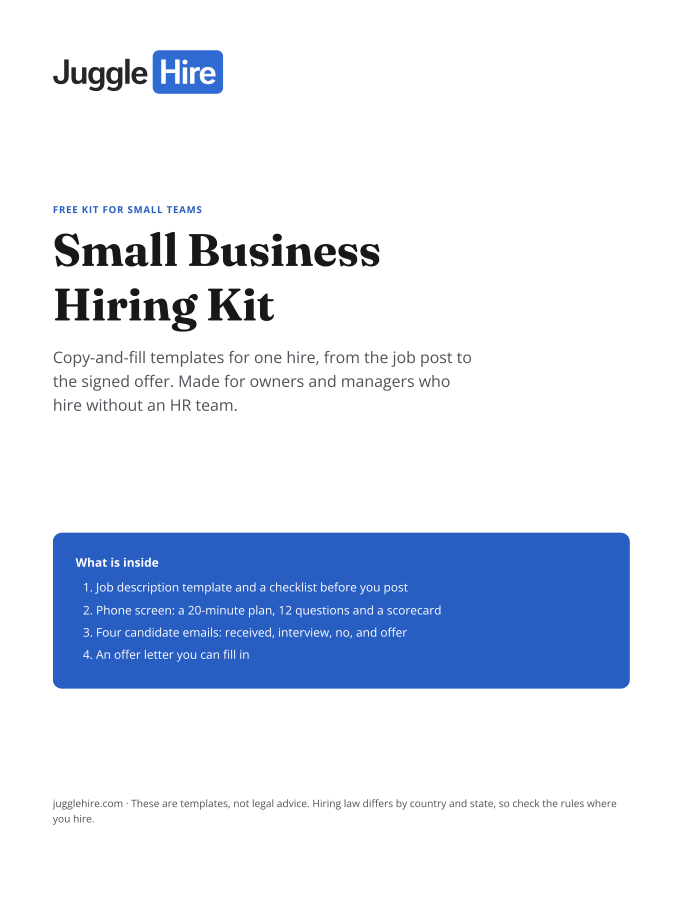
Get the Small Business Hiring Kit
- Job description template and a checklist before you post
- 20-minute phone screen: 12 questions and a scorecard
- Four candidate emails: received, interview, no, and offer
- An offer letter you can fill in
Free. We email you the kit and three short hiring tips. Unsubscribe any time.

Zakir Hossen
Zakir, founder of JuggleHire - a Google Forms alternative for hiring. Bootstrapped entrepreneur and software engineer with 10+ years coding experience from BD.
Related Posts
Candidate Experience Tools to Improve Your Hiring Journey
The best candidate experience tools for 2026. Improve every touchpoint of the applicant journey, from careers page to offer.
candidate experience toolscandidate experience softwareapplicant experience+5 more
Read more
8 Proven Hiring Strategies for Small Businesses in 2026
Discover 8 proven hiring strategies for small businesses to compete with larger companies.
hiring strategiessmall business hiringrecruitment tips+5 more
Read more