When you hire someone at a $60,000 salary, how much does that employee actually cost your business? If you answered "$60,000," you're significantly underestimating.
The true cost of an employee is typically 1.25x to 1.4x their base salary. That $60,000 employee actually costs $75,000-$84,000 per year when you factor in benefits, taxes, equipment, training, and overhead.
For small businesses, this miscalculation can be the difference between profitable growth and financial strain. This guide breaks down every component of employee costs, provides industry benchmarks, and helps you calculate the true cost for your specific situation.
Use our free Employee Cost Calculator to get an instant estimate for your next hire.
#Why Base Salary Is Just the Beginning
Most business owners focus on salary during hiring decisions. But salary typically represents only 70-80% of what an employee actually costs.
The hidden costs include:
- Employer payroll taxes (7.65% minimum)
- Health insurance ($7,000-$20,000/year)
- Retirement contributions (3-6% match)
- Paid time off (worth 5-8% of salary)
- Equipment and workspace ($2,000-$10,000)
- Training and onboarding ($1,000-$5,000)
- HR and administrative overhead
Ignoring these costs leads to:
- Hiring more people than you can afford
- Insufficient cash flow planning
- Inaccurate pricing for your products/services
- Poor financial projections
#Components of Total Employee Cost
#1. Base Salary (70-80% of total cost)
This is the straightforward part—the annual salary you agree to pay.
#2. Employer Payroll Taxes (7.65-15% of salary)
Mandatory employer contributions:
- Social Security: 6.2% of wages (up to $168,600 in 2026)
- Medicare: 1.45% of all wages
- Federal Unemployment (FUTA): 0.6% on first $7,000
- State Unemployment (SUTA): 0.5-5.4% depending on state
Total payroll taxes: Approximately 8-10% of salary for most employees
Example: $60,000 salary × 8% = $4,800 in employer payroll taxes
#3. Health Insurance (10-20% of salary)
Health insurance is typically the largest non-salary cost:
| Coverage Type | Monthly Cost | Annual Cost |
|---|---|---|
| Employee Only | $600-$800 | $7,200-$9,600 |
| Employee + Spouse | $1,200-$1,600 | $14,400-$19,200 |
| Family | $1,800-$2,400 | $21,600-$28,800 |
Average employer contribution: 80% of premium
- Employee-only: $5,760-$7,680/year
- Family: $17,280-$23,040/year
#4. Retirement Benefits (3-6% of salary)
401(k) matching:
- Common match: 50-100% of employee contribution up to 6% of salary
- Average employer cost: 3-4% of salary
Example: $60,000 salary × 4% match = $2,400/year
#5. Paid Time Off (5-10% of salary)
Typical PTO breakdown:
- Vacation: 10-20 days
- Sick days: 5-10 days
- Holidays: 10-12 days
- Total: 25-42 days of paid non-work time
Calculating PTO cost: Daily rate = Annual salary ÷ 260 work days PTO cost = Daily rate × PTO days
Example: $60,000 ÷ 260 = $231/day × 25 days = $5,775/year
#6. Equipment and Workspace (2-5% of salary)
One-time costs (amortized over 3 years):
- Computer/laptop: $1,000-$3,000
- Monitor, keyboard, peripherals: $300-$800
- Desk and chair: $500-$1,500
- Software licenses: $500-$2,000/year
Ongoing workspace costs:
- Office space: $200-$500/month per employee
- Utilities, internet: $50-$100/month
Annual equipment/workspace cost: $3,000-$8,000
#7. Training and Development (1-3% of salary)
Initial onboarding costs:
- Orientation time (HR, manager): $500-$1,500
- Training materials/courses: $200-$1,000
- Reduced productivity (first 90 days): $2,000-$5,000
Ongoing development:
- Annual training budget: $500-$2,000
- Conference attendance: $500-$2,000
- Professional memberships: $100-$500
#8. Administrative Overhead (3-5% of salary)
HR and management costs:
- Payroll processing
- Benefits administration
- Performance management
- Employee relations
- Compliance and legal
These costs are typically spread across all employees.
#True Cost of Employee Calculator
Here's a complete breakdown for a $60,000 salaried employee:
| Cost Component | Amount | % of Salary |
|---|---|---|
| Base Salary | $60,000 | 100% |
| Payroll Taxes | $4,800 | 8% |
| Health Insurance | $7,200 | 12% |
| 401(k) Match | $2,400 | 4% |
| PTO (value) | $5,775 | 9.6% |
| Equipment/Workspace | $4,000 | 6.7% |
| Training | $1,500 | 2.5% |
| Administrative | $1,800 | 3% |
| TOTAL COST | $87,475 | 145.8% |
Multiplier: 1.46x base salary
#Cost Multipliers by Role Type
Different roles have different cost structures:
| Role Type | Typical Multiplier | Why |
|---|---|---|
| Entry-level | 1.25-1.30x | Minimal benefits, less training |
| Mid-level | 1.30-1.40x | Full benefits, moderate training |
| Senior/Management | 1.40-1.50x | Full benefits, stock options, higher overhead |
| Executive | 1.50-1.80x | Full benefits, bonuses, stock, perks |
| Contract/1099 | 1.0x | No benefits (but higher hourly rate) |
| Part-time (<30 hrs) | 1.10-1.15x | Payroll taxes only, limited benefits |
#Industry Variations
Total employee costs vary by industry:
| Industry | Average Multiplier | Key Factors |
|---|---|---|
| Tech/Software | 1.40-1.55x | High salaries, good benefits, equipment |
| Healthcare | 1.35-1.50x | High insurance, compliance costs |
| Retail | 1.20-1.30x | Lower benefits, higher turnover costs |
| Manufacturing | 1.30-1.40x | Safety costs, training, equipment |
| Professional Services | 1.35-1.45x | High salaries, good benefits |
| Nonprofit | 1.25-1.35x | Limited benefits budgets |
#Location-Based Differences
Location significantly impacts costs. Use our Salary Benchmark Calculator to compare your compensation to industry standards in your region:
High-cost areas (NYC, SF, Seattle):
- 1.45-1.60x multiplier
- Higher salaries required
- Expensive real estate for workspace
- State taxes (California, New York)
Medium-cost areas:
- 1.35-1.45x multiplier
- Competitive salaries
- Moderate overhead
Low-cost areas:
- 1.25-1.35x multiplier
- Lower salaries acceptable
- Cheaper workspace
- Some states have no income tax
#Remote Employee Costs
Remote employees have a different cost structure:
Costs that decrease:
- Office space: Eliminated or reduced
- Utilities: Shifted to employee
- Commuter benefits: Eliminated
Costs that stay the same:
- Salary (though may vary by location)
- Payroll taxes
- Benefits (health, retirement)
Costs that may increase:
- Home office stipend: $500-$2,000
- Internet reimbursement: $50-$100/month
- Collaboration tools: $100-$300/year per user
- Occasional travel for meetings
Net result: Remote employees typically cost 5-10% less than office-based employees.
#How to Use This Information
#1. Budget Planning
When planning to hire, multiply salaries by appropriate factor:
- Entry-level: Salary × 1.28
- Mid-level: Salary × 1.35
- Senior: Salary × 1.45
#2. Pricing Decisions
If you're a service business, your employee costs directly impact pricing. A consultant paid $80,000 costs you ~$108,000/year. With 1,800 billable hours, you need to charge at least $60/hour just to break even on labor.
#3. Comparing Employees vs Contractors
Contractors cost more per hour but don't have benefits overhead:
| Factor | $60k Employee | Equivalent Contractor |
|---|---|---|
| Annual Cost | $78,000-$84,000 | Same budget |
| Hourly equivalent | $40-$43/hour | $40-$43/hour |
| Typical contractor rate | - | $50-$75/hour |
Contractors make sense when you need:
- Short-term help
- Specialized skills
- Flexibility
Employees make sense when you need:
- Long-term commitment
- Training investment
- Cultural fit
- Consistent availability
#Use Our Free Employee Cost Calculator
Calculating employee costs manually is complex. Our Employee Cost Calculator does the math for you:
- Enter base salary and location
- Customize benefits (health, retirement, PTO)
- Add equipment and overhead costs
- Get instant total cost and multiplier
The calculator shows:
- Total annual cost
- Cost multiplier
- Monthly breakdown
- Comparison to benchmarks
Try the Employee Cost Calculator →
#Frequently Asked Questions
#What is the true cost of a $50,000 employee?
Using a 1.35x multiplier, a $50,000 employee costs approximately $67,500 per year ($50,000 salary + $8,000 payroll taxes/benefits + $4,500 PTO value + $5,000 overhead/equipment).
#How much do benefits add to employee costs?
Benefits typically add 20-35% to base salary costs. Health insurance alone can add 10-20%. Retirement matching adds 3-6%. PTO value adds 5-10%.
#Are contractors cheaper than employees?
It depends. Contractors don't require benefits, but charge higher rates to compensate. For ongoing work, employees are usually more cost-effective. For short-term or specialized projects, contractors may be cheaper.
#Should I include training in employee costs?
Yes. Training costs are real business expenses. Initial onboarding costs $1,000-$5,000 per employee. Ongoing training adds $500-$2,000 per year.
#How do I reduce employee costs without cutting salaries?
- Offer remote/hybrid work (reduces office costs)
- Use high-deductible health plans with HSA contributions
- Optimize PTO policies
- Invest in efficient tools to reduce overhead time
- Hire the right people first (reduce turnover costs)
#What's the average cost per employee for a small business?
Small businesses typically spend $4,000-$8,000 per year on top of salary for benefits, taxes, and overhead. This translates to a 1.25-1.40x multiplier on base salary.
#Conclusion
Understanding the true cost of employees is essential for smart business decisions. Remember:
- Base salary is only 70-80% of total employee cost
- Average multiplier is 1.25-1.4x base salary
- Benefits are the biggest hidden cost (especially health insurance)
- Location and role significantly impact total costs
Before your next hire, use our Employee Cost Calculator to get an accurate picture of what that employee will really cost your business.
Related Articles:
Free download
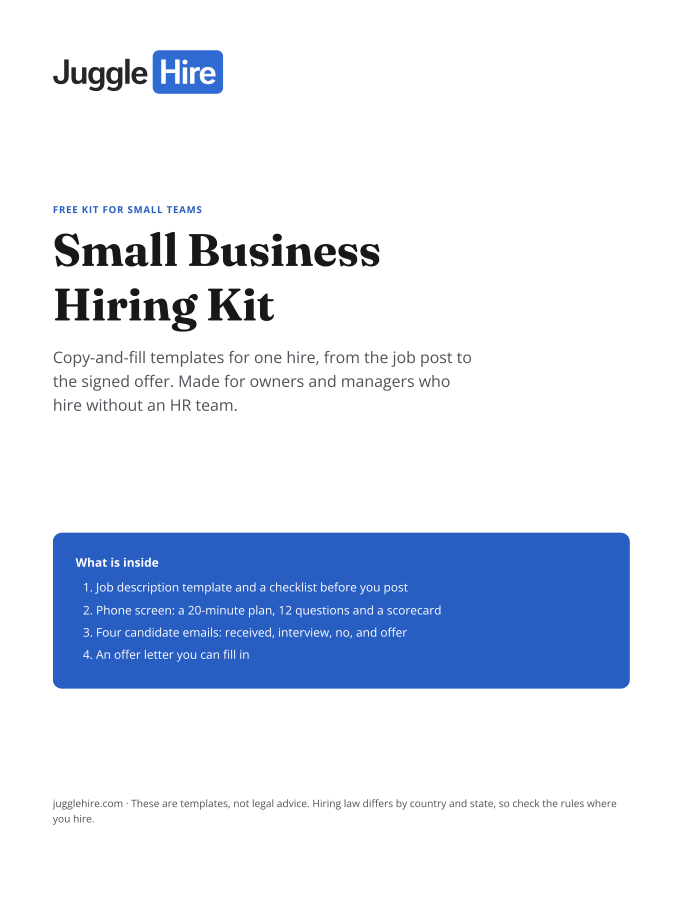
Get the Small Business Hiring Kit
- Job description template and a checklist before you post
- 20-minute phone screen: 12 questions and a scorecard
- Four candidate emails: received, interview, no, and offer
- An offer letter you can fill in
Free. We email you the kit and three short hiring tips. Unsubscribe any time.

Zakir Hossen
Zakir, founder of JuggleHire - a Google Forms alternative for hiring. Bootstrapped entrepreneur and software engineer with 10+ years coding experience from BD.
Related Posts
How to Reduce Cost Per Hire: 7 Proven Strategies
Cut cost per hire by 40% with 7 proven strategies. Includes a free cost calculator and an ATS comparison built for small businesses.
reduce cost per hirerecruitment costhiring budget+2 more
Read more
20 Recruitment Challenges and Proven Solutions
76% of recruiters say hiring the right candidate is their biggest challenge.
recruitment challengeshiring challengestalent acquisition+4 more
Read more