Recruitment Budget and Cost Per Hire Calculator
Work out your total recruitment budget and cost per hire, compare it with a rough reference figure for your industry, and get tips to spend less. See a sample budget.
What Is a Hiring Budget Calculator?
A hiring budget calculator helps you estimate the total cost of filling an open role — from posting a job ad to onboarding your new hire. Teams often underestimate what recruitment costs, usually because they leave out their own team’s time. This tool gives you an itemized estimate, so you can plan your recruitment budget, make the case to leadership, and compare one year with the next. The formula, a sample budget for 3 hires, and a step-by-step guide are below.
The Cost Per Hire Formula
The calculator uses the formula from the Cost-per-Hire American National Standard (ANSI/SHRM 06001.2012), which ANSI approved in 2012:
Cost per hire = (total external costs + total internal costs) ÷ total hires in the period
- →External costs are money paid outside the company: job ads, agency fees, background checks, referral bonuses, candidate travel, and recruiting software such as an ATS.
- →Internal costs are your own people’s time and costs: the recruiter or HR person, and the hiring manager’s interview hours.
- →Not included: costs after the hire, such as the new person’s salary and training. Budget those separately.
For a sense of scale, SHRM reported in April 2022 that the average cost per hire in its benchmarking data was nearly $4,700. That is an average across many employers and role types. Your own number can be much lower or much higher.
Sample Recruitment Budget: 3 Hires in One Year
A small services business plans 3 hires this year, using job boards and its own team, with no agency. The hourly rates are the fully loaded cost of each person’s time. Replace every number with your own.
| Cost line | Type | How it is worked out | Cost |
|---|---|---|---|
| Job board ads | External | $400 per role × 3 roles | $1,200 |
| Applicant tracking system | External | $15 a month × 12 months | $180 |
| Background checks | External | $60 per hire × 3 | $180 |
| Recruiter or HR time | Internal | 20 hours × $40 an hour × 3 hires | $2,400 |
| Hiring manager time | Internal | 15 hours × $60 an hour × 3 hires | $2,700 |
| External costs | $1,560 | ||
| Internal costs | $5,100 | ||
| Total recruitment budget | $6,660 | ||
| Cost per hire ($6,660 ÷ 3) | $2,220 | ||
- →Time is the biggest cost. Internal time is $5,100 of the $6,660 total. Fewer interview hours per hire is often the easiest saving for a small team.
- →An agency fee moves the number most. If one of the three roles goes through an agency that charges 20% of a $70,000 salary, add $14,000. The total becomes $20,660 and cost per hire rises from $2,220 to $6,887.
- →Check it in the calculator. Enter 3 hires, $400 for job boards, $180 for the ATS, $60 for background checks, 20 recruiter hours at $40, and 15 manager hours at $60. You get the same $2,220 per hire.
How to Create a Recruiting Budget in 6 Steps
- 1List the hires you plan this year. Write down each role, the month you want the person to start, and the salary range. A budget for "some hires" cannot be checked later.
- 2Pick a channel for each role. Job boards, referrals, your own network, or an agency. The channel decides most of the cost, so choose it per role, not once for the year.
- 3Price the external costs. Ads, software, background checks, assessments, candidate travel, referral bonuses, and agency fees. These are invoices you will pay.
- 4Price the internal time. Hours spent on screening and interviews, times the hourly cost of the people doing it. It is often the biggest line for a small team.
- 5Add a buffer for roles that take longer. Some roles need a second round of ads or a second search. A small buffer, for example 10%, saves you from asking for more money mid-year.
- 6Track what you actually spend per hire. After each hire, write down the real costs. Next year, plan from your own numbers instead of an average.
What to Include in a Hiring Budget
A complete recruitment budget goes beyond just job board fees. Here are the main cost categories to account for:
- →Job advertising. LinkedIn, Indeed, Glassdoor, and niche boards. Costs range from free to $500+ per post per month depending on visibility options.
- →Recruiter or agency fees. External recruiters typically charge 15–25% of the hire's first-year salary. Budget this only if you plan to use one.
- →Background checks and assessments. Criminal checks, skills assessments, and reference verification tools typically add $50–$200 per candidate who reaches the final stage.
- →Interviewer time. Often overlooked. A four-stage interview process involving three team members costs real hours. Multiply headcount by average hourly rate to quantify this.
- →Onboarding and training. Software licenses, training materials, and manager time during ramp-up all belong in the hiring cost picture.
How to Use This Tool
- 1Pick your industry and number of hires. The industry only sets the rough reference figure you compare against. The number of hires multiplies every per-hire cost.
- 2Fill in your planned costs. Add job board spend per hire, your yearly ATS cost, total agency fees, background checks, and the hours your recruiter and hiring manager spend per hire. The tool totals them and shows your cost per hire.
- 3Read the breakdown. See which cost lines are largest and where to save. The reference figure is a rough guide, not survey data, so your own cost per hire from last year is the better comparison.
Tips for Smarter Recruitment Budget Planning
- →Build a referral program first. Employee referrals are consistently the highest-quality and lowest-cost source of hires. Even a $500 referral bonus is far cheaper than an agency fee.
- →Use an ATS to cut wasted interviewer time. An applicant tracking system reduces duplicated effort, speeds up screening, and prevents good candidates from going cold.
- →Separate budget by seniority tier. Your junior hire budget should look very different from your VP-level budget. Mixing them in a single line item leads to under- or over-spending at both ends.
- →Include vacancy cost in your ROI calculation. A role that goes unfilled for 60 days has a real cost — typically measured as a daily rate of the expected salary. This makes the case for investing in faster hiring.
- →Track actuals vs. budget after each hire. The best way to improve future budget accuracy is to record what you actually spent on each role and compare it to your estimate.
Spend less time per hire. JuggleHire ranks applicants with AI, books interviews, and sends offers for e-signature, for one flat price per team from $15/month. Start a 14-day trial →
Frequently Asked Questions
Is this hiring budget calculator free?
Yes, the JuggleHire hiring budget calculator is completely free to use. No signup or credit card required.
What should a hiring budget include?
A hiring budget should include job board advertising costs, recruiter or agency fees, background check fees, assessment tool costs, interviewer time (as a labor cost), and any relocation or signing bonus costs. Many teams also plan onboarding and training here, but keep them on separate lines: under the SHRM cost-per-hire standard, costs after the hire are not part of cost per hire.
How do you calculate cost per hire?
Use the formula from the ANSI/SHRM cost-per-hire standard: (total external costs + total internal costs) ÷ total hires in the period. External costs are money paid outside the company, such as ads, agency fees, background checks, and recruiting software. Internal costs are your own people's time, such as the recruiter and the hiring manager. In the sample budget on this page, $6,660 for 3 hires is $2,220 per hire.
What is the average cost per hire in the US?
SHRM reported in April 2022 that the average cost per hire in its benchmarking data was nearly $4,700. It is an average across many employers and roles, so your number can be far lower or higher. The biggest swing is usually agency fees: in the sample budget on this page, one agency hire raises the cost per hire from $2,220 to $6,887.
How can I reduce my cost per hire?
The most effective ways to reduce cost per hire include building an employee referral program, investing in employer branding to generate inbound applicants, using an ATS to reduce time-to-hire, and reducing dependency on expensive recruiting agencies for mid-level roles.
How does hiring budget differ by seniority level?
Entry-level roles typically cost the least due to larger candidate pools and lower sourcing effort. Mid-level roles often require job board spend or agency fees. Senior and executive roles are the most expensive, often because they go through executive search firms, which usually charge a share of the first-year salary.
What is the difference in cost between agency and direct hire?
Agencies usually charge a percentage of the first-year salary. At 20% of a $70,000 salary, the fee alone is $14,000. In the sample budget on this page, 3 direct hires cost $2,220 each. Moving one of them to an agency raises the average to $6,887 per hire. Direct hiring costs more of your own time, but much less money.
How do I get a hiring budget approved by leadership?
Frame your budget request in terms of business impact. Show the cost of a vacancy (lost productivity, revenue impact), compare it to the cost of hiring, and present the ROI of filling the role quickly vs. slowly. A hiring budget calculator output is a useful artifact for these conversations.
What is the ROI of investing in a proper hiring budget?
Underfunding hiring leads to longer vacancies, weaker hires, and higher turnover, and all of these cost more than the savings. A well-funded hiring process fills roles sooner and lowers the chance of a bad hire, which means paying to recruit for the same role again.
Free download
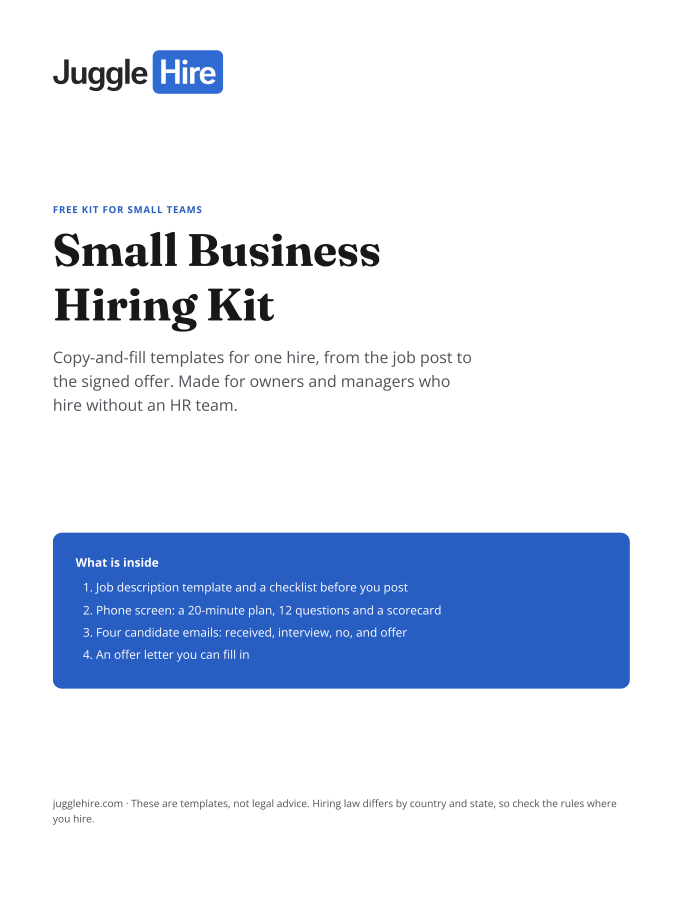
Get the Small Business Hiring Kit
- Job description template and a checklist before you post
- 20-minute phone screen: 12 questions and a scorecard
- Four candidate emails: received, interview, no, and offer
- An offer letter you can fill in
Free. We email you the kit and three short hiring tips. Unsubscribe any time.