Diversity Hiring Calculator
Track and calculate diversity hiring metrics across your hiring funnel. Measure representation rates, identify drop-off points, and benchmark against industry averages.
What Are DEI Hiring Metrics and Why Do They Matter?
Diversity hiring metrics are quantitative measures that track how well your recruitment process attracts, advances, and hires candidates from underrepresented groups. They move DEI from intention to accountability. Without data, you cannot tell whether your diversity initiatives are working or whether a single policy change—like removing degree requirements—actually moved the needle.
The critical insight that many teams miss is that diversity needs to be measured at every stage of the funnel, not just at the point of hire. A company can have a diverse applicant pool and still end up with a homogeneous workforce if bias enters during screening, interviewing, or offer negotiation. Funnel-level DEI data pinpoints exactly where representation breaks down—giving HR teams a specific, actionable problem to solve rather than a vague mandate to "do better."
How to Use This Tool
- 1Input candidates by demographic group at each stage. Enter the number of candidates from each group (gender, ethnicity, or any category you track) at each hiring stage: applied, screened, interviewed, and hired.
- 2Analyze representation rates and conversion gaps. The calculator surfaces representation percentages at each stage and flags where a demographic group's share drops significantly—indicating a potential bias point in your process.
- 3Use findings to inform process changes. Take the stage with the largest equity gap and investigate the specific criteria or practices used there. Run an A/B test on structured vs. unstructured evaluation to measure impact.
Tips for Improving Diversity Across Your Hiring Funnel
- →Audit job descriptions before posting. Words like "rockstar," "aggressive," and long lists of preferred-but-not-required qualifications deter underrepresented applicants. Aim for clear, skills-based language.
- →Diversify sourcing channels deliberately. If your entire pipeline comes from one job board or employee referrals, you'll replicate your existing demographic. Add 2–3 channels that reach different communities.
- →Standardize interview scoring with rubrics. Interviewers rating candidates on a 1–5 scale without defined criteria introduce significant subjectivity. A shared interview scorecard eliminates most of this variance.
- →Review compensation offers for equity. Pay gaps often begin at the offer stage when offers are based on salary history rather than role benchmarks. Use market data to set consistent offer ranges.
- →Report metrics quarterly, not annually. Annual DEI reports are too slow to catch regressions. A quarterly cadence lets you course-correct before a problematic pattern becomes systemic.
Track diversity metrics automatically. JuggleHire's ATS includes built-in diversity reporting across every hiring stage—so you always know where representation stands without manual spreadsheet work. Start free →
Frequently Asked Questions
Is this diversity hiring calculator free?
Yes, the JuggleHire Diversity Hiring Calculator is completely free. No sign-up required. Enter your hiring funnel data by demographic group and instantly see representation rates and where diversity drops.
What diversity metrics should I track?
The most important diversity hiring metrics are: representation rate at each funnel stage (applicants, screened, interviewed, hired), pipeline conversion rate by demographic group, offer acceptance rate by group, and adverse impact ratio. Tracking these together reveals whether your process is equitable at every step.
What is a good diversity ratio in hiring?
There is no universal benchmark—targets should reflect the available talent pool in your market and role type. A common starting goal is for your hired cohort to reflect your applicant pool. If 40% of applicants identify as women but only 15% of hires do, that gap signals a process problem worth investigating.
Where does pipeline diversity typically drop off?
Research consistently shows the steepest diversity drop occurs at the resume screening and first interview stages. Unstructured screening, résumé name bias, and inconsistent interview criteria disproportionately filter out underrepresented candidates before they can demonstrate their capabilities.
How can I improve diversity in sourcing?
Diversify your sourcing channels by posting on job boards and communities that serve underrepresented groups (e.g., HBCUs, Women Who Code, Latinx in Tech). Review job descriptions for exclusionary language using a tool like a job ad grader. Build relationships with diversity-focused professional associations before roles open.
How do I reduce bias in the screening process?
Use structured screening criteria applied consistently to every candidate. Consider blind resume review (removing names and identifying info) for initial screening. Standardize phone screen questions and use a scorecard with defined evaluation criteria. Bias tends to enter when evaluators rely on gut feel rather than pre-defined standards.
What is adverse impact analysis?
Adverse impact analysis compares selection rates between demographic groups to identify whether a hiring practice disproportionately excludes a protected class. The EEOC's "4/5ths rule" states that if a group's selection rate is less than 80% of the highest group's rate, adverse impact may exist. This is a legal and ethical risk signal worth monitoring.
How should I report diversity metrics to leadership?
Report diversity metrics at each funnel stage, not just as a final-hire snapshot. Show trend data quarter-over-quarter to demonstrate progress or regression. Pair representation rates with pipeline conversion rates by group to make clear where to focus. Frame findings around process improvements, not blame.
Free download
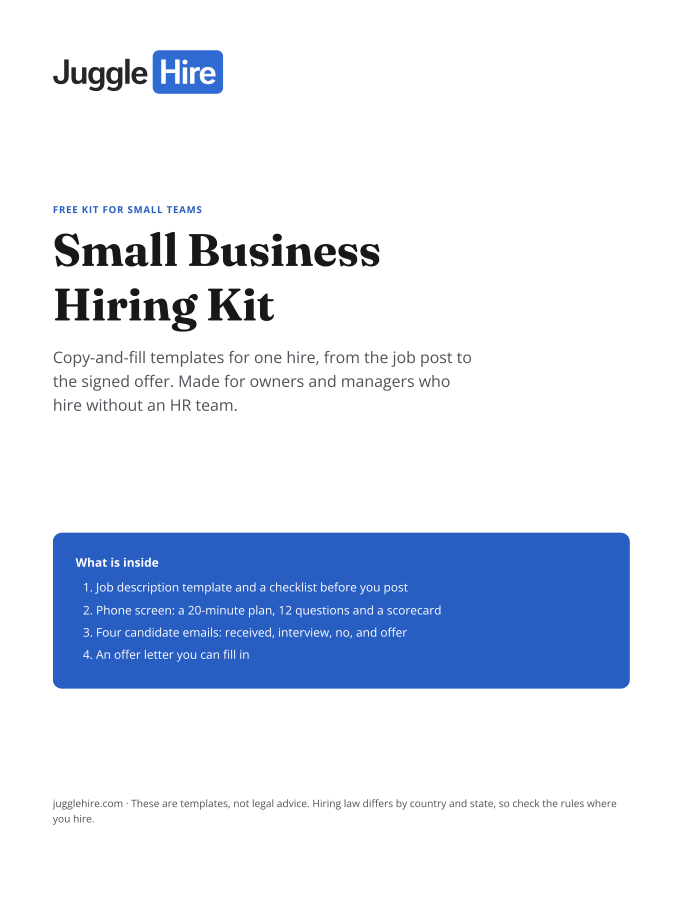
Get the Small Business Hiring Kit
- Job description template and a checklist before you post
- 20-minute phone screen: 12 questions and a scorecard
- Four candidate emails: received, interview, no, and offer
- An offer letter you can fill in
Free. We email you the kit and three short hiring tips. Unsubscribe any time.