Recruitment ROI Calculator
Calculate the return on investment of your recruitment efforts. Understand your cost per hire, channel effectiveness, and overall hiring ROI.
What Is Recruitment ROI?
Recruitment ROI measures the value a hire generates relative to what it cost to recruit, onboard, and ramp them. Most companies track cost per hire — but that only tells half the story. True recruitment ROI includes both the investment side (recruiting costs, onboarding time, ramp period) and the return side (revenue contribution, productivity value, or cost savings the role generates). This calculator helps you see the full picture so you can make better decisions about where to spend your recruiting budget.
How to Use This Calculator
- 1Enter your recruitment costs. Include recruiter time, job board fees, agency fees, interviewer hours, and onboarding costs. If you're unsure, use SHRM's average of $4,700 as a baseline.
- 2Enter the value the hire generates. For revenue-generating roles, use annual revenue contribution. For operational roles, use cost savings or productivity value (typically 1–3x annual salary).
- 3Review the output. The calculator shows your ROI percentage, cost per hire, and time to breakeven — the point at which the hire has generated enough value to cover your recruitment investment.
4 Ways to Improve Your Recruitment ROI
- →Launch an employee referral program. Referral hires cost 40–60% less than job board hires, convert at higher rates, and stay longer on average — all of which improve ROI at every stage.
- →Reduce time to hire. Every day a role stays open costs roughly 1/260th of the annual salary in lost productivity. A 36-day time to hire for a $80K role costs ~$11,000 in vacancy cost alone.
- →Track channel ROI, not just cost. A $500 LinkedIn job post that produces 3 qualified candidates beats a $100 Indeed post that produces 200 unqualified ones. Measure quality-adjusted cost per applicant.
- →Invest in onboarding. Brandon Hall Group research shows structured onboarding improves new hire retention by 82% and productivity by 70%. Reducing turnover in the first 90 days is the highest-leverage ROI lever.
Reduce your cost per hire. JuggleHire's ATS posts jobs to Google Jobs for free, organizes candidates in a visual pipeline, and cuts recruiter admin time — starting at $15/month. Start free →
Frequently Asked Questions
What is recruitment ROI?
Value generated by a hire minus total recruitment cost, divided by total cost. Measures whether your hiring investment is paying off.
What costs should I include?
Recruiter time, job board fees, agency fees, background checks, ATS cost per hire, interviewer time, and onboarding. SHRM pegs average US cost per hire at $4,700.
What is a good cost per hire benchmark?
SHRM average: $4,700. Entry-level: $1,500–$3,000. Senior/specialized: $10,000–$30,000+. Executives via agency: 20–30% of first-year salary.
How do I calculate cost per hire?
Total recruitment costs ÷ number of hires. Include both internal costs (time) and external costs (fees, tools).
How do I reduce costs without reducing quality?
Employee referral programs, ATS to reduce admin time, better job descriptions to reduce unqualified applications, and free channels before paid boards.
Which channels have the best ROI?
Employee referrals (lowest cost, highest retention), Google Jobs via ATS (free), your own career page. Paid boards are measurable but costlier.
How long until a new hire generates positive ROI?
Typically 3–6 months for most roles, 6–12 months for senior positions with longer ramp periods.
How does an ATS improve recruitment ROI?
Reduces recruiter admin time, speeds time to hire, improves candidate experience, and shows which channels produce the best hires at lowest cost.
Free download
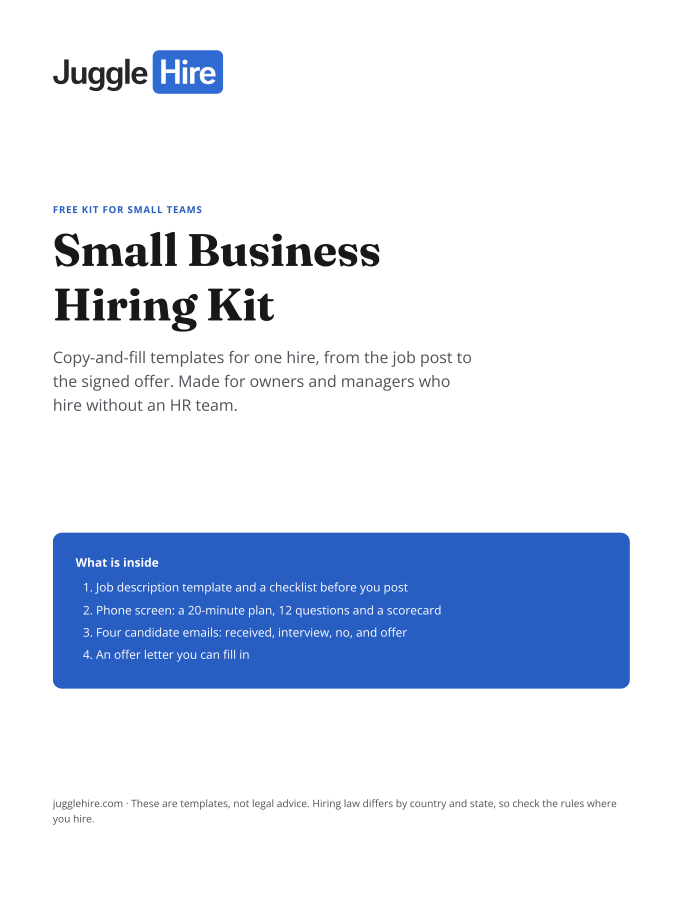
Get the Small Business Hiring Kit
- Job description template and a checklist before you post
- 20-minute phone screen: 12 questions and a scorecard
- Four candidate emails: received, interview, no, and offer
- An offer letter you can fill in
Free. We email you the kit and three short hiring tips. Unsubscribe any time.