Free Offer Letter Generator and Templates
Fill in the form to make a ready-to-send offer letter in your browser. No sign-up. Or scroll down for 7 templates, a fill-in-the-blank format, an offer email and conditional offer wording you can copy.
What Is an Offer Letter?
An offer letter is the formal document that bridges a verbal offer and the start of employment. It sets out the essential terms — job title, compensation, start date, and any conditions — in writing so both parties are aligned before day one. A well-crafted offer letter does more than just communicate terms: it reinforces the candidate's decision to accept, reflects your company's professionalism, and reduces the risk of misunderstandings or last-minute renegotiation. A poorly written or delayed offer letter, on the other hand, gives candidates cold feet and time to consider competing offers. Use the free offer letter creator above to build one online in a couple of minutes, or follow the step-by-step below and write it yourself.
Offer Letter Format: What Every Offer Letter Must Include
At minimum, every offer letter should cover these elements:
- →Job title and reporting structure. State the exact role title and who the employee will report to.
- →Start date and work location. Include whether the role is on-site, remote, or hybrid and the expected first day.
- →Compensation. Annual salary or hourly rate, pay frequency, and any variable pay (bonus targets, commission structure).
- →Benefits summary. Health, dental, vision, retirement plan, PTO policy, and any other significant perks.
- →Contingencies. Any conditions the offer depends on — background check clearance, right to work verification, or reference checks.
- →Offer expiration date. Give a clear deadline (typically 3–5 business days) to create urgency and manage your pipeline.
Below is the same format as a letter you can fill in. The labels in capitals show what each part does. Delete them before you send it. Below that is a shorter version for when you only need the basics.
Fill-in-the-blank offer letter format
Best for: Seeing the standard order of an offer letter. Replace the brackets and delete the labels in capitals before you send it.
[COMPANY LETTERHEAD: logo, company name, address]

[Date]

[Candidate full name]
[Candidate address or email]

Dear [Candidate first name],

[1. THE OFFER]
We are pleased to offer you the position of [job title] at [company name].

[2. ROLE AND START DATE]
You will report to [manager name, title]. Your first day will be [start date].
You will work [on-site at (address) / remotely from (city, country) /
hybrid, (number) days a week in the office].

[3. EMPLOYMENT TYPE]
This is a [full-time / part-time] position of about [number] hours a week.
It is [exempt / non-exempt] from overtime.

[4. PAY]
Your [annual salary / hourly rate] will be $[amount], paid [weekly / every two
weeks / twice a month / monthly]. [Add any bonus, commission or equity, and the
rules for earning it.]

[5. BENEFITS]
You will be eligible for [health insurance, (number) days of paid time off, a
retirement plan with (number)% match] starting [on your first day / after
(number) days].

[6. CONDITIONS]
This offer depends on [a background check / proof of your right to work in
(country) / reference checks].

[7. EMPLOYMENT TERMS]
[In most US states: Your employment is at-will. This means you or (company name) may
end it at any time, with or without cause or notice.]
[Outside the US: State the notice period and any probation period.]

[8. DEADLINE TO ACCEPT]
Please sign and return this letter by [date]. After that date, this offer expires.

[9. CONTACT]
If you have any questions, please contact [name] at [email or phone].

We look forward to working with you.

Sincerely,

_______________________
[Your name]
[Title]
[Company name]

ACCEPTED:

_______________________
[Candidate name]
Date: _______________
Simple offer letter (short version)
Best for: Small teams that want a basic offer letter on one page. It still covers the role, start date, pay, conditions and a deadline.
[Date]

Dear [Candidate name],

We are happy to offer you the job of [job title] at [company name]. Your first day
will be [start date] and you will report to [manager name]. Your pay will be
$[amount] per [year / hour], paid [every two weeks / monthly]. You will be eligible
for [main benefits]. This offer depends on [a background check / proof of your
right to work]. [In most US states: Your employment is at-will.]

To accept, please sign below and return this letter by [date]. If you have any
questions, call or email me at [phone / email].

We look forward to working with you.

Sincerely,

[Your name], [Title]
[Company name]

Accepted: _______________________   Date: _______________
[Candidate name]
How to Write an Offer Letter, Step by Step
If you would rather write the letter yourself than generate one, this is the order to write it in. Each step maps to a paragraph, so a complete offer letter is six short paragraphs and a signature block — not a legal document.
- 1Confirm the terms verbally first. Never let the written offer be the first time a candidate hears the number. Agree salary, start date, and work location on a call, then put exactly what you agreed in writing. A written offer that differs from the verbal one is the fastest way to lose a candidate you have already won.
- 2Open by making the offer, warmly and in one sentence. "We're delighted to offer you the position of [title] at [company]." Do not bury the offer under a paragraph of throat-clearing about your hiring process — the candidate is scanning for two things, the role and the number.
- 3State the role, the manager, and the start date. Exact job title, who they report to, whether the role is on-site, hybrid, or remote, and the expected first day. If the start date is still flexible, say so explicitly rather than leaving it blank.
- 4Lay out the full compensation package. Base salary with pay frequency, target bonus or commission, equity including type and vesting schedule, and the benefits that actually cost you money — health cover, retirement match, PTO days. Write it as a short list, not a paragraph. Candidates compare offers line by line.
- 5Name the conditions plainly. Background check, right-to-work verification, references, and — in most US states — the at-will employment statement. This is the paragraph to have reviewed by an employment lawyer once, then reuse unchanged for every hire.
- 6Close with a deadline, a name, and a signature block. Give a real decision date (3–5 business days is standard), name one person they can call with questions, and end with signature and date lines for both sides. An offer letter with no deadline drifts; one with no named contact makes the candidate negotiate with a mailbox.
How to Use This Tool
- 1Fill in the candidate and role details. Enter the candidate's name, job title, start date, compensation, and any relevant contingencies.
- 2Customize the tone and benefits. Adjust the letter to reflect your company's voice and fill in the benefits, PTO policy, and any role-specific details.
- 3Copy or download the letter. Use the generated output as a starting point, review it with your team or legal counsel if needed, then send it to the candidate.
7 Free Offer Letter Templates
Ready-to-copy offer letter templates for the situations that come up most. Replace everything in brackets, put it on your letterhead, and have the contingencies paragraph reviewed by an employment lawyer once before you reuse it. Every template can be copied to your clipboard or downloaded as a .txt file you can paste straight into Word or Google Docs.
- Formal offer letter
- Startup offer letter
- Part-time offer letter
- Internship offer letter
- Contractor offer letter
- Remote employee offer letter
- Sales offer letter with commission
Formal offer letter
Best for: Corporate environments, mid-to-large companies, and senior roles.
[Company Letterhead]

[Date]

[Candidate Full Name]
[Candidate Address]

Dear [Candidate Name],

We are pleased to offer you the position of [Job Title] at [Company Name]. We were
impressed by your experience and skills throughout the interview process, and we
believe you will be a valuable addition to our team.

Below are the details of your offer:

Position:        [Job Title]
Department:      [Department Name]
Reporting To:    [Manager Name], [Manager Title]
Employment Type: [Full-time/Part-time], [Exempt/Non-exempt]
Start Date:      [Proposed Start Date]
Work Location:   [Office Address / Remote / Hybrid]

Compensation:
- Base Salary: $[Amount] per year, paid [bi-weekly/monthly]
- Signing Bonus: $[Amount], payable within [timeframe]
- Performance Bonus: Up to [X]% of base salary, based on [criteria]

Benefits:
- Health, dental, and vision insurance (eligible after [X] days)
- [X] days of paid time off per year
- [401(k)/retirement plan] with [X]% company match
- [Additional benefits]

This offer is contingent upon:
- Successful completion of a background check
- Verification of your eligibility to work in [country]
- [Any additional contingencies]

This letter is not intended to create a contract of employment for a definite period
of time. Your employment with [Company Name] is at-will, meaning either you or the
company may terminate the employment relationship at any time, with or without cause
or notice.

Please indicate your acceptance by signing below and returning this letter by
[Response Deadline]. If you have any questions, please contact [HR Contact Name] at
[email/phone].

We are excited to welcome you to the [Company Name] team!

Sincerely,

_______________________
[Hiring Manager Name]
[Title]
[Company Name]

ACCEPTED AND AGREED:

_______________________
[Candidate Name]
Date: _______________
Startup offer letter
Best for: Startups, small businesses, and informal company cultures.
Hi [First Name],

Great news — we'd like to officially offer you the [Job Title] role at [Company Name]!
The whole team is excited to bring you on board.

Here's what we're proposing:

Role:       [Job Title]
Team:       [Team/Department]
Manager:    [Manager Name]
Start Date: [Date]
Location:   [Remote / Office / Hybrid]

Compensation:
- Salary: $[Amount]/year
- Equity: [X] stock options, vesting over [X] years with a 1-year cliff
- Bonus: [Details, if applicable]

Perks & Benefits:
- [Health insurance details]
- [X] days PTO + [X] company holidays
- $[Amount] annual learning & development budget
- [Other perks: equipment stipend, wellness benefit, etc.]

A few logistics:
- This offer is contingent on a clean background check and proof of work authorization
- Employment is at-will for both sides
- We'll send over the full employment agreement separately for your review

We'd love to hear back by [Date]. If you need more time or want to chat through
anything, just let me know — happy to hop on a call.

We're pumped to have you join us, [First Name]!

Cheers,

[Your Name]
[Title]
[Company Name]
Part-time offer letter
Best for: Hourly and part-time staff, where the schedule and benefit eligibility differ.
[Company Letterhead]

[Date]

Dear [Candidate Name],

We are pleased to offer you the part-time position of [Job Title] at [Company Name].

Position details:
- Title: [Job Title]
- Reports to: [Manager Name, Title]
- Schedule: [X] hours per week, [days/shift pattern]
- Start date: [Date]
- Location: [Office address / Remote / Hybrid]

Compensation:
- Hourly rate: $[Amount] per hour
- Paid [weekly / biweekly / monthly] by [direct deposit / cheque]
- Overtime is paid at [rate] for hours worked beyond [X] per week, where required by law

Benefits:
- [List any benefits available to part-time staff, or state clearly that
  part-time employees are not eligible for [benefit names]]
- [PTO accrual, if any — state the accrual rate]

Please note that your schedule may vary with business needs, and any change will be
agreed with your manager in advance.

This offer is contingent on [background check / proof of work authorization / reference
checks]. Employment with [Company Name] is at-will, meaning either you or the company
may end the employment relationship at any time, with or without cause or notice.

Please sign and return this letter by [Date] to confirm your acceptance.

Sincerely,

_______________________
[Hiring Manager Name]
[Title]
[Company Name]

ACCEPTED AND AGREED:

_______________________
[Candidate Name]
Date: _______________
Internship offer letter
Best for: Paid or unpaid interns, with duration, mentor, and credit arrangements.
[Company Letterhead]

[Date]

Dear [Candidate Name],

Congratulations — we would like to offer you the [Paid / Unpaid] [Season] Internship
position of [Internship Title] at [Company Name].

Internship details:
- Title: [Internship Title]
- Team: [Department]
- Mentor / supervisor: [Name, Title]
- Duration: [Start Date] to [End Date]
- Schedule: [X] hours per week
- Location: [Office address / Remote / Hybrid]

Compensation:
- [Stipend of $[Amount] per [month / week] OR hourly rate of $[Amount] per hour]
- [Academic credit arrangement, if applicable]
- [Equipment, travel, or housing stipend, if applicable]

What you will work on:
- [Project or area 1]
- [Project or area 2]
- [Project or area 3]

You will receive [mid-point and end-of-internship] feedback reviews. This internship
does not guarantee an offer of full-time employment, though many of our interns do go
on to join the team.

This offer is contingent on [proof of enrollment / work authorization / background
check]. Either party may end the internship at any time.

Please confirm your acceptance by [Date].

Warm regards,

_______________________
[Hiring Manager Name]
[Title]
[Company Name]

ACCEPTED AND AGREED:

_______________________
[Candidate Name]
Date: _______________
Contractor offer letter
Best for: Independent contractors and freelancers — keeps the classification clear.
[Company Letterhead]

[Date]

Dear [Contractor Name],

[Company Name] is pleased to engage you as an independent contractor for the role of
[Contract Role].

Engagement details:
- Scope of work: [Describe the deliverables and services]
- Term: [Start Date] through [End Date], or until the deliverables are accepted
- Point of contact: [Name, Title]
- Location: [Remote / On-site as needed]

Payment terms:
- Rate: $[Amount] per [hour / day / project milestone]
- Estimated total: $[Amount], not to exceed $[Cap] without written approval
- Invoicing: submit invoices [monthly / on milestone completion] to [email]
- Payment terms: net [15 / 30] days from invoice receipt

Important terms of this engagement:
- You are an independent contractor, not an employee. You are responsible for your own
  taxes, insurance, and any applicable business registrations.
- You will not receive employee benefits, PTO, or payroll tax withholding.
- You control how and when the work is performed, subject to the agreed deadlines.
- [IP assignment clause — confirm who owns the work product]
- [Confidentiality / NDA reference]

Either party may terminate this engagement with [X] days' written notice. Work completed
before termination will be invoiced and paid.

Please sign below to confirm, and return by [Date]. A [W-9 / contractor agreement] will
follow separately.

Sincerely,

_______________________
[Name]
[Title]
[Company Name]

ACCEPTED AND AGREED:

_______________________
[Contractor Name]
Date: _______________
Remote employee offer letter
Best for: Fully remote hires, covering work location, equipment, and time zones.
[Company Letterhead]

[Date]

Dear [Candidate Name],

We are delighted to offer you the position of [Job Title] at [Company Name], working
fully remotely from [Approved Country / State].

Position details:
- Title: [Job Title]
- Reports to: [Manager Name, Title]
- Start date: [Date]
- Employment type: Full-time, remote
- Core hours: [e.g. 10:00-15:00 [Time Zone]] — the rest of your day is flexible

Compensation:
- Annual salary: $[Amount], paid [biweekly / monthly]
- [Location-adjusted / location-independent] pay band: [Band name and range]
- [Bonus / equity details]

Remote work terms:
- Your registered work location is [City, State/Country]. Let us know before relocating,
  as it can affect payroll, tax, and benefits eligibility.
- Equipment: we provide [laptop, monitor, headset] and a $[Amount] home-office stipend.
- Internet / phone reimbursement: $[Amount] per month.
- Co-working allowance: $[Amount] per month, if you prefer not to work from home.
- Travel: we meet in person [X] times a year; travel and accommodation are covered.

Benefits:
- [Health, dental, vision — note how these differ by country if relevant]
- [X] days PTO plus [X] public holidays observed in your location
- [Retirement / pension arrangement]

This offer is contingent on proof of the right to work in [Country] and a clean
background check. Employment is at-will where local law allows.

Please confirm your acceptance by [Date].

Sincerely,

_______________________
[Hiring Manager Name]
[Title]
[Company Name]

ACCEPTED AND AGREED:

_______________________
[Candidate Name]
Date: _______________
Sales offer letter with commission
Best for: Quota-carrying roles, with OTE, accelerators, ramp, and clawback spelled out.
[Company Letterhead]

[Date]

Dear [Candidate Name],

We are pleased to offer you the position of [Sales Role] at [Company Name].

Position details:
- Title: [Sales Role]
- Reports to: [Sales Manager Name, Title]
- Territory / segment: [Region, vertical, or account list]
- Start date: [Date]

On-target earnings (OTE): $[Total]
- Base salary: $[Amount] per year, paid [biweekly / monthly]
- Variable commission: $[Amount] per year at 100% of quota

Commission plan:
- Annual quota: $[Amount] in [new ARR / closed-won revenue]
- Commission rate: [X]% of [revenue type] up to quota
- Accelerator: [X]% on every dollar above [100%] of quota
- Payout schedule: [monthly / quarterly], in the [following] pay cycle after the deal
  [closes / is invoiced / is collected]
- Ramp: quota is set at [X]% in month 1, [X]% in month 2, and full quota from month [X]
- Clawback: commission on a deal that cancels or refunds within [X] days is recovered
  from a future payout

Your full commission plan is attached and is reviewed [annually]. Commission is earned
only on deals recognised under that plan.

Benefits:
- [Health, dental, vision]
- [X] days PTO plus [X] company holidays
- [Expense policy, travel, car allowance if applicable]

This offer is contingent on [background check / references / work authorization].
Employment is at-will.

Please confirm your acceptance by [Date].

Sincerely,

_______________________
[Hiring Manager Name]
[Title]
[Company Name]

ACCEPTED AND AGREED:

_______________________
[Candidate Name]
Date: _______________
Offer Letter Email Template
Do not let the email be the first time the candidate hears the offer. Make the offer on a call, then send this email the same day with the letter attached. Keep the email short. The letter holds the details.
Subject line options:
- →Your offer letter for [job title] at [company name]
- →Job offer: [job title], [company name]
- →[First name], your offer from [company name]
Offer letter email template
Best for: The email you send with the offer letter attached, after you have made the offer on a call.
Subject: Your offer letter for [job title] at [company name]

Hi [First name],

Thank you again for your time on [day of the call]. As we discussed, we are happy
to offer you the [job title] role at [company name].

Your offer letter is attached. Here is a short summary:
- Start date: [date]
- Pay: $[amount] per [year / hour]
- [Bonus, equity or main benefit]
- Reports to: [manager name]

Please read the letter, sign it and send it back by [date]. If anything is unclear,
or you want to talk about any part of the offer, reply to this email or call me
at [phone].

We are excited about working with you.

Best regards,
[Your name]
[Title], [Company name]
Conditional Offer Letter Wording
A conditional offer letter (also called a contingent offer letter) is a normal offer letter with conditions. You offer the job, but the job only starts if the conditions are met. Use it when a check can only happen after you make the offer.
Conditional offer wording
Best for: Pasting into any template above when the offer depends on checks that happen after the candidate accepts.
This offer is conditional. It depends on:
- a background check with results that are satisfactory to [company name],
- proof that you have the right to work in [country], provided by [date / your
  first day],
- [satisfactory references from (number) former managers],
- [a medical exam or drug test, if we require it of everyone hired into this job].

We will start these checks after you accept this offer. If a condition is not met,
[company name] may withdraw this offer. If that happens, we will tell you in
writing.
In the US, the law sometimes decides what can happen before and after the offer:
- →Medical questions and exams. Under the Americans with Disabilities Act (ADA), which covers employers with 15 or more employees, an employer may not ask disability-related questions or require a medical exam until after it makes a conditional job offer. After the offer, it must do the same for everyone entering that job. (EEOC guidance)
- →Criminal history in California. The Fair Chance Act generally stops employers with five or more employees from asking about conviction history before making a job offer. (California Civil Rights Department)
- →Withdrawing because of a background check report. If you use a background check company in the US, the Fair Credit Reporting Act has steps you must follow first. Before you reject someone based on the report, you must give them a notice with a copy of the report and a summary of their rights. (FTC)
Keep each condition short and specific. Only list checks you will actually run. Other states, cities and countries have their own rules, so have this paragraph reviewed once by an employment lawyer before you reuse it. This section is general information, not legal advice.
Common Offer Letter Mistakes
These are the ones that actually cost companies hires:
- →Sending the letter too late. Waiting a week after the final interview kills momentum. The candidate assumes you are not interested — or accepts another offer while waiting.
- →Vague compensation. "Competitive salary" with no number wastes everyone's time. Be specific about base pay, bonus, and equity.
- →Missing contingencies. Leaving out background or reference checks limits your options if something surfaces later.
- →Overpromising. Promotion timelines, guaranteed raises, or specific project assignments in an offer letter set expectations you may not be able to meet. Stick to what you can commit to.
- →No at-will disclaimer. In at-will states, omitting this language can create complications if you later need to end the employment.
- →Typos. A misspelled name or a wrong salary figure erodes trust before the relationship starts. Proofread before sending.
Tips for Making Offer Letters More Effective
- →Send within 24 hours of the verbal offer. Delays between a verbal yes and a written offer create anxiety and open windows for competing offers to land.
- →Lead with excitement, not legalese. The first paragraph should make the candidate feel genuinely welcomed, not like they are signing a legal form.
- →Be specific about total compensation. List base salary, target bonus, equity (type, amount, vesting schedule), and key benefits. Candidates often compare total packages — make yours easy to evaluate.
- →Include a named point of contact. Giving the candidate a specific person to call or email with questions reduces friction and shows you are accessible.
- →Use consistent templates across all hires. Standardized offer letters reduce legal risk, save time, and ensure every candidate receives the same quality communication regardless of who is doing the hiring.
Want the candidate to sign online? In JuggleHire you send the offer as a link. The candidate signs it in the browser and you get a signed PDF. If they have not opened it after 48 hours, they get a reminder. One flat price per team, from $15 a month. Start a 14-day trial →
Frequently Asked Questions
Is this offer letter generator free?
Yes, the JuggleHire offer letter generator is completely free to use. No account or credit card required.
Is this an AI offer letter generator?
No. The generator does not use AI. It puts your details into a standard offer letter structure, so the result is predictable and every main part is there: role, start date, pay, benefits, conditions, deadline and signature lines. The letter is built in your browser and your inputs are not stored on our servers. If you want a different tone, edit the text after you copy it.
What is an offer letter?
An offer letter is a formal written document from an employer to a candidate that outlines the terms of employment — including job title, start date, compensation, benefits, and any conditions of employment. It is typically sent after a verbal offer is accepted and before the employee starts work.
What is the difference between an offer letter and an employment contract?
An offer letter is a summary of key employment terms and is generally less formal and legally binding than a full employment contract. An employment contract is a detailed legal agreement that may include non-compete clauses, IP assignment, dispute resolution, and specific termination terms. Many US employers use offer letters for at-will employment and reserve contracts for executives or specialized roles.
What must an offer letter include legally?
Legal requirements vary by jurisdiction, but best practice is to include: job title and description, start date, compensation (salary or hourly rate), pay frequency, benefits summary, employment type (full-time, part-time, at-will), any contingencies (background check, drug test, right to work verification), and an expiration date for the offer.
How do I make an offer letter compelling?
A compelling offer letter goes beyond listing terms. Open with a warm, genuine expression of excitement about the candidate joining the team. Briefly highlight what makes the role and company exciting. Present the full compensation package clearly — including equity, bonus potential, and benefits. Close with a clear next step and a named contact for questions.
Is an appointment letter the same as an offer letter?
Mostly, yes — the names differ by region. In the US the document is almost always called an offer letter. In India, Bangladesh, and much of South Asia the same document is commonly called an appointment letter or joining letter, and it is often treated as more binding than a US offer letter. In the UK you will more often see "written statement of employment particulars", which is a legal requirement rather than a courtesy. This generator produces the offer letter structure: role, start date, compensation, benefits, conditions, and a signature block. That structure works for all of them, but check your local labour law for anything that must be stated by law.
Can I create an offer letter online for free?
Yes. This offer letter maker runs entirely in your browser — fill in the candidate name, role, start date, compensation, and benefits, and it assembles the full letter for you. There is no account, no credit card, and no limit on how many letters you create. Your inputs are not stored on our servers.
Can I download the offer letter as a PDF?
Not from this free tool. It gives you two options: copy the finished letter to your clipboard, or download it as a plain .txt file. Most employers want the letter on company letterhead anyway, so the usual workflow is to paste it into Google Docs or Word, add your letterhead and signature block, then export to PDF from there. In the paid JuggleHire app, you send the offer as a link, the candidate signs it online, and you can download the letter as a PDF.
How long should a candidate have to decide on an offer?
Standard practice is 3–5 business days for most roles. For senior or executive positions, 5–7 business days is common. Giving less than 48 hours is considered high-pressure and can damage your employer brand. Set a reasonable deadline, but communicate that you are happy to answer questions during the decision period.
Can you rescind an offer letter?
Yes, in most at-will employment jurisdictions, an employer can rescind an offer letter before the candidate starts work. However, doing so without strong cause (e.g., failed background check, material misrepresentation) can expose the company to legal risk — especially if the candidate has already resigned from another job. Always consult an employment attorney before rescinding an offer.
What should I do if a candidate negotiates after receiving an offer letter?
Negotiation is normal and expected. Decide in advance what your walk-away point is. Be prepared to explain your salary positioning (e.g., referencing market benchmarks). If you cannot move on base salary, consider other levers: signing bonus, earlier review date, additional PTO, or remote work flexibility. Always respond in a positive tone — a counter-offer means the candidate is genuinely interested.
Free download
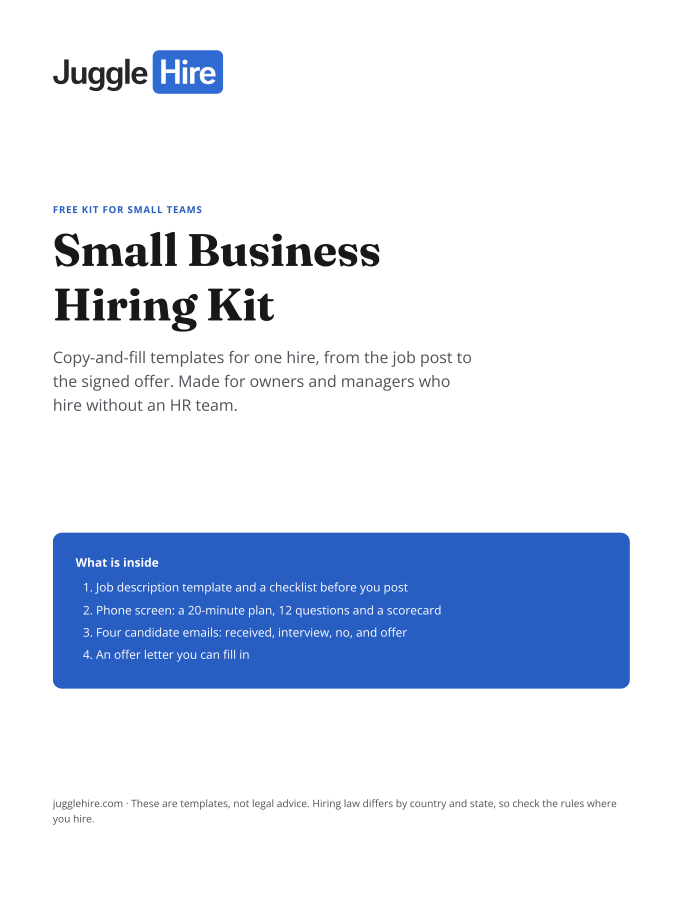
Get the Small Business Hiring Kit
- Job description template and a checklist before you post
- 20-minute phone screen: 12 questions and a scorecard
- Four candidate emails: received, interview, no, and offer
- An offer letter you can fill in
Free. We email you the kit and three short hiring tips. Unsubscribe any time.