Quick Answer: A complete employee onboarding checklist covers four phases: pre-boarding (offer accepted → day 1), day one setup (equipment, accounts, introductions), week one training, and 30/60/90-day check-ins. Brandon Hall Group research shows structured onboarding improves retention by 82% and productivity by 70%.
Last Updated: April 18, 2026
A strong onboarding process is the difference between a new hire who hits the ground running and one who quietly starts job searching within six months. Research consistently shows that companies with structured onboarding retain more employees, see faster time-to-productivity, and build stronger teams. This guide walks you through a complete onboarding checklist from pre-boarding through the first 90 days, with actionable items you can implement today.
Quick Tool: Want a ready-made checklist? Use our free Onboarding Checklist Generator to create a customized onboarding plan for any role in seconds.
#Why Onboarding Matters More Than You Think
Most companies treat onboarding as a one-day orientation: hand over a laptop, show the new hire their desk, and hope for the best. That approach costs you money, people, and momentum.
Here's what the data says:
- 20% of employee turnover happens within the first 45 days
- 69% of employees are more likely to stay 3+ years at a company with great onboarding
- New hires with structured onboarding reach full productivity 50% faster than those without
- Organizations with strong onboarding improve new hire retention by 82%
- Only 12% of employees say their company does a good job of onboarding
The cost of replacing an employee ranges from 50% to 200% of their annual salary. For a $70,000-per-year role, that is $35,000 to $140,000 lost every time someone leaves early. A solid onboarding process is not a nice-to-have; it is a direct investment in reducing that cost.
#The 4 Phases of Effective Onboarding
The biggest mistake companies make is treating onboarding as a single event. Effective onboarding is a process that unfolds over four distinct phases:
| Phase | Timeframe | Goal |
|---|---|---|
| Pre-boarding | Offer accepted to Day 1 | Eliminate first-day anxiety, handle logistics |
| Day 1 | First day | Create a welcoming experience, set the tone |
| First Week | Days 1-5 | Build foundational knowledge and relationships |
| First 90 Days | Days 1-90 | Achieve independence and measurable contribution |
Each phase has specific tasks that, when completed, build the foundation for the next. Skip a phase and you create gaps that compound over time.
#Phase 1: Pre-boarding Checklist
Pre-boarding starts the moment a candidate accepts your offer. The gap between acceptance and start date is when excitement fades and second-guessing begins. Fill that gap with purposeful communication and preparation.
#IT and Equipment Setup
- [ ] Order laptop/computer and peripherals (monitor, keyboard, headset)
- [ ] Set up company email account
- [ ] Create accounts for core tools (Slack, project management, CRM, etc.)
- [ ] Configure VPN access if applicable
- [ ] Prepare security credentials and two-factor authentication
- [ ] Test that all systems work before Day 1
#Paperwork and Compliance
- [ ] Send offer letter and employment contract for e-signature
- [ ] Distribute tax forms (W-4, I-9, or local equivalents)
- [ ] Share benefits enrollment information and deadlines
- [ ] Send employee handbook or policy documents
- [ ] Collect emergency contact information
- [ ] Process background check if not already completed
#Workspace Preparation
- [ ] Assign desk, office, or workspace
- [ ] Order business cards if applicable
- [ ] Set up phone extension or direct line
- [ ] Stock workspace with basic supplies
- [ ] Ensure building/office access (key card, security badge, parking pass)
#Welcome Package
- [ ] Send a welcome email from the hiring manager (personal, not templated)
- [ ] Share first-day logistics: where to go, who to ask for, what to bring, dress code
- [ ] Mail or prepare company swag (optional but effective)
- [ ] Share an organizational chart and team bios
- [ ] Provide a pre-reading list: company blog posts, product overview, or recent news
#Team Preparation
- [ ] Announce the new hire to the team via email or Slack
- [ ] Assign an onboarding buddy (not the manager)
- [ ] Block time on the manager's calendar for Day 1
- [ ] Pre-schedule key meetings for the first week
- [ ] Brief the team on the new hire's role and how they fit in
#Phase 2: Day 1 Checklist
Day 1 sets the emotional tone for the entire employment relationship. The goal is simple: make the new hire feel expected, welcomed, and clear on what happens next.
#Welcome and Orientation
- [ ] Greet the new hire at the door (do not make them wait in a lobby)
- [ ] Give a physical or virtual office tour
- [ ] Introduce them to their onboarding buddy
- [ ] Walk through the daily schedule and team norms
- [ ] Provide a printed or digital copy of their first-week schedule
#Tools and Access
- [ ] Verify all tech equipment works (laptop, email, tools)
- [ ] Walk through core software and how the team uses it
- [ ] Show them how to get IT support if something breaks
- [ ] Set up password manager and security protocols
- [ ] Provide access to internal documentation and knowledge base
#People and Introductions
- [ ] 1:1 meeting with direct manager (30 minutes minimum)
- [ ] Introduction to immediate team members
- [ ] Introduction to key cross-functional contacts
- [ ] Lunch with the team or onboarding buddy
- [ ] Brief meet-and-greet with senior leadership if possible
#Paperwork Wrap-up
- [ ] Complete any remaining compliance documents
- [ ] Review and sign off on company policies
- [ ] Enroll in benefits if not already done
- [ ] Set up direct deposit
#End-of-Day Check-in
- [ ] Manager checks in: How did the day go? Any questions?
- [ ] Confirm the schedule for tomorrow and the rest of the week
- [ ] Share any reading or preparation for Day 2
#Phase 3: First Week Checklist
The first week transitions from "welcome" to "learning." By Friday, the new hire should understand their role, know who to go to for help, and have clear short-term goals.
#Role-Specific Training
- [ ] Walk through job responsibilities in detail with the manager
- [ ] Shadow a team member on a typical workflow
- [ ] Review current projects and where the new hire will contribute
- [ ] Provide access to role-specific tools and training materials
- [ ] Assign a small, low-stakes first task to build confidence
#Meetings and Relationships
- [ ] Schedule 1:1 with direct manager (set recurring weekly cadence)
- [ ] Attend first team meeting
- [ ] Meet with cross-functional stakeholders relevant to their role
- [ ] Daily check-in with onboarding buddy (15 minutes)
- [ ] Coffee chats or informal introductions with 2-3 people outside their team
#Goals and Expectations
- [ ] Set clear 30-day goals collaboratively with the manager
- [ ] Define what "success" looks like for the first 90 days
- [ ] Discuss communication preferences (how to reach the manager, response time expectations)
- [ ] Review performance evaluation process and cadence
- [ ] Clarify decision-making authority and escalation paths
#Culture and Context
- [ ] Share company mission, values, and strategic priorities
- [ ] Explain team dynamics and working norms
- [ ] Review communication channels and when to use each (email vs. Slack vs. meetings)
- [ ] Discuss work-life balance expectations and flexible work policies
- [ ] Introduce any employee resource groups or social activities
#End-of-Week Check-in
- [ ] Manager conducts a 30-minute check-in: What is going well? What is confusing?
- [ ] Gather initial feedback on the onboarding experience
- [ ] Adjust the Week 2 plan based on progress and questions
#Phase 4: First 30 Days Checklist
By the end of the first month, the new hire should be contributing meaningfully and feeling integrated into the team.
#Performance and Progress
- [ ] Conduct a formal 30-day check-in with the manager
- [ ] Review progress against 30-day goals
- [ ] Set revised goals for days 31-60
- [ ] Identify any skill gaps and create a plan to address them
- [ ] Assign increasingly complex or independent work
#Feedback Loop
- [ ] Manager provides specific, constructive feedback on work completed so far
- [ ] New hire shares feedback on the onboarding process
- [ ] 360-degree informal feedback from the onboarding buddy and team
- [ ] Address any concerns or confusion before they become problems
- [ ] Document what is working and what needs improvement in your onboarding process
#Cultural Integration
- [ ] Ensure the new hire has attended at least one team social event
- [ ] Verify they have built relationships beyond their immediate team
- [ ] Check that they understand unwritten team norms
- [ ] Discuss company culture observations and answer questions
- [ ] Confirm they feel comfortable asking for help
#First 90 Days: Reaching Full Integration
The 90-day mark is where onboarding formally ends and ongoing development begins. Use this milestone to assess, celebrate, and plan forward.
#60-Day Milestone
- [ ] Conduct a 60-day performance check-in
- [ ] Evaluate progress on goals set at 30 days
- [ ] Discuss career interests and long-term development
- [ ] Transition from onboarding buddy to independent work
- [ ] Assign a meaningful project with real ownership
#90-Day Milestone
- [ ] Conduct a formal 90-day performance review
- [ ] Assess whether the employee meets role expectations
- [ ] Create a professional development plan for the next 6-12 months
- [ ] Set goals aligned with team and company objectives
- [ ] Discuss growth opportunities (skills, projects, promotions)
- [ ] Celebrate the milestone—acknowledge what they have accomplished
#Autonomy Milestones
By 90 days, a successfully onboarded employee should be able to:
- Complete core tasks independently without step-by-step guidance
- Navigate company tools and processes without frequent help
- Collaborate effectively with cross-functional teams
- Contribute ideas in meetings and planning sessions
- Manage their workload and prioritize based on team goals
If these milestones are not met, it signals a gap in the onboarding process rather than a problem with the employee. Review which phase was missed or rushed.
#Remote Onboarding Adaptations
Remote onboarding follows the same four phases but requires extra intentionality around connection and communication. Here is what to adjust:
#Pre-boarding
- Ship equipment and swag to the employee's home address with a tracking number
- Test video conferencing and VPN before Day 1 with a quick tech check call
- Send a digital welcome package with links, logins, and a first-week calendar invite
#Day 1
- Start with a video call, not a wall of text in Slack
- Use breakout rooms for small group introductions
- Send a virtual lunch delivery (gift card or meal service)
- Over-communicate the schedule—remote employees cannot "read the room"
#First Week
- Increase 1:1 frequency (daily for the first week)
- Use video for all meetings, not just audio
- Create a dedicated Slack channel for the new hire's questions
- Schedule virtual coffee chats with team members across time zones
#First 90 Days
- Be deliberate about including remote hires in informal conversations
- Use asynchronous video updates (Loom, etc.) for context-heavy topics
- Schedule quarterly in-person meetups if budget allows
- Check in on isolation and connection, not just task completion
For a deeper dive, see our guide on how to onboard a new employee remotely.
#Onboarding by Role Type
Not every role needs the same onboarding depth. Here is how to adjust your checklist based on role type:
| Component | Entry-Level | Mid-Level | Senior/Lead | Executive |
|---|---|---|---|---|
| Pre-boarding duration | 1-2 weeks | 1 week | 1-2 weeks | 2-4 weeks |
| Day 1 structure | Highly guided | Semi-guided | Self-directed with check-ins | Custom schedule |
| Training depth | Extensive (2-4 weeks) | Moderate (1-2 weeks) | Light (role-specific only) | Strategic context only |
| Buddy assignment | Required | Recommended | Optional | Executive mentor |
| First task timeline | Week 2 | End of Week 1 | Day 2-3 | Week 1 (strategic) |
| 30-day goal complexity | Learn processes | Own a workstream | Lead a project | Define strategy |
| Check-in frequency | Daily (Week 1), then weekly | Weekly | Bi-weekly | Weekly with CEO/founder |
| Time to full productivity | 3-6 months | 2-3 months | 1-2 months | 3-6 months |
Use our Onboarding Checklist Generator to create role-specific checklists that account for these differences automatically.
#Measuring Onboarding Success
You cannot improve what you do not measure. Track these metrics to evaluate and refine your onboarding program:
#Quantitative Metrics
- Time to productivity: How long until the new hire completes tasks at the expected level?
- 90-day retention rate: What percentage of new hires are still employed after 90 days?
- First-year retention rate: What percentage stay through their first year?
- Time to first contribution: How quickly does the new hire deliver measurable output?
- Training completion rate: Are new hires finishing all required onboarding modules?
#Qualitative Metrics
- New hire satisfaction survey: Administer at 30, 60, and 90 days. Ask about clarity, support, and belonging.
- Manager satisfaction: Does the manager feel the new hire is ramping at the expected pace?
- Buddy feedback: Was the new hire engaged and proactive during onboarding?
- eNPS (Employee Net Promoter Score): Would the new hire recommend working here based on their onboarding experience?
#Benchmark Targets
| Metric | Poor | Average | Strong |
|---|---|---|---|
| 90-day retention | Below 70% | 70-85% | Above 85% |
| New hire satisfaction (out of 10) | Below 6 | 6-7.5 | Above 7.5 |
| Time to productivity | 6+ months | 3-5 months | Under 3 months |
| Training completion | Below 60% | 60-80% | Above 90% |
#Common Onboarding Mistakes
These are the patterns that derail onboarding most often. Avoid them.
1. Information overload on Day 1. Dumping everything into a single orientation session guarantees the new hire retains almost nothing. Spread information across the first week and provide written references they can revisit.
2. No structured plan. "Just shadow Sarah for a week" is not onboarding. Without a documented checklist and clear milestones, the experience varies wildly depending on who happens to be available.
3. Manager absence. If the hiring manager is in back-to-back meetings all of Week 1, the new hire feels like an afterthought. Block protected time on the calendar before the start date.
4. Skipping pre-boarding. The gap between offer acceptance and Day 1 is when candidates ghost, accept other offers, or arrive anxious. Use that time intentionally.
5. No feedback mechanism. If you never ask new hires how onboarding went, you will repeat the same mistakes with every hire. Build feedback collection into the process at 30, 60, and 90 days.
6. Treating onboarding as HR's job alone. HR handles logistics. The manager, buddy, and team own the experience. If the manager is not actively involved, onboarding fails regardless of how polished the paperwork process is.
7. One-size-fits-all approach. An entry-level marketing coordinator and a senior engineering lead need fundamentally different onboarding paths. Customize by role, level, and department.
#Build Your Onboarding Checklist in Seconds
Creating a thorough onboarding plan for every role takes time. Our free Onboarding Checklist Generator builds a customized, phase-by-phase checklist based on the role title, department, seniority level, and work arrangement. You get a ready-to-use plan covering pre-boarding through the 90-day review.
No signup required. Generate your checklist and start onboarding better today.
#Related Resources
- Onboarding Checklist Generator - Free tool to create custom onboarding plans
- How to Onboard a New Employee Remotely
- Employee Retention Strategies
- Candidate Communication Email Templates
#Start Onboarding Right
A great hire is only as good as the onboarding that follows. You invested time and money finding the right person. Now invest in making sure they stay, grow, and contribute.
If you are managing hiring end-to-end as a solo recruiter or small team, JuggleHire helps you track candidates from application through onboarding in one simple platform. Pair it with the Onboarding Checklist Generator and you have a system that scales with every hire you make.
Free download
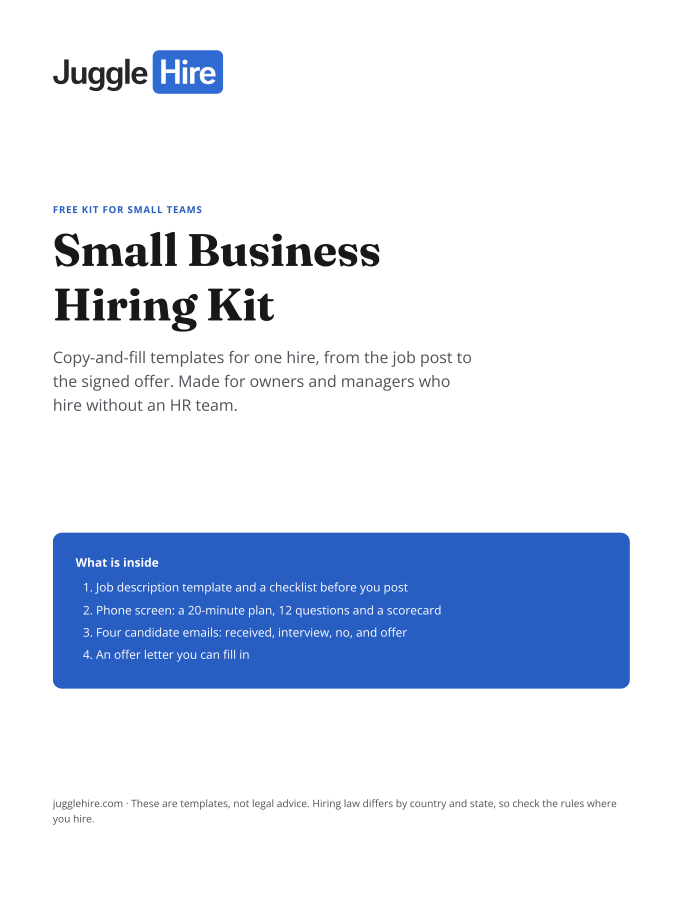
Get the Small Business Hiring Kit
- Job description template and a checklist before you post
- 20-minute phone screen: 12 questions and a scorecard
- Four candidate emails: received, interview, no, and offer
- An offer letter you can fill in
Free. We email you the kit and three short hiring tips. Unsubscribe any time.

Zakir Hossen
Zakir, founder of JuggleHire - a Google Forms alternative for hiring. Bootstrapped entrepreneur and software engineer with 10+ years coding experience from BD.
Related Posts
Candidate Experience Tools to Improve Your Hiring Journey
The best candidate experience tools for 2026. Improve every touchpoint of the applicant journey, from careers page to offer.
candidate experience toolscandidate experience softwareapplicant experience+5 more
Read more
8 Proven Hiring Strategies for Small Businesses in 2026
Discover 8 proven hiring strategies for small businesses to compete with larger companies.
hiring strategiessmall business hiringrecruitment tips+5 more
Read more