Employee Onboarding Checklist Template
A free checklist for every new hire, from before day 1 to day 90. Copy the template below, or fill in the form to generate one for a specific role.
Employee Onboarding Checklist: Before Day 1 to Day 90
A complete checklist for one new hire, in six phases and 41 tasks. Each task has one owner, so nothing is left for “someone” to do. In a small team, HR and IT may be the same person. Copy it into your own doc or download it as a .txt file, then delete what does not apply. Use the generator above if you want tasks for a specific department or a remote hire.
Before day 1
Goal: The new hire knows where to be, and everything works when they arrive.
- Send a welcome email: start date, start time, address or video link, and who to ask for. (Manager)
- Share the day 1 schedule and the ID documents to bring for Form I-9. (HR)
- Send Form W-4 and Form I-9 Section 1 so they can fill them in early. (HR)
- Add them to payroll and send the benefits enrollment details. (HR)
- Order the laptop and equipment. Ship it at least a few days early if they work remotely. (IT)
- Create email, chat, and tool accounts. Test every login. (IT)
- Pick an onboarding buddy and tell them what you expect from them. (Manager)
- Tell the team who is joining, when, and what they will work on. (Manager)
- Block time for the day 1 welcome meeting and the first week of 1:1s. (Manager)
- Draft the 30, 60, and 90-day goals. (Manager)
Day 1
Goal: They feel welcome, they can log in, and they know what this week looks like.
- Welcome meeting: the role, the team, and the plan for week 1. (Manager)
- Form I-9 Section 1 is complete. It is due no later than the first day of work. (New hire)
- Collect the signed Form W-4. (HR)
- Check the laptop, email, and every tool login. (IT)
- Walk through the handbook, key policies, and who to ask for what. (HR)
- Introduce the team and the onboarding buddy. (Manager)
- Lunch or a video coffee with the team or the buddy. (Buddy)
- Give one small, real task they can finish this week. (Manager)
- End-of-day check-in: questions, and anything that is missing. (Manager)
Week 1
Goal: They understand how the work gets done and who they work with.
- Complete Form I-9 Section 2 within 3 business days of the first day of paid work. (HR)
- Report the new hire to your state new-hire registry. The federal deadline is 20 days. (HR)
- Set a weekly 1:1 with the manager. (Manager)
- Meet the people they will work with most, inside and outside the team. (Manager)
- Shadow a teammate on the main tasks of the role. (Buddy)
- Finish the required security and policy training. (New hire)
- Agree on the 30, 60, and 90-day goals in writing. (Manager)
- Friday check-in: what went well, and what is still unclear. (Manager)
By day 30
Goal: They do real work with help, and you both know how it is going.
- Benefits enrollment is complete before the plan deadline. (HR)
- They deliver their first piece of work on their own. (New hire)
- They know the tools, the customers or users, and the main processes. (New hire)
- 30-day review: progress against the goals, and feedback both ways. (Manager)
- Ask what was missing or confusing in onboarding so far. (HR)
By day 60
Goal: They own part of the job without daily help.
- They own a regular part of the work end to end. (New hire)
- 60-day check-in against the goals. Change the goals if the role has changed. (Manager)
- Agree on one skill to build next, and how: a course, a mentor, or a project. (Manager)
- Buddy check-ins move to once a month, or end. (Buddy)
By day 90
Goal: Onboarding ends, and normal work and reviews begin.
- 90-day review: what they delivered against the goals. (Manager)
- Confirm the role is a fit on both sides, and write it down. (Manager)
- Set goals for the next 6 months. (Manager)
- Move to the normal 1:1 and review cycle. (Manager)
- Update this checklist with what you learned from this hire. (HR)
US New-Hire Paperwork Deadlines
If you hire in the United States, four of the tasks above have legal deadlines. Put them in the calendar on the day the offer is signed. Your state may have its own forms on top of these. This is general information, not legal advice.
| Form | Who | Deadline | Source |
|---|---|---|---|
| Form I-9, Section 1 | New hire | No later than the first day of work. They can fill it in any time after accepting the offer. | USCIS |
| Form I-9, Section 2 | Employer | Within 3 business days of the first day of paid work. If they start on Monday, finish by Thursday. | USCIS |
| Form W-4 | New hire gives it to you | When they start work. Without one, the IRS says to withhold as if the employee is single. | IRS |
| State new-hire report | Employer | Within 20 days of hire under federal law. Some states require it sooner. | ACF |
Why Onboarding Checklists Matter
Onboarding is the step after the offer that small teams most often skip. Without a written plan, a new hire gets ad hoc introductions and a “figure it out as you go” first week, which leaves them unsure what is expected and more likely to leave within 90 days. A checklist fixes that: every task has an owner and a date, and nothing depends on one person remembering.
A great onboarding checklist does more than list administrative tasks. It structures the new hire's experience across four distinct phases—pre-boarding, Day 1, Week 1, and the 30/60/90-day journey—ensuring they arrive prepared, feel welcomed, understand their role, and build momentum toward real contribution. When every manager follows the same checklist, onboarding quality stops depending on individual effort and becomes a repeatable, scalable process.
How to Use the Generator
- 1Select your role type and work arrangement. Choose from engineering, sales, marketing, operations, or other role categories. Indicate whether the hire is remote, hybrid, or in-office—the checklist adapts accordingly, including equipment shipping timelines and virtual introduction formats.
- 2Review the generated checklist by phase. The tool organizes tasks across pre-boarding, Day 1, Week 1, and 30/60/90-day milestones. Each phase has a clear purpose—review the tasks and remove any that don't apply to your specific situation.
- 3Download and share with your team. Export the checklist and share it with the hiring manager, HR, IT, and anyone else involved in the onboarding process. Assign ownership for each task before the new hire's start date.
Tips for Running a Great Onboarding Process
- →Start before Day 1 with strong pre-boarding. Send a welcome email within 24 hours of offer acceptance. Ship equipment early. Share a detailed Day 1 schedule so new hires arrive confident, not anxious.
- →Assign an onboarding buddy, not just a manager. A peer buddy handles the informal questions new hires are reluctant to ask their manager—where to eat, how decisions really get made, what norms to be aware of. This relationship accelerates cultural integration.
- →Set 30/60/90-day goals in the first week. Goals give new hires direction and reduce the anxiety of not knowing what success looks like. Review progress at each milestone with a structured check-in, not a casual chat.
- →Collect feedback at 30 and 90 days. Ask new hires what was missing or confusing in their onboarding. Iterate on your checklist based on real feedback—your process should improve with every new hire.
- →Don't stop after Week 1. The biggest onboarding failure is front-loading everything into the first week and then going silent. New hires need continued structured support through at least Day 90 to reach full productivity and feel genuinely part of the team.
Onboarding starts with the offer. JuggleHire sends offer letters for e-signature and keeps every applicant, interview, and offer in one place, for one flat price per team from $15/month. Start a 14-day trial →
Frequently Asked Questions
Is this onboarding checklist template free?
Yes. The checklist on this page is free to copy or download as a .txt file, with no sign-up. The generator at the top is free too: pick the department, seniority, and work model, and it builds a version for that role.
What should an onboarding checklist include?
Cover six phases. Before day 1: welcome email, equipment, accounts, and paperwork sent early. Day 1: welcome meeting, logins checked, team and buddy introductions. Week 1: shadowing, weekly 1:1s, and written 30/60/90-day goals. By day 30, 60, and 90: a check-in at each point, more ownership each time, and a formal review at day 90. Give every task one owner.
What paperwork does a new employee need in the US?
Three federal items. Form I-9: the employee completes Section 1 no later than the first day of work, and the employer completes Section 2 within 3 business days of the first day of paid work. Form W-4: ask for a signed copy when they start work. New-hire report: report the hire to your state within 20 days, or sooner if your state requires it.
How long should employee onboarding last?
Effective onboarding should last a minimum of 90 days, with the most intensive support in the first 30. A one-week orientation covers paperwork and tools; the 30, 60 and 90-day check-ins are where you catch a new hire who is struggling before they decide to leave.
What is pre-boarding and why does it matter?
Pre-boarding is the period between a new hire accepting the offer and their first day. It matters because new hire anxiety and second-guessing peaks during this window—candidates can still back out or accept competing offers. A proactive pre-boarding process that sends a welcome message, sets up equipment in advance, and shares a Day 1 agenda dramatically reduces no-shows and improves first-week confidence.
How do I onboard remote employees effectively?
Remote onboarding requires more proactive effort than in-person onboarding. Ship equipment at least 3 days before the start date. Schedule structured video calls for every key introduction rather than assuming casual connection will happen. Assign a dedicated onboarding buddy for informal questions. Create a shared digital workspace with all first-week resources accessible on Day 1. Over-communicate—remote hires feel isolated more quickly than office employees.
What are good 90-day milestones for new hires?
Strong 90-day milestones follow a 30/60/90 structure: by day 30, the new hire should understand the role, team, and key processes; by day 60, they should be contributing independently to projects; by day 90, they should be delivering measurable results and have a clear 6-month development plan. Milestones should be role-specific and agreed upon during the first week.
How does onboarding affect employee retention?
A clear onboarding plan gives a new hire fewer reasons to leave early. Poor onboarding is a common reason people leave within the first 90 days—often because they feel unclear about expectations, disconnected from the team, or undersupported in learning the role. Replacing them means paying for the whole hiring process again.
How do I customize an onboarding checklist by role?
Start with a universal base checklist covering administrative, IT, and cultural onboarding—these apply to every new hire. Then add a role-specific layer: engineers need code repository access and architecture walkthroughs; salespeople need CRM setup and territory briefings; managers need direct report introductions and decision-making framework training. The generator handles this by letting you select role type so it surfaces the right role-specific tasks automatically.
Free download
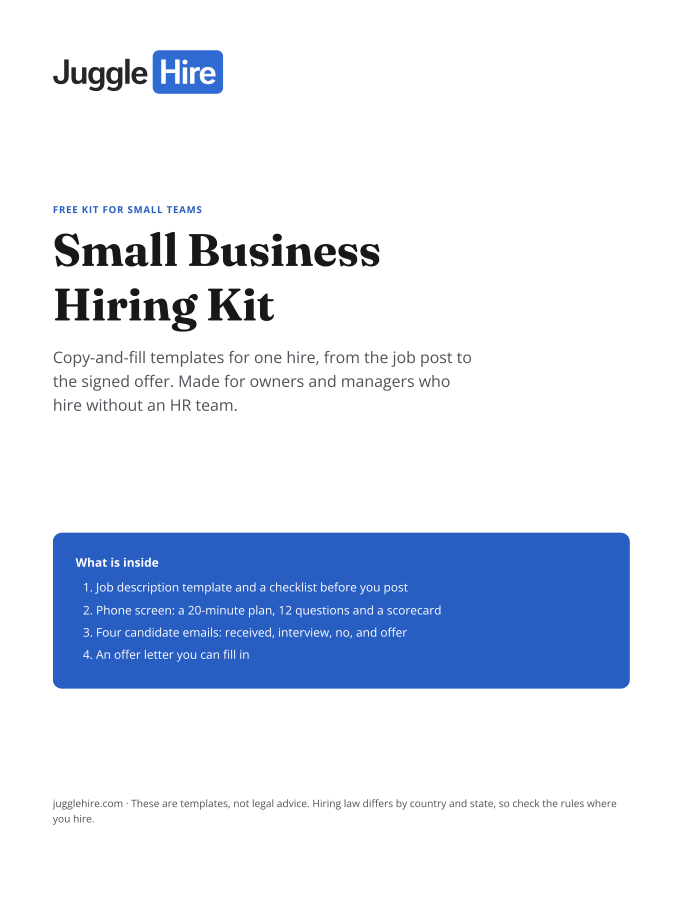
Get the Small Business Hiring Kit
- Job description template and a checklist before you post
- 20-minute phone screen: 12 questions and a scorecard
- Four candidate emails: received, interview, no, and offer
- An offer letter you can fill in
Free. We email you the kit and three short hiring tips. Unsubscribe any time.