Hiring is one of the biggest investments any company makes, yet most teams struggle to prove the return on that investment. When leadership asks "What are we getting for all this recruiting spend?" you need real numbers, not gut feelings.
This guide walks you through exactly how to calculate recruitment ROI, what benchmarks to target, and how to present the data so decision-makers actually listen.
Quick Calculator: Want to see your recruitment ROI right now? Try our free Recruitment ROI Calculator to calculate your return on hiring investments instantly.
#What is Recruitment ROI?
Recruitment ROI (Return on Investment) measures the financial value your hiring process generates compared to what it costs. It answers a simple question: for every dollar you spend on recruiting, how much value are you getting back?
Unlike vanity metrics that look good on dashboards but mean nothing, recruitment ROI connects your hiring efforts directly to business outcomes. It accounts for everything from job board fees and recruiter salaries to the productivity and revenue contribution of the people you bring in.
A positive ROI means your hires are generating more value than they cost to acquire. A negative ROI means you are burning money somewhere in the process and need to find out where.
#The Basic Recruitment ROI Formula
The standard formula is straightforward:
1Recruitment ROI (%) = ((Value of Hires - Total Recruitment Costs) / Total Recruitment Costs) x 100
For example, if you spent $50,000 on recruiting last quarter and the hires you made generated $200,000 in measurable value:
1ROI = (($200,000 - $50,000) / $50,000) x 100 = 300%
That means for every $1 you spent on recruiting, you got $3 back in value. A 300% ROI is strong by any standard.
The tricky part is not the math. It is accurately calculating the two inputs: total recruitment costs and value of hires.
#Breaking Down Recruitment Costs
To get an accurate ROI, you need to capture every dollar that goes into your hiring process. Most teams undercount costs because they only look at direct expenses and ignore internal overhead.
#Internal Costs
- Recruiter salaries and benefits (proportional to time spent hiring)
- Hiring manager time spent reviewing resumes, interviewing, and making decisions
- HR admin time for onboarding paperwork, background checks, and coordination
- Employee referral bonuses
- ATS and recruitment software subscriptions
- Employer branding efforts (careers page, social media, content)
#External Costs
- Job board fees (Indeed, LinkedIn, niche boards)
- Agency and headhunter fees (typically 15-25% of first-year salary)
- Background check and drug screening services
- Assessment and testing tools
- Recruitment marketing (paid ads, sponsored posts, events)
- Relocation packages for new hires
#How to Calculate Total Cost
Add up every internal and external cost for a specific period (monthly, quarterly, or annually). Be honest about time allocations. If a hiring manager spends 10 hours per week interviewing candidates, that is real cost even though it does not show up on an invoice.
A quick formula for internal time costs:
1Internal Time Cost = (Hours Spent on Hiring x Hourly Rate) per Person
For a hiring manager earning $120,000/year who spends 8 hours per week on recruiting:
 1Hourly rate = $120,000 / 2,080 hours = ~$58/hour
 2Weekly recruiting cost = 8 x $58 = $464
 3Monthly cost = $464 x 4.3 = ~$1,995
That single manager's recruiting time costs nearly $24,000 per year. Multiply that across all managers involved in hiring and the internal costs add up fast.
To work out what the hire itself costs once they start — salary plus payroll taxes, benefits, equipment and overhead — use the free Employee Cost Calculator.
#Measuring the Value of a Hire
This is where most ROI calculations fall apart. Quantifying the "value" side of the equation takes more thought, but there are several practical approaches.
#Revenue Per Employee
Divide total company revenue by total employees. This gives you a baseline for what each person contributes on average.
1Revenue Per Employee = Annual Revenue / Total Employees
If your company generates $10M with 50 employees, each person represents $200,000 in revenue contribution.
#First-Year Productivity Value
Estimate the output value of a new hire during their first year. For sales roles, this is straightforward (deals closed, revenue generated). For other roles, use a percentage of the fully-productive output:
- Months 1-3: 25% productivity (ramp-up)
- Months 4-6: 50% productivity
- Months 7-9: 75% productivity
- Months 10-12: 100% productivity
Average first-year productivity is roughly 62.5% of a fully ramped employee.
#Cost of Vacancy Avoided
Every day a role sits empty costs money. Calculate the daily cost of a vacancy and multiply by the number of days saved by filling it quickly:
1Daily Vacancy Cost = Annual Revenue Per Employee / 365
#Turnover Cost Avoided
If your recruitment process brings in people who stay longer, that avoids replacement costs. The cost of replacing an employee typically ranges from 50-200% of their annual salary depending on seniority.
Use our Recruitment ROI Calculator to plug in your specific numbers and see the value breakdown for your team.
#ROI Benchmarks by Company Size and Industry
What counts as "good" recruitment ROI depends on your context. Here are general benchmarks:
#By Company Size
| Company Size | Average Recruitment ROI | Target ROI |
|---|---|---|
| Startups (1-50) | 150-250% | 300%+ |
| SMBs (51-500) | 200-350% | 400%+ |
| Mid-Market (501-2,000) | 250-400% | 500%+ |
| Enterprise (2,000+) | 300-500% | 600%+ |
Larger companies typically see higher ROI because they can spread fixed recruitment costs across more hires and benefit from stronger employer brands.
#By Industry
| Industry | Typical ROI Range |
|---|---|
| Technology | 300-600% |
| Finance & Banking | 350-550% |
| Healthcare | 200-400% |
| Manufacturing | 150-350% |
| Retail | 100-250% |
| Professional Services | 250-500% |
| Education | 100-200% |
High-revenue-per-employee industries like tech and finance naturally produce higher recruitment ROI since each hire contributes more revenue relative to acquisition cost.
#Step-by-Step Calculation Example
Let's walk through a real scenario for a mid-sized SaaS company hiring 20 people in Q1.
Step 1: Total Recruitment Costs
| Cost Category | Amount |
|---|---|
| 2 in-house recruiters (salary + benefits, quarterly) | $60,000 |
| ATS software (quarterly) | $3,000 |
| Job board postings (LinkedIn, Indeed) | $8,000 |
| Hiring manager time (5 managers, ~6 hrs/week each) | $18,750 |
| Employee referral bonuses (4 referrals x $2,000) | $8,000 |
| Background checks (20 x $100) | $2,000 |
| Recruitment marketing (career page, ads) | $5,000 |
| Total | $104,750 |
Step 2: Value of Hires
- Average salary of 20 hires: $85,000
- Average revenue per employee at this company: $250,000
- First-year productivity factor: 62.5%
- Estimated first-year value per hire: $250,000 x 0.625 = $156,250
- Total value of 20 hires (annualized): 20 x $156,250 = $3,125,000
- Prorated for Q1 attribution: $3,125,000 x 0.25 = $781,250
Step 3: Calculate ROI
1ROI = (($781,250 - $104,750) / $104,750) x 100 = 645%
That is a strong result. For every $1 spent on recruiting, the company got $6.45 back in hire value during Q1.
#Key Metrics to Track Alongside ROI
ROI tells you the overall picture, but you need supporting metrics to understand what is driving it up or down.
#Cost Per Hire
1Cost Per Hire = Total Recruitment Costs / Number of Hires
The SHRM average is around $4,700 per hire, but this varies wildly by role and industry. Track this alongside ROI to spot cost efficiency trends.
#Quality of Hire
Arguably the most important metric for ROI. Measure it through:
- Performance ratings at 6 and 12 months
- Retention rate after first year
- Time to full productivity
- Hiring manager satisfaction scores
Higher quality hires directly increase the "value" side of your ROI equation.
#Time to Productivity
How quickly new hires reach full output determines how much value they generate in their first year. Shorter ramp-up means higher ROI.
#Source of Hire Effectiveness
Track which channels produce hires with the best combination of low cost and high performance. This data helps you allocate budget to the channels that maximize ROI.
#Offer Acceptance Rate
A low acceptance rate means you are spending money on candidates who never join. Every declined offer is wasted cost that drags down ROI.
#How to Improve Your Recruitment ROI
Improving ROI means either reducing costs, increasing hire value, or both. Here are the highest-impact levers.
#1. Build an Employee Referral Program
Referral hires typically cost 50-70% less than agency or job board hires and tend to stay longer. A structured referral program with clear incentives is one of the fastest ways to boost ROI.
#2. Invest in Employer Branding
Companies with strong employer brands see 50% more qualified applicants and spend 43% less per hire. The upfront investment pays for itself quickly through a larger, better talent pipeline.
#3. Use Data to Optimize Channels
Stop spending equally across all channels. Use your recruitment ROI data to identify which sources produce the best hires at the lowest cost, and shift budget accordingly.
#4. Reduce Time to Hire
Every extra day in the process costs money (recruiter time, hiring manager time, vacancy costs) and increases the risk of losing top candidates. Streamline interviews, speed up decisions, and automate administrative tasks.
#5. Improve Onboarding
Better onboarding reduces time to productivity and improves retention, both of which directly increase hire value. A structured 90-day onboarding plan can increase new hire productivity by 70%.
#6. Use an ATS to Cut Admin Costs
Manual recruiting is expensive. An applicant tracking system automates resume screening, interview scheduling, and candidate communication, freeing up recruiter and manager time for higher-value activities.
#Proving ROI to Leadership
Calculating ROI is only useful if you can communicate it effectively. Here is how to make your case.
#Speak Their Language
Executives care about revenue, profit, and growth. Frame recruitment ROI in terms of business impact, not HR jargon. Say "Every $1 we invested in recruiting returned $4.50 in employee productivity" instead of "Our cost per hire decreased by 12%."
#Use Visualizations
A simple chart showing ROI trends over time, or a comparison of ROI by channel, communicates more than a spreadsheet of numbers. Keep it to 2-3 visuals per report.
#Show the Counterfactual
What would it cost to NOT invest in recruiting? Calculate the cost of unfilled positions, bad hires, and turnover to show what happens when recruiting is underfunded.
#Report Quarterly, Not Annually
Annual reports are too infrequent for course correction. Quarterly ROI reports let you catch problems early and show consistent improvement.
#Benchmark Against Industry
Context matters. A 250% ROI might sound average until you show that the industry benchmark is 180%. Always include comparison data to frame your results.
#Common ROI Calculation Mistakes
Avoid these errors that lead to misleading ROI numbers.
#1. Ignoring Internal Costs
Only counting job board fees and agency costs makes your ROI look artificially high. Always include recruiter salaries, hiring manager time, and overhead.
#2. Overestimating Hire Value
Be conservative when estimating how much value a new hire creates. Use actual performance data when available rather than optimistic projections.
#3. Mixing Time Periods
If you calculate costs over Q1 but measure hire value over a full year, your ROI will be inflated. Keep cost and value time periods consistent.
#4. Ignoring Failed Hires
That employee who left after 3 months still cost you money to recruit and onboard. Include the cost of turnover and replacement in your calculations.
#5. Not Accounting for Ramp-Up Time
New hires do not produce full value from day one. Use a ramp-up factor (the 62.5% first-year average discussed earlier) to get realistic value estimates.
#ROI by Recruitment Channel
Not all sources are created equal. Here is how common channels typically compare:
| Recruitment Channel | Avg. Cost Per Hire | Avg. Quality of Hire | Avg. Retention (1 yr) | Typical ROI |
|---|---|---|---|---|
| Employee Referrals | $1,500-$3,000 | High | 85-90% | 400-600% |
| Company Career Page | $500-$1,500 | Medium-High | 75-85% | 350-500% |
| LinkedIn Recruiter | $3,000-$8,000 | Medium-High | 70-80% | 200-350% |
| Job Boards (Indeed, etc.) | $2,000-$5,000 | Medium | 65-75% | 150-300% |
| Recruitment Agencies | $8,000-$25,000 | Medium-High | 75-85% | 100-200% |
| Social Media (organic) | $500-$2,000 | Medium | 65-75% | 250-400% |
| University/Campus | $2,000-$6,000 | Medium | 60-70% | 150-250% |
| Job Fairs/Events | $3,000-$7,000 | Low-Medium | 60-70% | 100-200% |
Employee referrals consistently deliver the highest ROI due to low cost, high quality, and strong retention. If you are not investing in a referral program, that is likely your biggest ROI opportunity.
#Calculate Your Recruitment ROI Now
Stop guessing whether your recruitment spend is paying off. Use our free Recruitment ROI Calculator to plug in your actual numbers and get an instant ROI breakdown. You will see exactly where your money is going and where the biggest improvement opportunities are.
The calculator walks you through each cost category and value estimate, so you do not miss anything. Run it quarterly to track trends and build the data you need for leadership reporting.
#Related Resources
- Recruitment ROI Calculator - Free tool to calculate hiring ROI
- How to Reduce Cost Per Hire
- How to Create a Hiring Budget
- Set Recruitment KPIs That Actually Matter
Recruitment ROI is not just a metric. It is the business case for your entire hiring operation. When you can prove that every dollar invested in recruiting returns multiple dollars in employee value, you earn the budget, headcount, and executive support your team needs to keep improving.
Ready to streamline your hiring process and boost your ROI? JuggleHire helps small teams hire faster with built-in tracking, collaboration, and automation, so you spend less time on admin and more time landing great candidates.
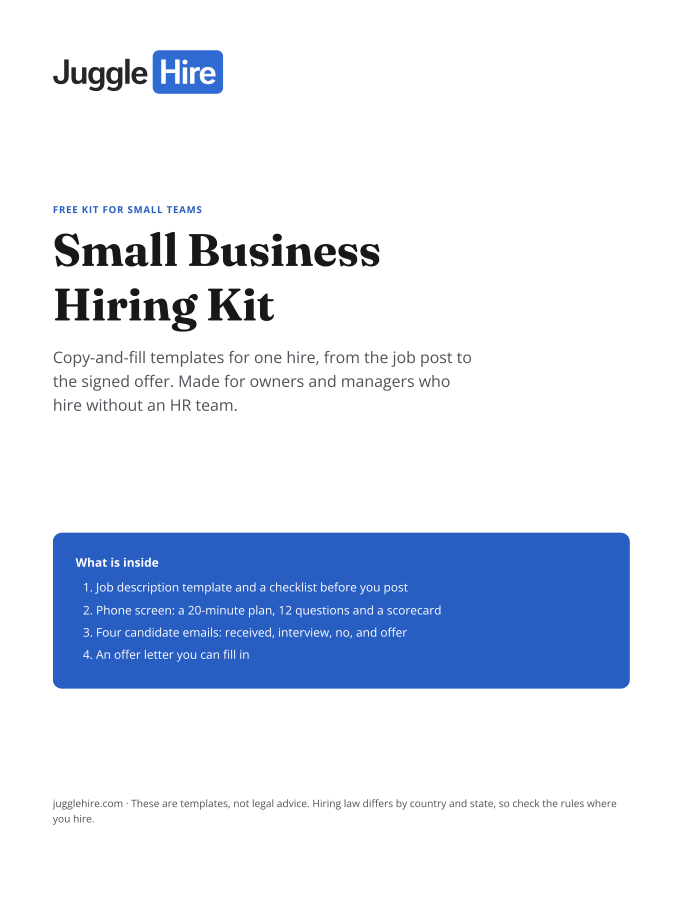
Free download
Get the Small Business Hiring Kit
- Job description template and a checklist before you post
- 20-minute phone screen: 12 questions and a scorecard
- Four candidate emails: received, interview, no, and offer
- An offer letter you can fill in
Free. We email you the kit and three short hiring tips. Unsubscribe any time.

Zakir Hossen
Zakir, founder of JuggleHire - a Google Forms alternative for hiring. Bootstrapped entrepreneur and software engineer with 10+ years coding experience from BD.
Related Posts
Candidate Experience Tools to Improve Your Hiring Journey
The best candidate experience tools for 2026. Improve every touchpoint of the applicant journey, from careers page to offer.
candidate experience toolscandidate experience softwareapplicant experience+5 more
Read more
8 Proven Hiring Strategies for Small Businesses in 2026
Discover 8 proven hiring strategies for small businesses to compete with larger companies.
hiring strategiessmall business hiringrecruitment tips+5 more
Read more