Quick Answer: An ATS for a staffing agency needs to do one thing a regular ATS doesn't: keep candidates visible and searchable across every client role, not just one job. This guide is a checklist for what to actually evaluate — for per-seat pricing across the market, see our best ATS for staffing agencies comparison.
#Why a regular ATS doesn't fit a staffing agency
Most ATS software (Greenhouse, Lever, BambooHR) is built for a single company hiring for itself: one set of open roles, one internal team, candidates who apply and disappear into "hired" or "rejected."
A staffing agency's job is structurally different:
- You run multiple client roles at once, not one company's requisitions.
- The candidate database outlives any single job — someone you sourced for Client A last month might be the right fit for Client B's role next week.
- You're paid on placement, not headcount, so speed to shortlist is revenue, not a nice-to-have.
- A competing agency can place your candidate first if you're slow to submit.
An ATS built for internal hiring treats every job as an island. Candidates get buried in whichever job they first applied to. That's the gap agency-native tools and recruitment CRMs exist to close — see our Recruitment CRM vs ATS guide for the terminology difference.
One scope note before the checklist: "staffing agency" in this industry usually means temp or contract placement, which needs timesheets, pay-and-bill, and VMS integrations. This guide — and JuggleHire — is for permanent-placement agencies only. If you run temp or contract desks, you need the per-seat agency-suite category (Bullhorn, JobAdder, Vincere) built for that workflow.
#The checklist: what to evaluate before you buy
#1. Cross-job candidate search
Can you search your entire candidate pool by skill, tag, or history — regardless of which job they originally applied to? If the answer is "only within one job," it's not built for agency work.
#2. Speed to shortlist
AI-assisted ranking that scores candidates on first profile view beats manual resume-by-resume review. In agency work, a day saved on shortlisting is a day you're ahead of a competing agency chasing the same candidate.
#3. Bulk operations
Agencies move candidates between roles and message groups constantly, often 50+ at a time when a client role closes or a batch gets re-shortlisted. One-candidate-at-a-time tools slow you down exactly where volume is highest — and bulk operations are often gated to a higher tier, so confirm it's included on the plan you're buying, not just the product overall.
#4. Native scheduling
Every round of "does Tuesday at 2pm work?" emails adds a day — and a day is long enough for another agency to get there first. Native scheduling with auto-generated Google Meet or Zoom links removes that friction. We compare the options in our guide to scheduling software for staffing agencies.
#5. Import path for your existing mess
Most agencies arrive with candidates scattered across spreadsheets, email threads, and LinkedIn messages. Check for CSV import at minimum, and Google Sheets or bulk PDF resume import with AI extraction if you have a large backlog — confirm which import methods are actually on the tier you're buying, since not every tool includes all three on every plan.
#6. Honest limits
Watch for vague "unlimited" marketing claims on jobs, candidates, or seats. Ask for the actual plan caps in writing — and watch for seat minimums baked into the pricing, not just the per-seat rate. For the real per-seat numbers and any published seat minimums across the market, see our full ATS comparison.
#Where JuggleHire fits
JuggleHire is the recruitment CRM for agencies that place permanent hires — built for US agencies with 2–8 staff, typically in tech or finance/accounting placements. It's priced flat per agency, not per seat: $15/month (Starter) or $49/month (Unlimited), monthly billing only.
What it covers well for a small agency: a talent pool searchable across every open role (not siloed per job), AI candidate ranking with a verdict on every profile, native scheduling with Google Meet/Zoom, and offer letters with e-signature — on every plan. Starter includes 3 open jobs, up to 200 applicants per job, 5 team members, 10 AI job posts a month, bulk actions, video interviews, skills tests and GDPR tools. Unlimited adds unlimited open jobs, unlimited team members, 50 AI job posts a month and automations.
Where it's honest about the gap: JuggleHire runs on two core entities today — Candidates and Jobs. It doesn't yet have a formal Companies/Contacts/Submittals record model the way Bullhorn or Recruit CRM do, so candidates aren't tied to a specific client-account record. For most 2–8 person agencies running a straightforward placement workflow, that's rarely a dealbreaker. If your agency needs formal client-account management and submittal-record tracking today, a dedicated agency CRM covers that ground more completely. Our CRM for staffing agency comparison covers those options in depth.
Trial: 14 days, credit card required.
#How to decide
You're a 2–8 person perm-placement agency, price-sensitive, want to move fast: an ATS built for agencies with flat pricing — JuggleHire fits this directly.
You need dedicated client/contact records and deal-pipeline reporting today: look at Recruit CRM or Vincere — see the CRM for staffing agency breakdown.
You run 50+ recruiters with VMS and back-office needs, or run temp/contract desks: Bullhorn or JobAdder are built for that scale and workflow, and the per-seat pricing is a reasonable trade there.
For the broader category primer, see Recruitment Agency Software: The Complete Buyer's Guide and our ATS software guide.
#FAQ
#What makes an ATS "for staffing agencies" specifically?
Cross-job candidate visibility. A regular ATS treats each job as standalone; an agency ATS keeps your full candidate database searchable across every client role, since the same person can be a fit for multiple clients over time.
#Do I need a CRM instead of an ATS?
If you're placing fewer than 10 candidates a month with one or two clients, a solid ATS with strong talent-pool search is usually enough. Once you're juggling multiple client roles and reusing the same candidate pool across them, cross-job features start paying for themselves — see Recruitment CRM vs ATS.
#Why do most staffing agency ATS tools charge per recruiter?
It's the legacy pricing model from enterprise agency software (Bullhorn, JobAdder), and most newer entrants copied it. It scales fine for large agencies with predictable headcount but punishes small agencies that add and drop recruiters as contracts change.
#Is there a flat-rate ATS for staffing agencies?
Yes, for permanent-placement agencies — JuggleHire is a recruitment CRM priced at $15/month (Starter, up to 5 team members) or $49/month (Unlimited, unlimited team members), rather than billing per seat like Bullhorn, Recruiterflow, or Loxo.
#What should I check before switching ATS tools?
Get the real monthly cost at your current headcount and at headcount + 2, including any seat minimum — per-seat pricing hides the true number until you've signed. Also confirm import support for your existing candidate database (CSV, spreadsheet, or resume PDFs), and check which of those import methods are actually included on the plan tier you're buying, not just the product overall. If budget is the hard limit, see what free recruitment agency software actually gives you before you pay.
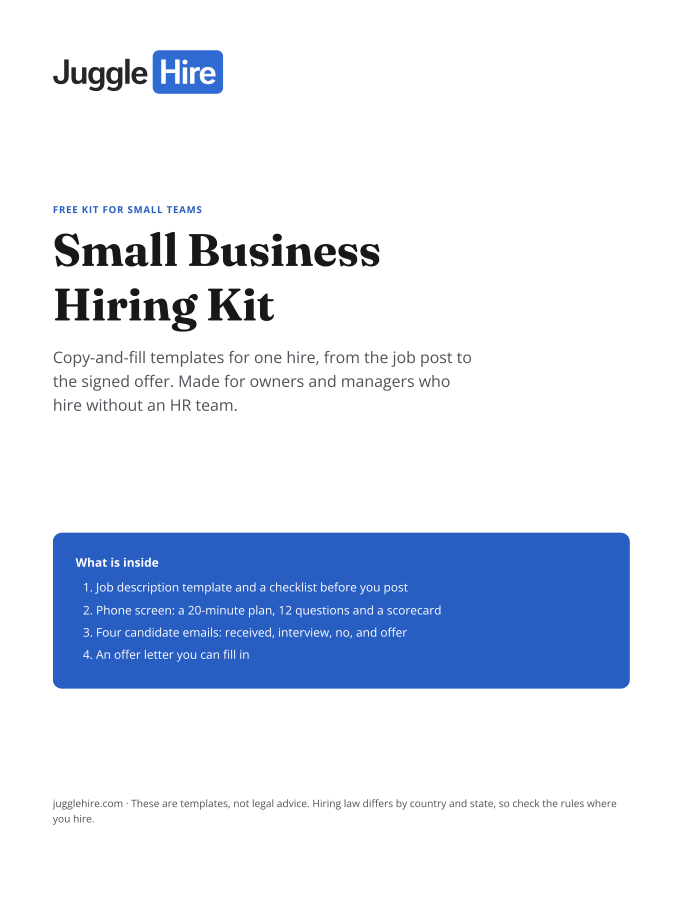
Free download
Get the Small Business Hiring Kit
- Job description template and a checklist before you post
- 20-minute phone screen: 12 questions and a scorecard
- Four candidate emails: received, interview, no, and offer
- An offer letter you can fill in
Free. We email you the kit and three short hiring tips. Unsubscribe any time.

Zakir Hossen
Zakir, founder of JuggleHire - a Google Forms alternative for hiring. Bootstrapped entrepreneur and software engineer with 10+ years coding experience from BD.
Related Posts
ATS for Staffing Agencies: The Real Monthly Cost for a 3-Recruiter Team (2026)
What a 3-recruiter staffing agency actually pays for an ATS — verified per-seat rates from $237 to $597/mo, and the flat-price alternative at $15/mo.
ats pricing for staffing agenciesstaffing agency software costper-seat vs flat-rate ats+1 more
Read more
11 Best Sourcing and Placement Tools for Recruitment Agencies in 2026
Compare 11 sourcing and placement tools built for staffing and recruitment agencies, with 2026 pricing and honest pros and cons.
candidate sourcing tools for recruitment agenciesrecruitment agency software
Read more