Quick Answer: If you run weekly temp payroll as the employer of record, budget $85–$165+/user/month for a payroll-capable staffing platform — Bullhorn and Crelate publish that range; TempWorks, JobAdder, and Avionté publish no number at all (third-party estimates put TempWorks from ~$49/user/month, and ITQlick reports Avionté starting around $750/month as a flat account fee, not per user). If you're a permanent-placement agency — filling roles without running weekly temp payroll yourself — JuggleHire at $15–$49/month, flat per agency covers the candidate database, screening, scheduling, and offers, with no payroll layer. "Light industrial staffing" — warehouse, production line, assembly, general labor, filled through weekly-pay temp agencies — is a subset of the broader "industrial staffing" category, which also covers heavier, credentialed work like welding, CNC machining, and chemical processing under different workers' comp class codes; in practice, most agencies market themselves under either label interchangeably. Either way, the workflow needs timesheets, payroll, and often VMS integration, not just a candidate database.
Last Updated: October 20, 2026
#First: "industrial" vs. "light industrial" — and what does either mean for your agency?
The two terms aren't fully interchangeable, even though agencies often use them that way in marketing. Industry sources put them on a spectrum:
- Light industrial — warehouse, production-line, assembly, packaging, pick-pack, general labor. High volume, fast turnover, weekly pay, entry-level workers' comp class codes. Driver and logistics desks (CDL drivers, dispatchers, warehouse crews) work much the same way; see what a transportation recruiter does.
- Industrial (the broader term) — includes light industrial, but also the heavier, credentialed tier: welders, CNC machinists, chemical-processing operators, industrial electricians. Different workers' comp class codes and commonly higher insurance rates than light industrial, plus certification tracking (OSHA 10/30, forklift, welding certs) that light-industrial placements rarely need.
The software distinction that actually matters isn't the label — it's whether you run payroll yourself:
| Your agency | What you need | Software category |
|---|---|---|
| Places temp/industrial labor (light or heavy) — warehouse, production, assembly, or skilled trades — and runs weekly payroll as the employer of record | Timesheets, payroll, billing/invoicing, VMS integration for enterprise clients | Full staffing platform with native payroll (Avionté, TempWorks) or payroll via integration (Bullhorn ecosystem, JobAdder + a payroll partner) |
| Places permanent hires — including into industrial or manufacturing companies — and doesn't run payroll yourself | Candidate database, screening, scheduling, offers — no payroll | A recruiting CRM |
| Runs both — perm placement plus occasional temp-to-hire, with payroll through a PEO or the client | Same as above — no payroll needed in the tool | A recruiting CRM |
Most generic "best staffing software" lists don't draw this line, then point a warehouse-staffing agency at a $15/month tool with no timesheets, or point a permanent-placement recruiter at a $150+/user/month payroll platform they'll never use half of. Figure out which row you're in first.
#What running industrial temp payroll actually involves
If you're the employer of record for industrial temps, the tool has to handle more than a standard ATS workflow:
- Shift-fill speed — light-industrial openings fill in hours to days, not weeks. The tool needs to move a candidate from application to a confirmed shift fast, often across dozens of open shifts at multiple client sites at once.
- Badge-in and time-clock integration — warehouse and plant floors run physical time clocks or badge systems; the software needs to pull those punches in for timesheet approval rather than relying on manual entry.
- Workers' comp classification — light-industrial and heavier industrial trades sit in different class codes with different insurance rates. Misclassifying a welder or CNC operator under a light-industrial code is a compliance and cost problem, not just a data-entry one.
- OSHA and certification tracking — heavier industrial placements often require tracking OSHA 10/30 cards, forklift certification, or trade-specific credentials with expiry dates; light-industrial placements usually don't.
- Payroll and tax handling — weekly pay runs are standard, plus W-2 handling. Our guide to staffing agency payroll software explains the build-or-outsource choice.
- Billing and invoicing — markup on bill rate vs. pay rate, automated client invoicing.
- VMS onboarding — large manufacturers and distribution centers route staffing orders through a Vendor Management System (Beeline, SAP Fieldglass). Getting approved as a VMS-connected vendor commonly means submitting rate cards, proving background-check and drug-screen compliance, and demonstrating safety-certification tracking for the roles you're supplying — not just having an API connection.
This is a payroll-and-compliance product with a recruiting front end, not a recruiting tool with payroll bolted on — which is why it's priced differently from a standard ATS.
#Software built for this
Avionté, TempWorks, Bullhorn, Crelate, and JobAdder all serve this category. Bullhorn and Crelate publish per-user front-office pricing; TempWorks, JobAdder, and Avionté publish none — treat any number for those three as a third-party estimate, not a quote.
| Vendor | Price | Model |
|---|---|---|
| Bullhorn | $99–$165/user/mo (Starter–Core, published); Pro/Max quote-only | Per user |
| Crelate | $85–$119/user/mo (Business tier; Essentials caps at 2 users) | Per user |
| TempWorks | ~$49/user/mo (Core) to ~$100–$120/user/mo (Enterprise Infinity) — third-party estimates | Per user (unpublished) |
| Avionté | ~$750/mo — ITQlick estimate | Flat account fee (unpublished) |
| JobAdder | Quote-only | Per user (unpublished) |
Payroll, timesheets, and invoicing are frequently priced as separate add-ons on top of the above. Bullhorn's Core tier at $165/user/month is its highest published price — Bullhorn also sells quote-only Pro and Max tiers above Core, plus Bullhorn One as a bundled front-to-back product with timesheets and pay/bill built in. Crelate's per-user tiers cover the ATS+CRM layer only; timekeeping, the Pay Rules engine, and invoicing live in Crelate Deliver, which has no published price, and payroll runs through a separate Check integration. Avionté's pricing has no vendor-published number at all — ITQlick, a third-party site, reports it starting around $750/month as a flat account fee, not per user, and TrustRadius lists no pricing for it; treat any specific Avionté number as a rough third-party estimate, not a quote.
For the full vendor-by-vendor pricing table, see our temporary staffing agency software guide.
#Where a recruitment CRM like JuggleHire fits — and where it doesn't
JuggleHire does NOT have: timesheets, payroll, invoicing, badge-in time tracking, or VMS integration. If weekly payroll for temp industrial workers is core to your business, the tools above are your options, not JuggleHire. JuggleHire also doesn't yet have client company records or a submittal/placement pipeline — it's a 2-entity product (candidates and jobs), so agencies that need client-facing account records inside the tool will find that layer missing too.
JuggleHire is built for US permanent-placement agencies, 2–8 staff, in tech or finance/accounting roles. JuggleHire's core buyer is tech or finance/accounting perm placement — an industrial perm desk (a technical recruiter placing plant engineers or supervisors, for example) can use it, but it isn't who the product is built around. JuggleHire skips temp/contract placement, since it needs timesheets JuggleHire doesn't have, and skips light-industrial temp — that's Avionté/TempWorks territory. The one exception: occasional temp-to-hire where payroll runs entirely through a PEO, the client, or a back-office partner, since no payroll ever touches JuggleHire itself.
Both plans include:
- Candidate database with AI ranking, verdict, and fit signals — one searchable talent pool across every open role (Starter: 3 open jobs, 5 team members; Unlimited: unlimited open jobs and team members)
- Native interview scheduling (Google Meet/Zoom auto-link)
- Offer letters with e-signature
- CSV and bulk PDF resume import with AI extraction
Unlimited adds:
- Automation engine to move candidates through stages and fire emails without manual follow-up
- Unlimited open jobs and team members (Starter: 3 open jobs, 5 team members)
Pricing: Starter at $15/month (3 open jobs, 5 team members) or Unlimited at $49/month (unlimited open jobs and team members, plus automations) — both flat per agency, not per recruiter, billed monthly. A 14-day trial is available (credit card required).
The math that matters: a 3-recruiter permanent-placement agency fits inside Starter's 5-seat cap at $15/month, or needs Unlimited at $49/month for unlimited open jobs and automations. The same 3-person team on a per-user payroll-capable staffing platform starts around $357/month, paid annually, at Crelate's Business tier ($119/user/month — Essentials caps at 2 users, so a 3-person team can't use its $85 floor) — before you even account for the payroll and timesheet modules JuggleHire simply doesn't have.
For a wider look at what "recruitment agency software" costs across pricing models, see our recruitment agency software guide.
#FAQ
#How much does industrial staffing software cost?
Payroll-capable platforms built for industrial/light-industrial staffing mostly price front-office access per user — Bullhorn and Crelate publish $85–$165/user/month, often on annual contracts — with payroll, timesheets, and invoicing often quoted separately. TempWorks, JobAdder, and Avionté publish no number; third-party sources put TempWorks from ~$49/user/month and Avionté around $750/month as a flat account fee, not per user. A 3-person team can run $350+/month before add-ons.
#Do I need shift-fill or high-volume onboarding features specifically for industrial roles?
If you're filling warehouse, production, or assembly shifts, yes — the tools above are built to move a candidate from application to a badge on day one in hours, not weeks, often across dozens of open shifts at once. That's a different workload from permanent placement, where a handful of candidates move through a longer, more selective process. A general recruiting CRM like JuggleHire isn't built for shift-fill volume; it's built for the selective side.
#Can I use JuggleHire for industrial staffing?
Only if you're placing candidates permanently — including into industrial or manufacturing companies. If you run payroll yourself for temp industrial workers, or need built-in client/submittal records, JuggleHire will not cover your core workflow; use a dedicated staffing platform instead. For permanent placement, JuggleHire covers the candidate database, screening, and placement at a fraction of the cost of a full staffing platform.
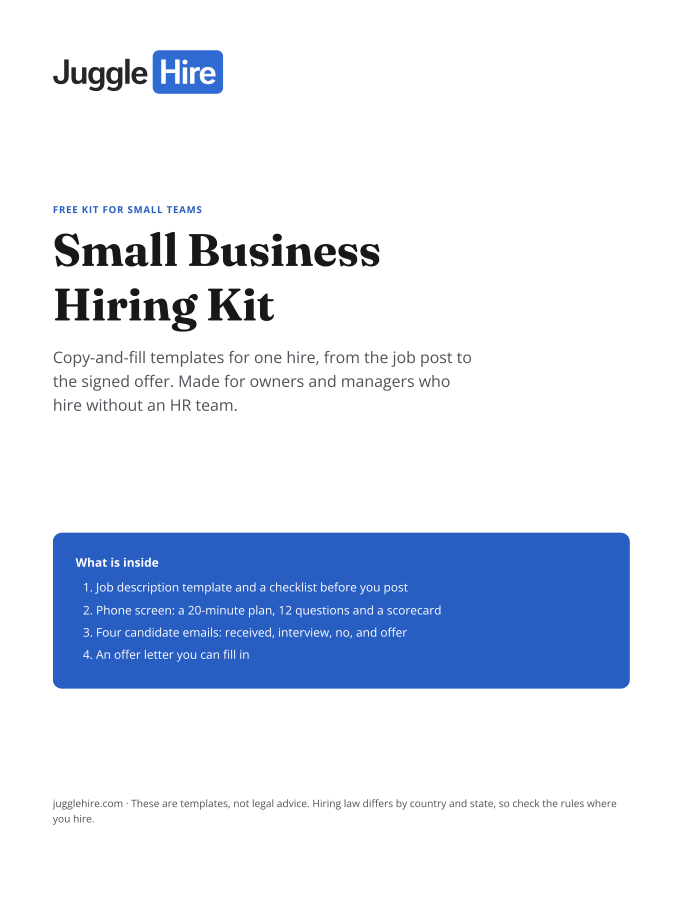
Free download
Get the Small Business Hiring Kit
- Job description template and a checklist before you post
- 20-minute phone screen: 12 questions and a scorecard
- Four candidate emails: received, interview, no, and offer
- An offer letter you can fill in
Free. We email you the kit and three short hiring tips. Unsubscribe any time.

Zakir Hossen
Zakir, founder of JuggleHire - a Google Forms alternative for hiring. Bootstrapped entrepreneur and software engineer with 10+ years coding experience from BD.
Related Posts
ATS for Staffing Agency: How to Choose One in 2026
A buyer's checklist for picking an ATS for a staffing agency — what to look for, and where JuggleHire fits.
ats for staffing agencystaffing agency softwareapplicant tracking system
Read more
ATS for Staffing Agencies: The Real Monthly Cost for a 3-Recruiter Team (2026)
What a 3-recruiter staffing agency actually pays for an ATS — verified per-seat rates from $237 to $597/mo, and the flat-price alternative at $15/mo.
ats pricing for staffing agenciesstaffing agency software costper-seat vs flat-rate ats+1 more
Read more