Data Engineer Interview Questions
A hiring manager's question bank for data engineers — pipelines, modeling, SQL and Python, Spark, and the data-quality instincts that keep dashboards honest. Use these to find someone who builds systems that survive bad input.
A data engineer is judged by the pipelines nobody notices — the ones that run every night, recover from a malformed file, and never quietly drop half the rows. So while a candidate must be able to write a correct join and explain a partition strategy, the deeper signal is whether they design for failure. Real production data is late, duplicated, schema-drifted, and occasionally garbage; the engineers worth hiring assume this and build idempotent, observable systems around it. The questions below move from foundations (SQL fluency, batch versus streaming, dimensional modeling) into the harder ground of pipeline design and data quality. Use the early questions to confirm they can actually move and shape data, then spend the bulk of the interview on scenarios: how they would backfill three months of history without double-counting, what they do when an upstream API silently changes a field type, how they decide between ELT in the warehouse and transformation in Spark. Reward candidates who talk about idempotency, late-arriving data, schema evolution, and monitoring without being prompted — those are the habits that separate someone who has shipped pipelines from someone who has only read about them. Watch for engineers who confuse "the job succeeded" with "the data is correct," and favor those who instrument their own pipelines so they find problems before the business does.
How to use these questions
Confirm core SQL and modeling fluency with two or three foundational questions, then spend most of the interview on a pipeline-design scenario specific to your stack. The strongest signal is an engineer who designs for late, duplicate, and malformed data without being asked.
Foundations: SQL, Python & Modeling
- Explain the difference between ETL and ELT and when you would choose each.
- What is the difference between a star schema and a snowflake schema, and when does each make sense?
- How do you decide whether a column belongs in a fact table or a dimension table?
- Walk me through how you would deduplicate a table with millions of rows in SQL efficiently.
- When would you reach for Python over SQL in a transformation step, and why?
Pipelines & Processing
- What does it mean for a pipeline to be idempotent, and why does it matter for a nightly batch job?
- Explain the difference between batch and streaming processing and a case where streaming is genuinely required.
- In Spark, what is a shuffle and how would you reduce its cost in a slow job?
- How would you orchestrate a set of dependent jobs and handle a failure halfway through?
- What is a slowly changing dimension and how would you implement Type 2 history?
Data Quality & Scenarios
- You need to backfill three months of history into a table that already feeds a daily report. How do you avoid double-counting?
- An upstream API silently changes a field from integer to string overnight. How does your pipeline behave, and how should it?
- A stakeholder says yesterday's revenue number looks wrong. Walk me through how you would investigate.
- How do you detect that a pipeline succeeded technically but produced bad data?
- What data-quality checks do you put in place, and where in the pipeline do you put them?
- How would you handle late-arriving events that belong to a window you have already closed?
- Describe a time a pipeline you built broke in production. What was the root cause and what did you change?
Tips for interviewing Data Engineering candidates
- Give a small messy dataset and ask them to design the ingestion, not just query it.
- Probe for idempotency and how they handle reruns and backfills.
- Ask what monitoring or alerting they add to their own pipelines.
- Favor candidates who assume upstream data will be late, duplicated, or malformed.
- Pair a modeling question with a "the number looks wrong" debugging scenario.
Frequently asked questions
Hiring data engineers? JuggleHire screens for real pipeline and SQL skill before you interview.
JuggleHire goes beyond simple job posting. Leverage custom forms, powerful screening filters, and automated social media previews to find the perfect fit for your team.
Free download
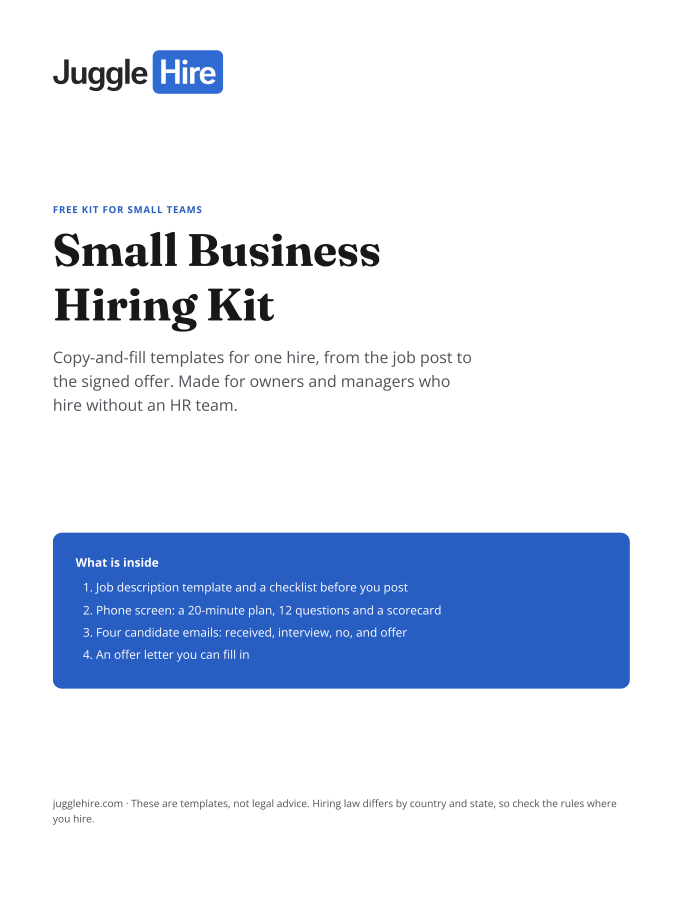
Get the Small Business Hiring Kit
- Job description template and a checklist before you post
- 20-minute phone screen: 12 questions and a scorecard
- Four candidate emails: received, interview, no, and offer
- An offer letter you can fill in
Free. We email you the kit and three short hiring tips. Unsubscribe any time.