Data Scientist Interview Questions
A practical question bank for hiring data scientists — statistics, modeling, evaluation, and experimentation, plus the judgement to know when a model is helping the business and when it is just impressive. Use these to find a scientist, not a Kaggle competitor.
The hardest part of hiring a data scientist is that the flashy skill — training models — is rarely the bottleneck on the job. The bottleneck is judgement: framing a fuzzy business problem as a measurable question, picking an evaluation metric that matches what the business actually cares about, knowing when a simple model beats a complex one, and noticing when a result is too good to be true. Many candidates can recite the bias-variance trade-off but cannot explain why their cross-validation score did not survive contact with production. The questions below are grouped so you can test the fundamentals (statistics, modeling, evaluation) and then the applied reasoning that separates a scientist from a notebook operator. Push hard on evaluation: ask why accuracy is misleading on imbalanced data, what precision and recall mean for a specific business decision, and how they would detect data leakage. Push equally hard on experimentation, because most real impact comes through well-run A/B tests, not exotic architectures. And reserve real weight for communication — a data scientist who cannot explain a result to a skeptical product manager will see their work ignored regardless of how good the model is. Reward candidates who ask clarifying questions, reach for the simplest method that works, and talk in terms of business outcomes rather than leaderboard scores.
How to use these questions
Test fundamentals with a couple of statistics and evaluation questions, then spend most of the time on an applied scenario: frame a business problem, pick a metric, and defend the trade-offs. The strongest signal is a candidate who reaches for the simplest approach that works and ties everything back to a business decision.
Statistics & Experimentation
- Explain a p-value to a non-technical stakeholder in plain language.
- What is the difference between correlation and causation, and how would you establish causation?
- How would you design an A/B test to measure whether a new feature increases retention?
- What is statistical power and how do you decide on a sample size before running an experiment?
- Your A/B test shows a significant result after two days. Should you ship it? Why or why not?
Modeling & Evaluation
- Why can accuracy be a misleading metric, and when would you use precision, recall, or AUC instead?
- Explain the bias-variance trade-off with a concrete example of overfitting.
- What is data leakage and how have you caught it in a real project?
- How do you decide which features to engineer, and how do you guard against creating features that leak the target?
- When would you choose a simple logistic regression over a gradient-boosted model or a neural network?
Applied Reasoning & Communication
- A product manager asks you to "use AI to improve churn." How do you turn that into a measurable problem?
- Your model performs well offline but worse in production. Walk me through how you investigate.
- How would you explain to a skeptical executive why your model should be trusted?
- Tell me about an analysis where the data led you to a conclusion the team did not want to hear.
- How do you decide when a model is good enough to ship versus needs more work?
- A stakeholder wants a single accuracy number for a fraud model. Why might that be the wrong thing to give them?
- Describe a project where the simplest solution turned out to be the right one.
Tips for interviewing Data Science candidates
- Weight evaluation and metric choice heavily — it predicts on-the-job judgement better than model trivia.
- Ask them to frame a vague business problem; strong candidates clarify before modeling.
- Probe for data leakage awareness in any modeling answer.
- Reward candidates who reach for the simplest method that solves the problem.
- Include one "explain this to a non-technical stakeholder" question to test communication.
Frequently asked questions
Hiring data scientists? JuggleHire screens for real statistical and modeling judgement before you interview.
JuggleHire goes beyond simple job posting. Leverage custom forms, powerful screening filters, and automated social media previews to find the perfect fit for your team.
Free download
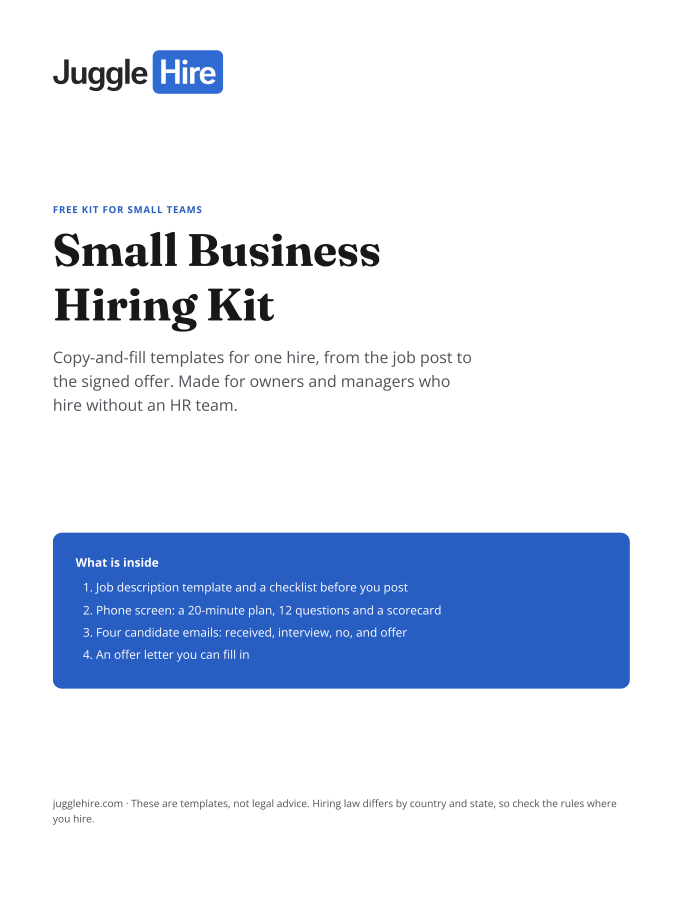
Get the Small Business Hiring Kit
- Job description template and a checklist before you post
- 20-minute phone screen: 12 questions and a scorecard
- Four candidate emails: received, interview, no, and offer
- An offer letter you can fill in
Free. We email you the kit and three short hiring tips. Unsubscribe any time.