Reference Check Template Generator
Generate role-specific reference check questionnaires with professionally crafted questions organized by evaluation category.
What Is a Reference Check and When Should You Do One?
A reference check is a structured conversation with someone who has worked directly with a candidate — typically a former manager, peer, or direct report — to verify what they told you in interviews and surface anything that might not have come up. Done well, reference checks are not a formality. They are one of the most cost-effective ways to reduce bad hires, because the people who know the candidate best can tell you in 20 minutes what it would take you six months on the job to discover. This tool generates role-specific reference check questions so you know exactly what to ask and how to interpret the answers.
How to Use This Tool
- 1Enter the job title and competencies to verify. The more specific you are about what matters in the role — leadership, technical depth, client management, execution speed — the more targeted the generated questions will be.
- 2Review and customize the template. The tool generates questions organized by category — role verification, performance, working style, development areas, and re-hire intent. Remove questions that do not apply and add any specific things the interview raised that you want to probe further.
- 3Use it on a call or send it as a written form. Phone reference checks give you richer signal — you can hear hesitation and ask follow-ups. Written references are faster to collect and easier to compare across multiple references. Download the template and use whichever format fits your process.
How to Get More Honest Answers from References
- →Always ask "Would you rehire them?" This single question is the most reliable signal in a reference check. A genuine "absolutely yes" is very different from "I am sure they would do well in the right environment." Listen for what is not said as much as what is.
- →Ask for specific examples, not general assessments. "Tell me about a time they disagreed with you on a decision — how did they handle it?" gets more honest, useful information than "Are they a good communicator?"
- →Cross-reference what the candidate told you. If the candidate mentioned a specific achievement or situation in the interview, ask the reference about it. This lets you verify accuracy and often surfaces important context the candidate left out.
- →Pay attention to pauses and hedges. References rarely lie outright — they just get vague, change subject, or give qualified praise. A long pause before answering a competency question is signal worth probing.
- →Check references before making a final offer, not after. If you discover a significant issue after the offer is accepted, you are in a difficult position. Treating reference checks as a real gate — not a box to tick — protects both parties.
Track your entire hiring process in one place. JuggleHire lets you attach reference check templates to candidates, track completion, and store notes — so nothing falls through the cracks before you make an offer. Start free →
Frequently Asked Questions
Is this reference check template generator free?
Yes, completely free. Enter the role and any key competencies you want to verify, and the tool generates a structured reference check template with role-specific questions you can use on a call or send as a written form.
When in the hiring process should you do reference checks?
Reference checks should happen after you have made a conditional offer or identified a final candidate, but before the offer is formally accepted. Doing them too early wastes time on candidates who may not progress; doing them after acceptance creates awkward situations if the reference reveals a problem.
How many references should you check?
Two to three references is standard for most roles. Always include at least one direct manager — peer references are useful but less predictive. For senior leadership or high-trust roles, check three to four references including at least two managers or direct reports.
What can you legally ask in a reference check?
You can ask about job performance, specific competencies, work style, strengths and development areas, reasons for leaving, and whether they would rehire. Avoid questions that touch on protected characteristics (age, health, family status, religion, etc.). Laws vary by jurisdiction — in some locations, references are legally limited to confirming employment dates and titles only.
What reference check questions give the best signal?
The most predictive questions are: "Would you rehire this person? In what role?" (a hesitation here is the most reliable red flag), "What does this person struggle with?" (how the reference navigates this reveals honesty), and "How did they handle [specific situation from the interview]?" — referencing something the candidate said lets you cross-check their account.
How long does a reference check call take?
Plan for 15–20 minutes per reference. Shorter calls tend to stay surface-level; longer is rarely necessary unless you are uncovering a significant issue worth exploring. Brief the reference at the start: tell them about the role and the specific qualities you are trying to verify. This focuses their answers and gets more useful information.
Should you always do reference checks?
For permanent hires, yes — especially for senior, client-facing, or high-trust roles. For contract or short-term engagements, the time investment may not be warranted. The calculus also depends on your risk tolerance: skipping reference checks is most dangerous when a bad hire would be costly or difficult to reverse.
How do you spot a fake or coached reference?
Watch for: excessive enthusiasm with no specific details, inability to recall concrete examples, consistent phrasing that sounds rehearsed, and reluctance to name any development areas. Ask unexpected follow-up questions that a coached reference would not have prepared for. You can also verify employment independently through LinkedIn or a background check service.
Free download
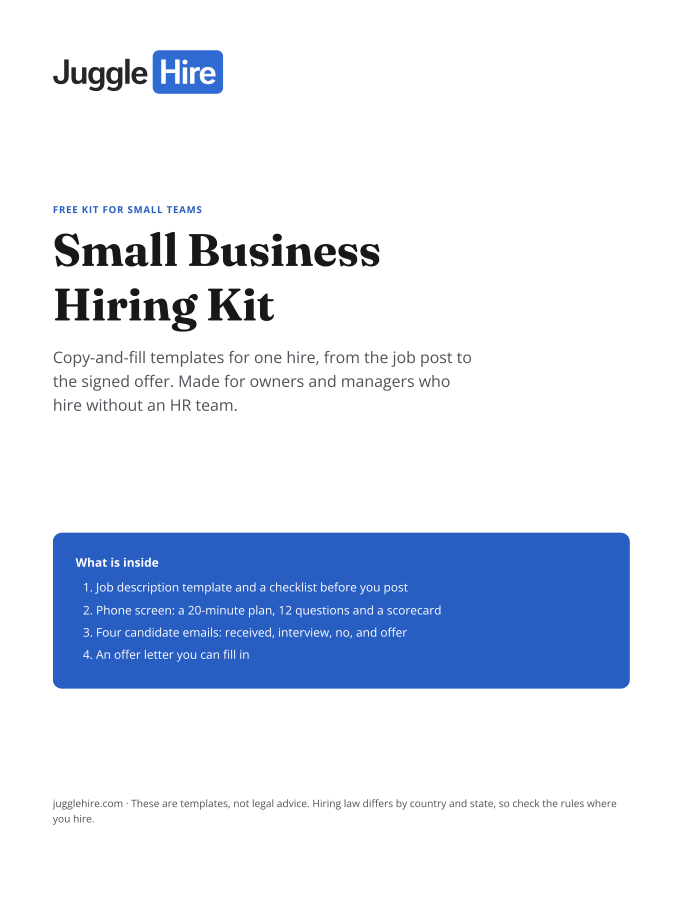
Get the Small Business Hiring Kit
- Job description template and a checklist before you post
- 20-minute phone screen: 12 questions and a scorecard
- Four candidate emails: received, interview, no, and offer
- An offer letter you can fill in
Free. We email you the kit and three short hiring tips. Unsubscribe any time.