Quick Answer: Starting a recruitment agency in 2026 takes five steps: pick a niche you can staff from your own network, register the business ($50–$500 for LLC + EIN, ~$500–$2,000 all-in for legal setup), decide your fee model (typically 15–25% of first-year salary for permanent placement), land your first 2–3 clients before you build anything fancy, and run the work on a flat-priced recruitment CRM instead of a per-seat enterprise ATS. Most solo or 2-person agencies can launch for under $5,000.
Last Updated: October 20, 2026
If you're reading this, you probably don't have a client yet, and maybe not even a registered business — just a network from your last recruiting job and an idea that you could do this on your own. That's the normal starting point. This guide walks through the full process in order: choosing a niche, the legal and financial setup, how placement fees actually work, landing your first clients without an existing book of business, and the tools you need on day one versus the tools that can wait.
#Step 1: Pick a Niche Before You Do Anything Else
The single biggest mistake new agency owners make is staying generalist. "I place anyone, anywhere" is not a pitch a client remembers. "I place senior backend engineers for Series A/B startups" is.
Why niche matters for a new agency specifically:
- You already have a network in your niche from your last recruiting job — that's your first candidate pipeline, free.
- Clients hire specialists over generalists when the role is hard to fill.
- A narrow niche means fewer, higher-quality job orders instead of chasing everything.
How to pick: Look at your last 2–3 years of placements. Which roles did you fill fastest? Which clients came back for repeat hires? That's your niche — not the market you find most exciting, the one where you already have proof you can deliver.
Permanent placement in tech (backend/DevOps/data) or finance & accounting tends to have the best fee math for a small team — at the standard 15–25% fee, a $100K–$200K salary base commonly lands in the $15K–$50K range, trending toward the higher end for these two verticals. Other niches (healthcare support, legal support, light-industrial/skilled trades) can work too, but they carry different economics — lower average salaries, more temp/contract volume, and in light-industrial specifically, more entrenched competition from staffing giants. If you're starting solo, tech or finance/accounting perm placement is the more forgiving place to begin.
#Step 2: Decide Perm Placement vs. Temp/Contract vs. Executive Search
These are three different businesses with different cash flow, different back-office needs, and different startup complexity.
| Model | How you get paid | Startup complexity |
|---|---|---|
| Permanent placement | One-time fee, 15–25% of first-year salary, paid on the candidate's start date | Lowest — no payroll, no timesheets, no VMS |
| Temp / contract staffing | Markup on an hourly bill rate, paid weekly/biweekly | Highest — you run payroll and workers' comp for people who work at someone else's company |
| Executive / retained search | Retainer + placement fee, often 1/3 up front | Low volume, needs an established reputation to land retainers |
Within permanent placement, most new agencies start contingency — no placement, no fee — because it removes the client's biggest objection to hiring an unproven agency. Retained search means the client pays a portion upfront regardless of outcome; it's harder to land without a track record, so it's usually something you grow into once you have case studies.
For a first agency, permanent contingency placement is the easiest starting point. No payroll, no timesheets, no vendor management system — you find the candidate, the client hires them, you invoice. Temp staffing can be lucrative but needs working capital to cover payroll before the client pays you, which is a hard way to start with no cash cushion.
#Step 3: Register the Business and Handle the Legal Basics
This part is boring but non-negotiable before you invoice anyone.
- Choose a structure. Most solo/small agencies form an LLC — simple, limits personal liability, cheap to maintain. Cost: $50–$500 depending on state.
- Get an EIN from the IRS (free, takes 10 minutes online).
- Open a business bank account — keep agency money separate from personal money from day one; you'll thank yourself at tax time.
- Check state staffing/employment agency licensing. Some US states require a license or registration specifically for employment agencies (this is more common for temp/contract than perm placement) — check your state's Department of Labor site before you sign your first client.
- Get a placement agreement template. This is the contract that defines your fee, your replacement guarantee (typically 90 days — if the hire leaves, you find a free replacement or refund a prorated amount), and payment terms (net 15–30 is standard). Don't skip a written agreement, even with a client you trust.
- Basic insurance. General liability at minimum; add professional liability (errors & omissions) once you're placing regularly.
Realistic startup cost for a solo perm-placement agency: $500–$2,000 in legal/registration, plus whatever you spend on tools (Step 5). You do not need an office, staff, or a big war chest to start.
#Step 4: Land Your First 2–3 Clients Before You Build Anything
Don't build a polished website, a branded career page, or a fancy process before you have a client willing to pay you. Your first clients come from your existing network, not cold outreach to strangers.
Where first clients actually come from for a new agency:
- Former employer relationships — hiring managers you worked with who trust your judgment, now that you're independent.
- LinkedIn, direct — message hiring managers you already have a relationship with; offer to fill one role on a contingency basis (no placement, no fee) to prove yourself.
- Referrals from your candidate network — people you've placed before often move into hiring-manager roles themselves.
- Trade associations and recruiter communities — for tech, recruiter Slack/Discord groups; for other verticals, the trade associations your niche already gathers in. (Peer subreddits like r/recruiting are useful for learning the trade, but their rules bar solicitation — don't use them to pitch for clients.)
The pitch that works for a brand-new agency: contingency-only, no retainer, no risk to the client. You get paid only when they hire your candidate. This removes the biggest objection ("why would I pay an unproven agency upfront") and gets you your first placements — and your first case studies — fast.
#Step 5: Set Up Your Tech Stack — What You Need Day One vs. Later
New agencies over-buy tools before they have revenue to justify them. Here's what actually matters at each stage.
Day one (before your first placement):
- A place to track candidates and client roles — not a spreadsheet past your first 10–15 open roles, it breaks down fast.
- Email and calendar you already have (Gmail/Outlook).
- A placement agreement template (Step 3).
Once you have 2+ active clients:
- A recruitment CRM/ATS that can track candidates across multiple client roles at once — this is the point where spreadsheets stop working, because the same candidate is often relevant to more than one client role and email/spreadsheets lose that context.
- Interview scheduling that doesn't eat your evenings in back-and-forth email.
- A way to send offer paperwork for e-signature.
Most agency-native tools charge per recruiter, which adds up fast for a small team. Bullhorn publishes Starter at $99/user/mo and Core at $165/user/mo (bullhorn.com/pricing); its Pro and Max plans, plus AI and back-office modules, are quote-only add-ons on top. JobAdder doesn't publish list pricing either — it's quote-only, with third-party estimates putting it around $100–$200+/user/month. Loxo starts at $149/user/mo for Core and starts at $199/user/mo for Professional, billed annually, with a 7-day free trial of Professional rather than a free tier (loxo.co/pricing) — two Loxo seats alone can run $298–$398/month. Manatal runs $15–$55/user/mo billed annually ($19–$59 monthly, depending on tier). Recruit CRM's Pro plan starts at $49/user/mo billed annually ($59/mo month-to-month), rising to $79/user/mo on Business and $129/user/mo on Enterprise — two Pro seats run $98–$118/month, already about double JuggleHire Unlimited's flat $49 at that headcount; three Recruit CRM Pro seats run $147–$177/month, three times Unlimited or more.
Vendor pricing verified September 2026 against each vendor's own pricing page — these numbers move, so re-check before quoting them.
JuggleHire takes a different approach to the seat question: Starter is $15/month flat for up to 5 team seats, and Unlimited is $49/month with unlimited seats — either way, adding a recruiter doesn't change your bill until you outgrow the plan. It covers the day-one-to-scale range: one candidate database you search across every client role, AI candidate ranking, native interview scheduling with Google Meet/Zoom auto-links, and offer letters with e-signature — the parts of the day-one/later split above that a spreadsheet can't do once you're running more than one client role at a time. It's a 14-day trial (card required), billed monthly, with no annual contract to sign before you know the business is working.
Being direct about the gap: JuggleHire today tracks candidates and jobs — it does not yet have a dedicated Companies/Contacts/Submittals data model for formally separating "this candidate belongs to Client A vs. Client B." For a solo or 2–3 person agency this rarely matters in practice (tags and talent pool search cover it); if you're already running complex multi-client submittal workflows at scale, a dedicated agency CRM like Bullhorn or JobAdder may fit better.
#How Much Does It Cost to Start a Recruitment Agency?
| Item | Typical cost |
|---|---|
| LLC registration + EIN | $50–$500 |
| Business bank account | Free–$15/mo |
| Placement agreement template (lawyer-reviewed or template service) | $0–$500 |
| Business insurance (general liability) | $300–$800/year |
| Recruitment CRM/ATS | $0 (spreadsheet, day one) → $15–$49/mo once you're running client roles |
| Website / LinkedIn presence | $0–$300 (many agencies start with LinkedIn only) |
| Total to launch | $500–$5,000, most of it optional beyond legal setup |
You do not need to spend $5,000. A lean solo launch — LLC, EIN, bank account, insurance, and a flat-rate ATS once you land client #2 — can be done for well under $1,500.
#Common Mistakes New Agency Owners Make
- Staying generalist too long. A narrow niche gets you client meetings faster than a broad one.
- Signing per-recruiter software before you have revenue. Start on a flat-rate tool or a spreadsheet; upgrade once volume justifies it.
- No written placement agreement. Get your fee, replacement guarantee, and payment terms in writing before you start work — verbally agreed terms leave you with nothing to point to if a client disputes the invoice.
- Underpricing to win the first client. 15% is already on the low end for perm placement — don't go lower just to land a logo.
- Losing track of candidates across client roles. The candidate you sourced for Client A last month is often the best fit for Client B's role this month — a tool that only shows candidates per-job loses that connection.
#Frequently Asked Questions
#How much money do I need to start a recruitment agency?
Most solo agencies launch for $500–$5,000 covering legal registration, insurance, and basic tools. You don't need an office or staff — many successful small agencies run from a laptop with a niche, a network, and a recruitment CRM.
#Do I need a license to start a recruitment agency?
It depends on your state and whether you're doing permanent placement or temp/contract staffing. Permanent placement generally has lighter licensing requirements than temp staffing, which involves acting as the employer of record. Check your state's Department of Labor before signing your first client.
#How do recruitment agencies get their first clients?
Almost always from the owner's existing network — former colleagues, hiring managers they've worked with before, and referrals from candidates they've placed in the past. Cold outreach to strangers rarely lands a first client; warm relationships do.
#What software do I need to start a recruitment agency?
Day one, a spreadsheet is fine. Once you're running more than one client role at a time, you need a place that tracks candidates across roles — that's the point spreadsheets break down. A flat-priced tool like JuggleHire (Starter $15/mo for up to 5 seats, Unlimited $49/mo unlimited seats) avoids the per-recruiter pricing of agency-native tools like Bullhorn, which publishes $99–$165/user/mo before you've made a placement.
#Is permanent placement or temp staffing easier to start?
Permanent placement. It has no payroll or working-capital requirements — you invoice once the candidate starts. Temp/contract staffing means running payroll and workers' comp for people working at your client's company, which needs cash reserves most new agencies don't have.
#Related Resources
- 6 Best Bullhorn Alternatives in 2026
- Recruitment CRM vs. ATS: What's the Difference?
- Best Hiring Software & Recruiting Tools for Small Business
- How to Choose the Right Recruitment Software in 2026
 1
 2One item outside this draft's scope, flagged for you separately: `loxo-alternatives.md:29` and `context/jugglehire/marketing.md` still need their own fixes (stale Loxo price, stale pricing-tier doc) — those are different files, not touched here since I have read-only access.
Free download
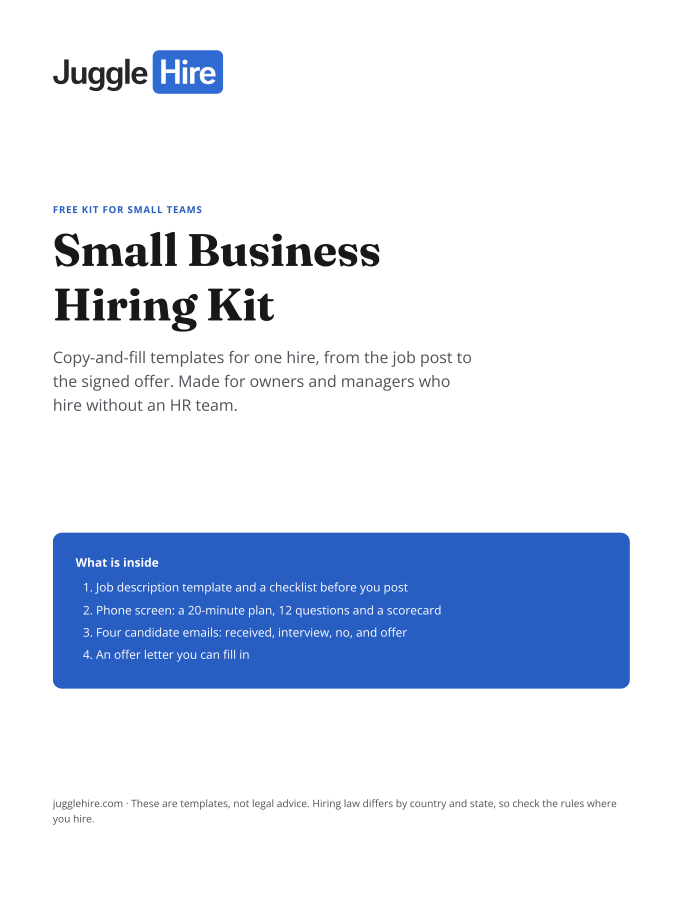
Get the Small Business Hiring Kit
- Job description template and a checklist before you post
- 20-minute phone screen: 12 questions and a scorecard
- Four candidate emails: received, interview, no, and offer
- An offer letter you can fill in
Free. We email you the kit and three short hiring tips. Unsubscribe any time.

Zakir Hossen
Zakir, founder of JuggleHire - a Google Forms alternative for hiring. Bootstrapped entrepreneur and software engineer with 10+ years coding experience from BD.
Related Posts
ATS for Staffing Agency: How to Choose One in 2026
A buyer's checklist for picking an ATS for a staffing agency — what to look for, and where JuggleHire fits.
ats for staffing agencystaffing agency softwareapplicant tracking system
Read more
ATS for Staffing Agencies: The Real Monthly Cost for a 3-Recruiter Team (2026)
What a 3-recruiter staffing agency actually pays for an ATS — verified per-seat rates from $237 to $597/mo, and the flat-price alternative at $15/mo.
ats pricing for staffing agenciesstaffing agency software costper-seat vs flat-rate ats+1 more
Read more