Node.js Developer Interview Questions
A hiring manager's question bank for Node.js developers — the event loop, streams, async patterns, building APIs with Express, error handling, and security. Built to separate people who can call npm install from people who can keep a Node service healthy under load.
Hiring a Node.js developer is really about backend judgement expressed through one specific runtime. The thing that trips people up is that Node is single-threaded and event-driven, so a candidate who treats it like a traditional threaded server will write code that quietly blocks the event loop and tanks throughput for every other request. The strongest signal in a Node interview is whether someone understands that distinction in their bones: that synchronous work, a heavy JSON parse, or a tight CPU loop in a request handler stalls the whole process, and that the answer is offloading, streaming, or a worker — not more requests per second on faith. Beyond the runtime, you want to confirm they can build and structure a real API: middleware ordering, validation, consistent error handling, not leaking stack traces, and not blowing up memory by buffering a large file into RAM instead of streaming it. The questions below run from event-loop fundamentals through streams and async patterns into API design, error handling, and security, which mirrors how production maturity reveals itself. Listen for candidates who talk about backpressure, graceful shutdown, timeouts, and what happens when a downstream dependency is slow. Pair a couple of runtime questions with one API-design discussion and one "a Node service is using too much memory" scenario, and you will quickly learn whether someone has operated Node in production or only built a tutorial CRUD app.
How to use these questions
Pick six to eight questions across two or three categories rather than the entire list. Start with an Event Loop & Runtime question to set a baseline, then move into an APIs & Architecture discussion and one Production scenario about errors, memory, or security. Push every clean answer with "what happens under load?" or "what if that downstream call hangs?" — that is where production experience shows.
Event Loop & Runtime
- Node is single-threaded — so how does it handle thousands of concurrent connections?
- What does it mean to "block the event loop", and can you give an example of code that accidentally does it?
- How would you handle a genuinely CPU-intensive task in Node without freezing the server?
- What is the difference between process.nextTick, setImmediate, and setTimeout(fn, 0)?
- How does Node achieve non-blocking I/O under the hood?
Streams & Async Patterns
- What are streams in Node, and when would you process a large file as a stream instead of reading it into memory?
- What is backpressure, and how do streams handle it?
- How do you run several async operations in parallel and wait for all of them, and how is that different from awaiting them in sequence?
- What is the difference between callbacks, Promises, and async/await, and how do you avoid unhandled rejections?
- How would you add a timeout to an async operation that might hang?
APIs & Architecture
- Walk me through how middleware works in Express and why ordering matters.
- How do you structure a growing Express or Fastify app so it stays maintainable?
- How do you centralize error handling in an Express API so failures return consistent responses?
- Where and how do you validate incoming request data?
- How do you implement graceful shutdown so in-flight requests are not dropped on deploy?
Error Handling & Security
- What happens to an uncaught exception in Node, and how should you handle one safely?
- A Node service is steadily increasing its memory usage. How do you investigate a leak?
- How do you protect a Node API against common risks like injection, leaked secrets, and exposed stack traces?
- How do you manage secrets and configuration across environments?
- Tell me about a production Node incident you debugged. What was the root cause and what did you change?
Tips for interviewing Node.js candidates
- Make sure they truly grasp the event loop — misunderstanding it is the single biggest source of bad Node code.
- Reward candidates who mention streaming and backpressure unprompted; it signals real-world file and data work.
- Probe error handling hard; consistent error responses and handled rejections separate seniors from juniors.
- Ask about behaviour under load and slow downstreams — production Node lives or dies on timeouts and shutdown.
- Watch for security awareness; leaking stack traces or secrets is a common and costly junior mistake.
Frequently asked questions
More interview question sets
Hiring Node.js developers? JuggleHire ranks, screens, and schedules candidates for you.
JuggleHire goes beyond simple job posting. Leverage custom forms, powerful screening filters, and automated social media previews to find the perfect fit for your team.
Free download
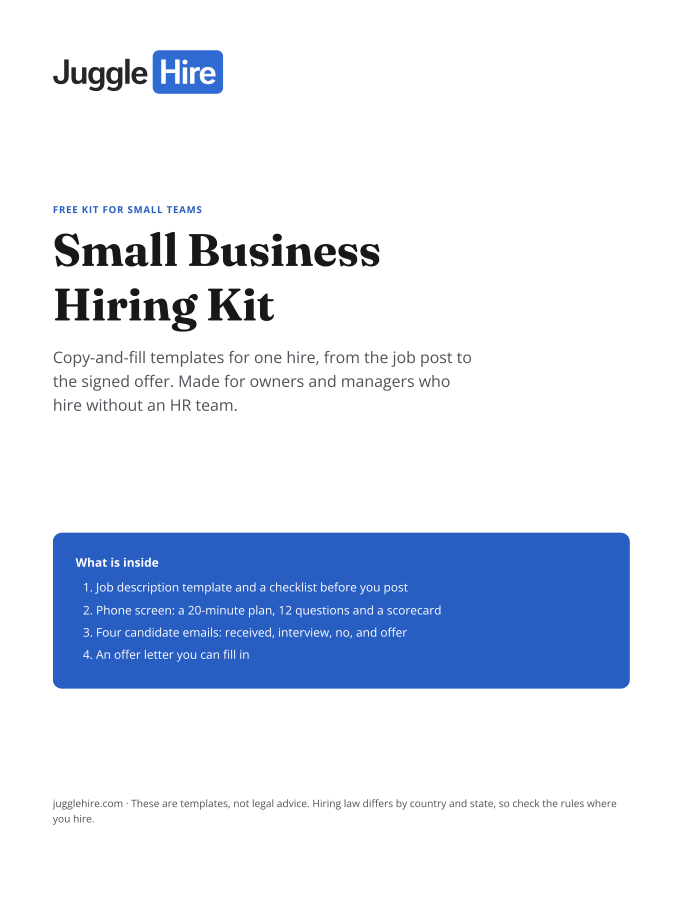
Get the Small Business Hiring Kit
- Job description template and a checklist before you post
- 20-minute phone screen: 12 questions and a scorecard
- Four candidate emails: received, interview, no, and offer
- An offer letter you can fill in
Free. We email you the kit and three short hiring tips. Unsubscribe any time.