React Developer Interview Questions
A hiring manager's question bank for React developers — hooks, state, rendering and reconciliation, performance, and component design. Built to separate people who can wire up a component from people who understand why it re-renders.
Modern React looks simple on the surface — write a function, return some JSX, sprinkle in a hook — but the developers who are worth hiring are the ones who understand what React is doing underneath. Most real React problems are not "how do I show this data?" but "why is this re-rendering forty times?", "why does this effect run twice?", or "why is my state one update behind?". So a good interview probes mental models, not API recall. A strong candidate can explain why state updates are batched and asynchronous, what actually goes in a useEffect dependency array and why, the difference between derived state and stored state, and when memoization genuinely helps versus when it just adds noise. The questions below progress from hooks and state through rendering and reconciliation into performance and component design, which is roughly the order in which seniority reveals itself. You are listening for someone who thinks in terms of data flow and render cycles, who knows when to lift state up and when not to, and who can explain a tradeoff like "I reached for context here, but it would have caused unnecessary re-renders, so I did this instead." Pair a couple of hook questions with one rendering scenario and one component-design discussion, and you will quickly tell whether someone has maintained a real React codebase or only followed tutorials.
How to use these questions
Choose six to eight questions across two or three categories instead of running the full list. Open with a Hooks & State question, move into a Rendering & Reconciliation scenario, then close on a Component Design discussion. Push every clean answer with "what triggers a re-render here?" or "when would that hurt performance?" — the follow-up is where real React understanding shows.
Hooks & State
- What problem do hooks solve compared with class components, and what are the rules of hooks?
- Walk me through the useEffect dependency array — what goes in it, and what happens if you get it wrong?
- Why are state updates asynchronous and batched, and how does that bite people who read state right after setting it?
- When would you use useState versus useReducer?
- What is the difference between useMemo, useCallback, and React.memo, and when does each actually help?
- What is a custom hook, and when have you extracted one to avoid repeating logic?
Rendering & Reconciliation
- What actually happens when a component re-renders, and what triggers a re-render?
- Explain reconciliation and the virtual DOM in your own words.
- Why does React need a stable key on list items, and what goes wrong if you use the array index?
- Why might an effect run twice in development, and how should you reason about it?
- How do you stop a parent re-render from needlessly re-rendering all of its children?
Performance & State Management
- A list of a few thousand rows is laggy. How do you diagnose and fix it?
- When does Context cause performance problems, and how do you avoid them?
- How do you decide between local state, lifted state, Context, and an external store like Redux or Zustand?
- What is the difference between derived state and stored state, and why prefer deriving?
Component Design & Judgement
- How do you decide when to split one component into several?
- How do you handle data fetching in a component, and where does loading and error state live?
- Tell me about a React component or pattern you refactored. What was wrong and what did you change?
- How do you keep a growing React app maintainable and testable?
- A teammate puts business logic directly in a JSX-heavy component. How do you handle that in review?
Tips for interviewing React candidates
- Probe re-render mental models — that single concept predicts React competence better than any API trivia.
- Reward candidates who reach for memoization only after measuring, not by reflex.
- Listen for "I lift state up here but not there" reasoning; component boundaries reveal experience.
- Ask for a real refactor story; maintaining a React codebase teaches lessons tutorials never do.
- Do not over-weight knowledge of the newest API; solid fundamentals matter far more than the latest hook.
Frequently asked questions
More interview question sets
Hiring React developers? JuggleHire ranks, screens, and schedules candidates for you.
JuggleHire goes beyond simple job posting. Leverage custom forms, powerful screening filters, and automated social media previews to find the perfect fit for your team.
Free download
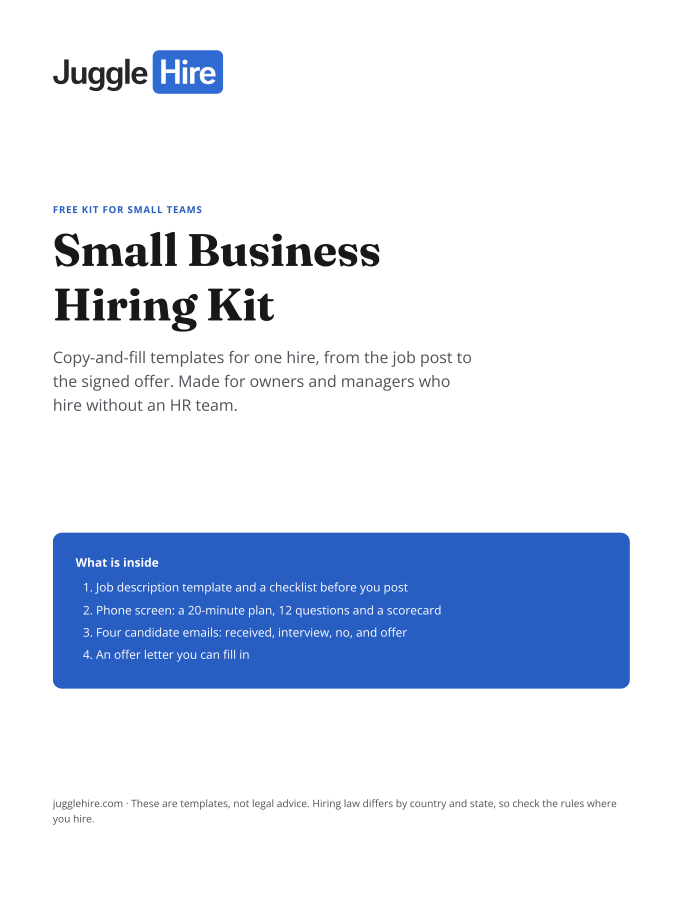
Get the Small Business Hiring Kit
- Job description template and a checklist before you post
- 20-minute phone screen: 12 questions and a scorecard
- Four candidate emails: received, interview, no, and offer
- An offer letter you can fill in
Free. We email you the kit and three short hiring tips. Unsubscribe any time.