Junior Python Developer Interview Questions
Entry-level Python questions for hiring managers screening juniors, bootcamp grads, and career switchers. Built to test fundamentals and problem-solving instinct, not memorized trivia.
When you are hiring a junior Python developer, you are not buying deep experience — you are buying fundamentals, curiosity, and the ability to learn fast. The goal of the interview is to confirm that the basics are genuinely understood (not just memorized) and that the candidate can reason through an unfamiliar problem without freezing. The questions below start gentle and build up. Early ones confirm the candidate can talk about Python's core data types and control flow with confidence; later ones reveal whether they understand the "why" behind common patterns and can debug their own thinking. For juniors especially, how they respond when they do not know something matters as much as what they know — look for candidates who say "I am not sure, but here is how I would find out." Mix three or four fundamentals questions with one small problem-solving prompt, and keep the tone collaborative. A nervous junior who relaxes into a good conversation often turns out to be your strongest hire.
How to use these questions
Open with two or three Fundamentals questions to build the candidate's confidence, then move to one Practical Problem-Solving prompt you can work through together. For juniors, prioritize reasoning and coachability over perfect answers — a candidate who debugs their own mistake live is showing you exactly the skill you are hiring for.
Python Fundamentals
- What is the difference between a list and a tuple, and when would you use each?
- What does it mean that strings are immutable in Python? Show me with an example.
- Explain the difference between == and is.
- What is a dictionary, and what kinds of keys can it have?
- What is the difference between a for loop and a while loop, and when would you reach for each?
- What does the len() function do, and what types can you call it on?
- What is a list comprehension, and can you rewrite a simple for loop as one?
Functions & Basic OOP
- What is the difference between an argument and a parameter?
- What does *args and **kwargs let you do in a function signature?
- What is a class, and how is it different from an object?
- What does the self parameter mean in a method?
- What is the difference between a function that returns a value and one that prints it?
Common Pitfalls & Debugging
- What happens if you use a mutable default argument like def f(x=[]) — and why is that surprising?
- You get an IndentationError. What does that usually mean and how do you fix it?
- How would you find out why a piece of code is producing the wrong output?
- What is the difference between an error and an exception, and how do you handle one with try/except?
Problem-Solving & Attitude
- Write a function that returns whether a string is a palindrome. Talk me through your thinking.
- How would you count how many times each word appears in a sentence?
- Tell me about something you built in Python — what was hard about it?
- When you get stuck on a bug you cannot solve, what do you do?
- What is a Python concept you learned recently, and how did you learn it?
Tips for interviewing Python candidates
- Start easy to settle nerves — a panicked junior underperforms and tells you nothing useful.
- Reward "I don't know, but here is how I'd find out" — coachability beats memorization at this level.
- Let them use a search engine or docs on the problem-solving question; that mirrors real work.
- Listen for genuine curiosity in the "concept you learned recently" question.
- Don't over-index on syntax mistakes; focus on whether the reasoning is sound.
Frequently asked questions
More interview question sets
Hiring junior developers? JuggleHire screens and ranks applicants so you interview the best.
JuggleHire goes beyond simple job posting. Leverage custom forms, powerful screening filters, and automated social media previews to find the perfect fit for your team.
Free download
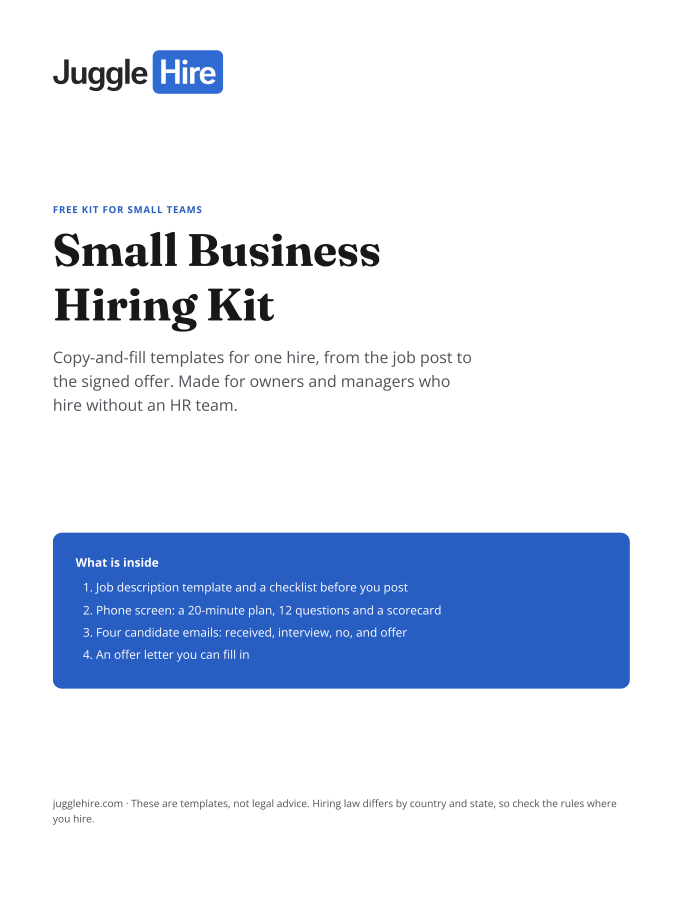
Get the Small Business Hiring Kit
- Job description template and a checklist before you post
- 20-minute phone screen: 12 questions and a scorecard
- Four candidate emails: received, interview, no, and offer
- An offer letter you can fill in
Free. We email you the kit and three short hiring tips. Unsubscribe any time.