Quick Answer: Cost per hire for a recruitment agency = (internal costs + external costs) ÷ placements made in that period. This guide's own estimate for small agencies (2–8 recruiters) is $300–$1,200 in internal cost per placement — recruiter time at a loaded hourly rate (commission, salary, benefits) plus flat tooling cost, not an industry-published figure, just this guide's math from the ranges below. That number measures something different from what a client pays: the client's cost is the agency's fee, typically 15–25% of first-year salary — covered below. It's also a different measure from SHRM's $1,200 average cost per hire for in-house teams (non-executive roles, 2025 Benchmarking Report): SHRM's figure is direct spend only (job ads, agency fees, background checks) and excludes most respondents' internal recruiter labor, while this guide's $300–$1,200 is mostly recruiter hours. They're not a like-for-like comparison — the agency's edge is that its tools and sourcing process are reused across every client, not a lower headline number.
Last Updated: October 20, 2026
Agency owners get asked "what's your cost per hire" by two different people, for two different reasons. A client asks it to judge whether your fee is worth it. Your own P&L asks it to tell you if you're actually making money on placements, or just staying busy.
This guide covers both — the formula, estimated numbers for small perm-placement agencies, and where the cost actually leaks.
#What "Cost Per Hire" Means for an Agency (Not the Same as In-House)
An in-house recruiting team calculates cost per hire once, for hires made for their own company. An agency runs the same formula on a completely different unit of work: every placement is a separate transaction with its own sourcing cost, its own client, its own fee.
That changes the metric two ways:
- Volume dilutes fixed cost. Your recruitment CRM, your job board subscriptions — all fixed monthly costs — get divided across every placement you make that month, not just one hire. Run 3 placements and a $49/mo tool is about $16/placement. Run 15 and it's about $3.
- Recruiter time is the dominant variable. Unlike an in-house HR team juggling one req at a time, an agency recruiter runs several open roles across multiple clients simultaneously. Time lost to admin — reformatting a CV, chasing an interview slot, updating a client — is the cost that actually moves the number, not software.
#The Formula
1Cost Per Hire = (Internal Recruiting Costs + External Recruiting Costs) ÷ Number of Placements
Internal costs (agency-side, per period):
- Recruiter salary/time allocated to sourcing, screening, and submitting candidates
- Recruitment CRM / ATS subscription
- Admin time: reformatting resumes into submittal packages, scheduling, chasing client feedback
External costs (per period):
- Job board postings (Indeed, LinkedIn) if the agency pays for visibility beyond organic applicants
- Background checks, when the agency runs them before submitting
- Any paid sourcing tools (LinkedIn Recruiter seats, database access)
What agencies leave out of the calculation, and shouldn't: the hours spent on roles that don't fill. If you run 20 roles a month and close 12, the sourcing time on the 8 that didn't close still counts as recruiting cost for that period — it's real time your team spent. Excluding it makes your cost per hire look artificially low and hides where your team's time is actually going.
Before you quote a client, it also helps to know what the role costs them to employ. The free Employee Cost Calculator works out salary plus payroll taxes, benefits and overhead, which is the number a client is really comparing your fee against.
#What a Healthy Cost Per Hire Looks Like for a Small Agency
| Agency size | Assumed monthly placements (for the math below) | Tool cost (flat-priced CRM) | Cost per placement (tooling only) |
|---|---|---|---|
| Solo / 2-person | 3–5 | $15/mo (Starter) | $3–5 |
| 3–5 recruiters | 8–15 | $49/mo (Unlimited) | $3–6 |
| 6–8 recruiters | 15–30 | $49/mo (Unlimited) | $2–3 |
The placement volumes above are this guide's assumption for the math, not a published benchmark. These are the tooling portion only — the number most agencies actually control, and it shrinks fast with volume on a flat-priced tool since the bill doesn't grow with headcount. Add in recruiter time at a loaded hourly rate (commission, salary, benefits) and this guide's estimate for total internal cost per placement at a 3-person perm-placement agency is $300–$1,200, driven almost entirely by hours spent per fill, not subscription cost. For comparison, SHRM's 2025 Benchmarking Report puts in-house cost per hire at $1,200 for non-executive roles — but that figure is direct spend only and excludes most companies' internal recruiter labor, so it's not directly comparable to this guide's fully-loaded estimate. The agency's real edge is amortizing sourcing effort across many roles at once, not a lower headline number.
Where this number goes wrong for most small agencies: it isn't the CRM bill. It's the admin hours nobody tracks — reformatting the same candidate's CV for the third client this month, redoing a submittal package by hand, chasing a client for interview feedback over email. Those hours don't show up as a line item, but they're the biggest lever on the formula because they scale with headcount, not with software.
#Where Agencies Can Cut Cost Per Hire
For the general playbook — job descriptions, referrals, employer brand, ATS adoption — see How to Reduce Cost Per Hire: 7 Proven Strategies. The levers below are specific to running an agency, where the cost is spread across many clients and roles at once rather than one company's hiring plan.
#1. Stop paying per recruiter for your core tool
Most agency-native CRM/ATS tools charge per user, per month: Bullhorn runs $99/user/mo Starter to $165/user/mo Core (Pro and Max are quote-only; third-party estimates put them around $200–$315+/user/mo), Loxo is $149/user/mo Core billed annually, $199/user/mo Professional billed annually, Recruiterflow is $119/mo on an annual plan or $149/mo monthly. JobAdder doesn't publish per-user pricing — it's quote-only. Across that range, a 3-recruiter agency can pay anywhere from roughly $300 to $900+/mo before add-ons. That cost divides across fewer placements than it should, because it grows every time you hire a recruiter, not every time you make a placement.
Flat-priced tools remove that scaling problem. JuggleHire's Unlimited plan is $49/mo flat, billed monthly, for the whole team — unlimited open jobs, up to 1,000 applicants per job, unlimited team members — covering AI candidate ranking, native interview scheduling, offer e-signature, automations, bulk actions, and GDPR tools most agencies otherwise buy as several separate tools. (Solo recruiters and small desks that don't need automations can start on Starter at $15/mo — 3 open jobs, 5 team members.) Adding a 4th or 5th recruiter costs nothing extra on either plan.
#2. Wake up your existing database before buying new sourcing tools
Every agency calls its candidate database "the asset." Most never mine it. A candidate sourced for one role last quarter might be the perfect fit for a different open role today — if you can find them. A searchable talent pool with tagging and saved searches across your open jobs turns re-placement into a near-zero-cost hire.
#3. Automate the stage-transition busywork
Every manual "still interested?" email, every stage-move notification, every idle-candidate nudge is a few minutes of recruiter time — multiplied by every open role. An automation engine that fires on triggers (stage move, candidate idle, new applicant) removes that time from every placement, not just one. On JuggleHire this is an Unlimited-plan feature.
#4. Shortlist faster to beat the competing agency
Speed to shortlist isn't just a client-experience metric — it's a cost metric. The longer a role stays open, the more total hours get spent on it before it closes. AI ranking that surfaces the strongest candidates on first view (rather than a recruiter reading every resume manually) compresses that window.
#The Other Meaning: What Clients Pay an Agency Per Hire
If you landed here comparing agency fees instead of running your own agency's numbers: recruitment agencies typically charge 15–25% of the placed candidate's first-year salary for permanent placements (some boutique/executive searches run higher), or a flat fee of $3,000–$8,000 for lower-salary roles. On a $70K hire at 20%, that's a $14,000 agency fee — which is what the client pays, not the agency's internal cost to make the placement. The gap between those two numbers is the agency's margin, and it's exactly the gap this guide's formula measures from the agency's side.
#FAQ
#What is a good cost per hire for a recruitment agency?
For a small perm-placement agency (2–8 recruiters), this guide's estimate for internal cost per placement — recruiter time plus tooling — is $300–$1,200, driven mostly by recruiter hours per fill rather than software cost. SHRM's 2025 Benchmarking Report puts in-house cost per hire at $1,200 for non-executive roles, but that's direct spend only and excludes most companies' internal recruiter labor, so the two numbers aren't measuring the same thing. The agency's real advantage is that its sourcing infrastructure is reused across every client and role, not a lower headline figure.
#How is cost per hire different for an agency vs. an in-house team?
An in-house team calculates cost per hire once per company, dividing fixed HR/recruiting costs across a handful of hires per year. An agency runs the same formula across many placements per month, for many different clients — so recruiter time per placement, not fixed software cost, is the dominant variable. That is why placements per recruiter matter as much as the cost side; see the hires per recruiter benchmark for agency and in-house numbers.
#Does the CRM or ATS cost matter much to cost per hire?
Less than most agencies assume. Even a $49/mo flat-priced tool (JuggleHire Unlimited) divides to $2–$6 per placement at typical agency volume. Per-recruiter-priced tools like Bullhorn ($99–$165/user/mo published, higher tiers quote-only) or Loxo ($149–$199/user/mo, billed annually) scale with headcount instead of placement volume, which is why they inflate cost per hire faster as an agency grows its team.
#How do I calculate cost per hire for my agency?
Add up internal costs (recruiter time, CRM/ATS subscription, admin hours) and external costs (job ads, background checks, paid sourcing tools) for a given period, then divide by the number of placements closed in that period. Include time spent on roles that didn't close — it's still real recruiting cost for that period.
#What's the difference between cost per hire and the fee I charge clients?
Cost per hire is what it costs you to make the placement. Your fee (typically 15–25% of first-year salary) is what the client pays you. The difference between the two is your margin per placement — tracking both numbers separately is the only way to know which clients or role types are actually profitable. Cost per hire also can't tell you whether placements stick; pair it with the agency metrics that show if hiring actually works.
Related reading:
- How to Reduce Cost Per Hire: 7 Proven Strategies
- The True Cost of Hiring an Employee
- How to Calculate Recruitment ROI
- Recruitment Metrics Every Agency Should Track
- Recruitment Agency KPIs: The 11 Metrics Worth Tracking
- Bullhorn Alternatives for Small Agencies
- Best Recruiting Tools for Small Businesses
Want to see what a flat-priced, agency-built recruitment CRM actually costs? Start a 14-day trial (card required, cancel anytime) — Starter is $15/mo, Unlimited is $49/mo, billed monthly, for your whole team, not per recruiter.
1
Free download
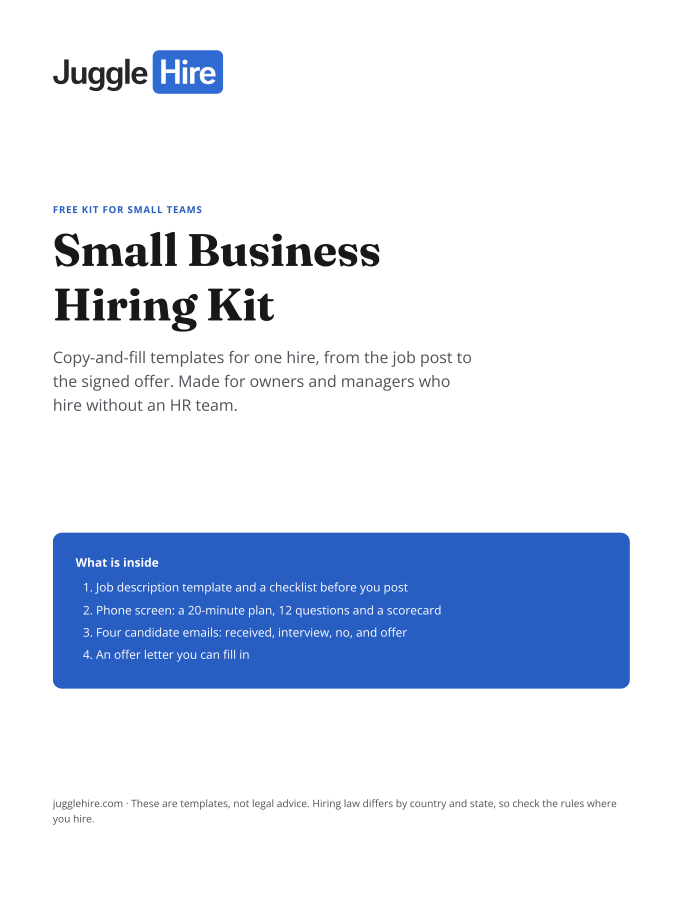
Get the Small Business Hiring Kit
- Job description template and a checklist before you post
- 20-minute phone screen: 12 questions and a scorecard
- Four candidate emails: received, interview, no, and offer
- An offer letter you can fill in
Free. We email you the kit and three short hiring tips. Unsubscribe any time.
Tagged with:

Zakir Hossen
Zakir, founder of JuggleHire - a Google Forms alternative for hiring. Bootstrapped entrepreneur and software engineer with 10+ years coding experience from BD.
Related Posts
ATS for Staffing Agency: How to Choose One in 2026
A buyer's checklist for picking an ATS for a staffing agency — what to look for, and where JuggleHire fits.
ats for staffing agencystaffing agency softwareapplicant tracking system
Read more
ATS for Staffing Agencies: The Real Monthly Cost for a 3-Recruiter Team (2026)
What a 3-recruiter staffing agency actually pays for an ATS — verified per-seat rates from $237 to $597/mo, and the flat-price alternative at $15/mo.
ats pricing for staffing agenciesstaffing agency software costper-seat vs flat-rate ats+1 more
Read more