AWS Cloud Engineer Interview Questions
A hiring manager's question bank for AWS cloud engineers. Use these to find candidates who design secure, cost-aware architectures — not ones who have only clicked around the console.
Hiring an AWS cloud engineer is really about hiring judgment, because AWS gives you a hundred ways to do anything and only a few of them are right for your situation. The danger is a candidate who has memorized service names and passed a certification but has never had to explain why a workload bankrupted the team on NAT gateway charges, or why their security group let the whole internet into a database. Good questions force the candidate to make architectural choices and defend them: when to use a load balancer versus a CDN, how to lay out public and private subnets in a VPC so a database is never reachable from the internet, how IAM roles beat long-lived access keys, and how to make a system scale and stay cheap at the same time. The Well-Architected Framework — its pillars of operational excellence, security, reliability, performance efficiency, cost optimization, and sustainability — is a useful spine for a senior conversation, since strong candidates naturally trade those pillars against each other rather than chasing one in isolation. The questions below are grouped so you can probe core compute and storage choices, VPC and networking, IAM and security, and the scalability-plus-cost thinking that separates an engineer who can build something that works from one who can build something that works, stays secure, and doesn't blow the budget. Look for people who ask "what does this cost and who can reach it?" before they reach for a service, who default to least privilege, and who can sketch a multi-AZ architecture and explain exactly what fails over when an availability zone goes down.
How to use these questions
Pick six to eight questions across compute, networking, security, and cost rather than running the entire list. Frame the security and cost questions as "defend this design" discussions — the reasoning a candidate gives matters far more than naming the right service.
Core Services & Compute
- When would you choose EC2 over Lambda over a container service like ECS or EKS?
- What is the difference between S3 and EBS, and when would you reach for each?
- Walk me through how you'd host a highly available web application across multiple availability zones.
- When would you use an Application Load Balancer versus CloudFront, and can they work together?
VPC & Networking
- How would you design a VPC so a database is never reachable from the public internet?
- Explain the difference between a security group and a network ACL.
- What does a NAT gateway do, why does it surprise people on the bill, and how do you reduce that cost?
- How do public and private subnets differ, and how does traffic leave a private subnet?
IAM & Security
- Why are IAM roles preferred over long-lived access keys for an application running on EC2?
- What does the principle of least privilege mean in practice on AWS, and how do you enforce it?
- How would you encrypt data at rest and in transit, and where does KMS fit in?
- You discover a public S3 bucket with customer data. Walk me through your response.
Scalability, Cost & Well-Architected
- How would you design a system to scale automatically with traffic while keeping costs predictable?
- A monthly AWS bill has spiked. Walk me through how you find and fix the cause.
- Name the Well-Architected pillars and describe a trade-off you've made between two of them.
- When would you use reserved instances or savings plans versus on-demand, and what is the risk?
- How do you make a stateless service resilient to an entire availability zone failing?
Tips for interviewing AWS candidates
- Frame questions as "defend this design" — AWS has many right answers, so the reasoning matters more than the service name.
- Always include a security scenario; a candidate who doesn't default to least privilege is a real risk in production.
- Probe cost awareness directly — NAT gateways, data transfer, and idle resources sink budgets, and good engineers think about it unprompted.
- Use the Well-Architected pillars as a spine and listen for trade-off thinking, not pillar-by-pillar memorization.
- Ask for a multi-AZ failover walkthrough; the ones who can say exactly what fails over have run real systems, not just labs.
Frequently asked questions
More interview question sets
Hiring AWS cloud engineers? JuggleHire ranks, screens, and schedules candidates for you.
JuggleHire goes beyond simple job posting. Leverage custom forms, powerful screening filters, and automated social media previews to find the perfect fit for your team.
Free download
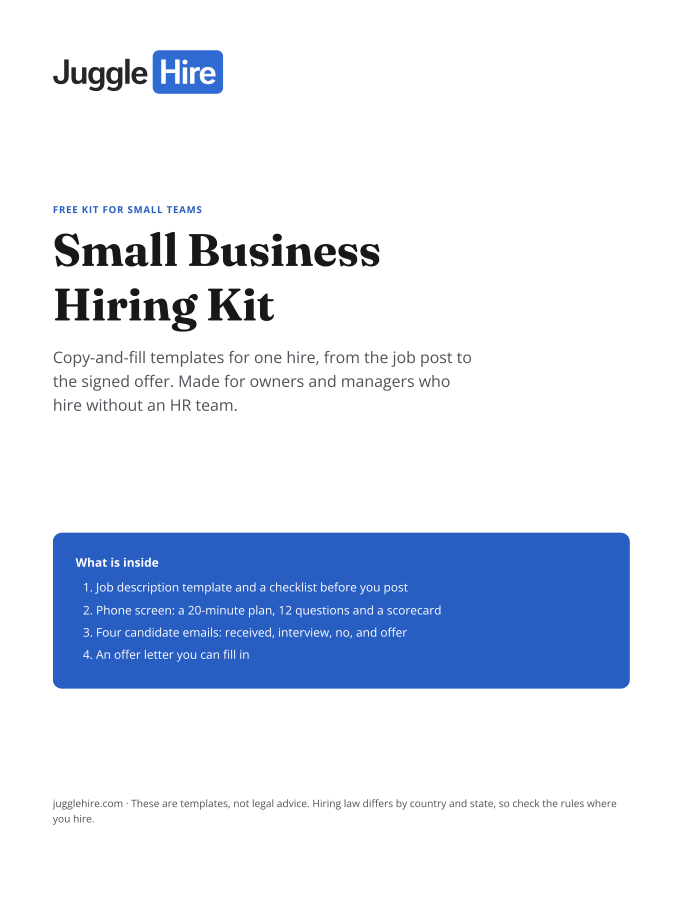
Get the Small Business Hiring Kit
- Job description template and a checklist before you post
- 20-minute phone screen: 12 questions and a scorecard
- Four candidate emails: received, interview, no, and offer
- An offer letter you can fill in
Free. We email you the kit and three short hiring tips. Unsubscribe any time.