Customer Success Manager Interview Questions
A hiring manager's question bank for customer success managers — onboarding, retention, QBRs, upsell, and saving at-risk accounts. Designed to find someone who keeps customers and grows them, not just someone who answers tickets.
Customer success sits in the most commercially important seat in many SaaS businesses, because keeping and expanding existing customers is cheaper and more durable than winning new ones. Yet the role is widely misunderstood, so the first thing a good interview should reveal is whether the candidate sees customer success as reactive support or as proactive, outcome-driven account management. The strong ones talk about driving the customer toward a result, spotting the early warning signs of churn long before a renewal date, and earning the trust that makes an upsell feel like help rather than a sales pitch. You are looking for someone who is genuinely empathetic but also commercially aware — comfortable with retention numbers, net revenue retention, and the uncomfortable conversation when an account is unhappy or about to leave. The most revealing questions are behavioral, because this is a relationship job: ask how they actually saved a churning account, how they handled an angry customer, how they ran a quarterly business review that changed the relationship. Listen for whether they led the customer to value or simply waited for problems to land in their inbox. Watch the internal angle too, since a great CSM is the customer's advocate inside the company, pushing product and engineering to fix what is hurting accounts while still managing the customer's expectations honestly. The questions below move from onboarding and adoption into retention and churn, then the expansion and difficult-conversation scenarios that show whether someone can carry a book of business, not just keep people calm.
How to use these questions
Pick six to eight questions and weight toward behavioral and scenario prompts — this is a relationship role, so past behavior is your best predictor. Lead with an onboarding question, then a specific churn-save story, then a difficult-customer scenario. Follow each with "what early signal did you miss or catch?" to test whether they manage accounts proactively or reactively.
Onboarding & Adoption
- Walk me through how you onboard a new customer in their first 30 days. What does success look like?
- How do you define and measure whether a customer has actually reached value?
- Tell me about a customer who was slow to adopt. How did you turn it around?
- How do you handle onboarding when the customer is busy and keeps going quiet?
- What is the difference, to you, between customer support and customer success?
Retention & Churn
- Tell me about an account you saved that was about to churn. What were the early signals?
- What signals tell you a customer is at risk long before the renewal date?
- You lose a customer despite your best effort. How do you handle it and what do you take from it?
- How do you prioritize your time across a book of, say, fifty accounts?
- How do you approach a renewal conversation with a customer who is on the fence?
QBRs & Expansion
- Walk me through how you run a quarterly business review. What makes it valuable rather than a status update?
- Tell me about a time you grew an account through upsell or expansion. How did it come about?
- How do you raise an upsell without making the customer feel sold to?
- How do you measure your own success in this role beyond renewals?
Difficult Customers & Advocacy
- Tell me about an angry customer. How did you handle the conversation and where did it land?
- A customer wants a feature that does not exist and may never be built. What do you do?
- Describe a time you pushed product or engineering internally on behalf of a customer. What happened?
- How do you say no to a customer while keeping the relationship strong?
Tips for interviewing Customer Success candidates
- Listen for proactive versus reactive language — strong CSMs drive customers to value and catch churn signals early; weak ones wait for problems to arrive.
- Probe commercial awareness: a great CSM is comfortable with retention numbers, renewals, and expansion, not just keeping people happy.
- On the angry-customer story, reward composure and a concrete resolution over a vague "I stayed calm and listened."
- Test the internal advocacy angle; the best CSMs influence product and engineering without overpromising to the customer.
- Match empathy with backbone — you want someone who can say no, set expectations, and still protect the relationship.
Frequently asked questions
More interview question sets
Hiring customer success managers? JuggleHire screens and ranks candidates before you interview.
JuggleHire goes beyond simple job posting. Leverage custom forms, powerful screening filters, and automated social media previews to find the perfect fit for your team.
Free download
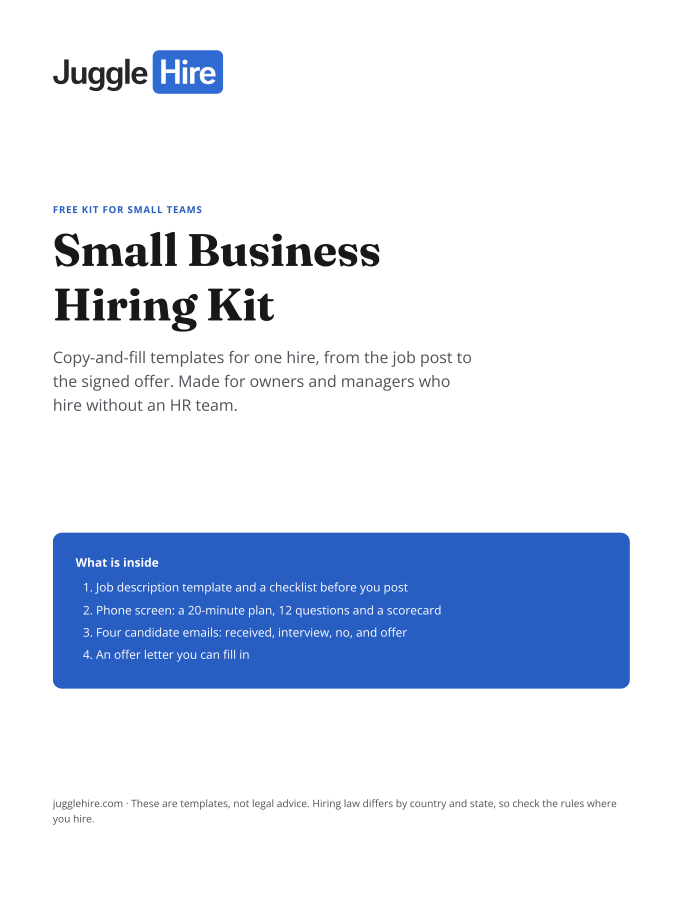
Get the Small Business Hiring Kit
- Job description template and a checklist before you post
- 20-minute phone screen: 12 questions and a scorecard
- Four candidate emails: received, interview, no, and offer
- An offer letter you can fill in
Free. We email you the kit and three short hiring tips. Unsubscribe any time.