DevOps Engineer Interview Questions
A hiring manager's question bank for DevOps engineers. Use these to find people who can keep production up at 3am, not just ones who can recite the names of tools.
DevOps interviews are uniquely tricky because the role spans so much: build and deployment pipelines, containers and orchestration, infrastructure-as-code, observability, the Linux fundamentals underneath it all, and — most importantly — how someone behaves when production is on fire. The failure mode is hiring a "tool tourist" who can list Docker, Kubernetes, Terraform and Prometheus on a resume but has never actually debugged a failing rollout or written an idempotent Terraform module that didn't recreate a database on apply. The questions below are built to get past the buzzword layer. They ask candidates to walk through a CI/CD pipeline they actually built, explain what really happens when a Kubernetes pod is stuck in `CrashLoopBackOff`, describe how they'd structure Terraform state so a teammate doesn't clobber it, and — crucially — narrate a real incident from alert to root cause to postmortem. That last category matters most: DevOps is judged on reliability, and the best candidates treat incidents as learning systems, write blameless postmortems, and automate away the toil that caused the last outage. For a strong read, combine one pipeline question, one containers/orchestration question, one infrastructure-as-code question, and one incident-response scenario. Look for people who think in terms of automation, repeatability, and failure recovery — who reach for "how do we make sure this never pages us again" rather than a one-off manual fix — and who can explain a Linux or networking issue down to the actual mechanism, not just the command they Googled.
How to use these questions
Pick six to eight questions across pipelines, infrastructure, and incident response rather than running the whole list. The incident-response scenario is the most revealing — give a candidate room to walk through it end to end and watch how they reason under simulated pressure.
CI/CD Pipelines
- Walk me through a CI/CD pipeline you built from commit to production. What stages did it have and why?
- How do you safely roll out a risky change — blue/green, canary, feature flags — and when would you pick each?
- A deploy half-succeeds and leaves prod in a broken state. How is your pipeline designed to handle that?
- How do you manage secrets in a pipeline without leaking them into logs or images?
Containers & Orchestration
- A Kubernetes pod is stuck in `CrashLoopBackOff`. Walk me through how you diagnose it.
- What is the difference between a Deployment, a StatefulSet, and a DaemonSet, and when do you use each?
- How do liveness and readiness probes differ, and what breaks if you configure them wrong?
- How would you reduce a bloated Docker image, and why does image size matter in production?
Infrastructure as Code
- How do you structure Terraform state so multiple engineers can work without clobbering each other?
- What does "idempotent" mean for infrastructure, and how do you avoid a Terraform apply that recreates a database?
- How do you manage configuration drift between what Terraform thinks exists and what actually exists?
- How would you roll out an infra change across staging and production safely?
Monitoring, Incidents & Linux
- Tell me about a real production incident — walk me from the alert to root cause to what you changed afterward.
- What is the difference between metrics, logs, and traces, and when does each one help you?
- A server's load average is high but CPU looks idle. How do you investigate?
- How do you decide what to alert on so the on-call rotation doesn't drown in noise?
- Write or describe a small script you'd use to automate a repetitive ops task, and why automate it.
Tips for interviewing DevOps candidates
- Hunt for tool tourists — make candidates describe a pipeline or incident they personally owned, not tools they've heard of.
- Spend the most time on the incident-response scenario; reliability is the job, and it reveals real judgment under pressure.
- Reward an automation mindset — "how do we make sure this never pages us again" beats a clever one-off manual fix.
- Probe Linux and networking down to the mechanism; a candidate who only knows the command but not why it works will stall in a real outage.
- Listen for blameless thinking on postmortems; engineers who blame people instead of systems make teams worse.
Frequently asked questions
More interview question sets
Hiring DevOps engineers? JuggleHire ranks, screens, and schedules candidates for you.
JuggleHire goes beyond simple job posting. Leverage custom forms, powerful screening filters, and automated social media previews to find the perfect fit for your team.
Free download
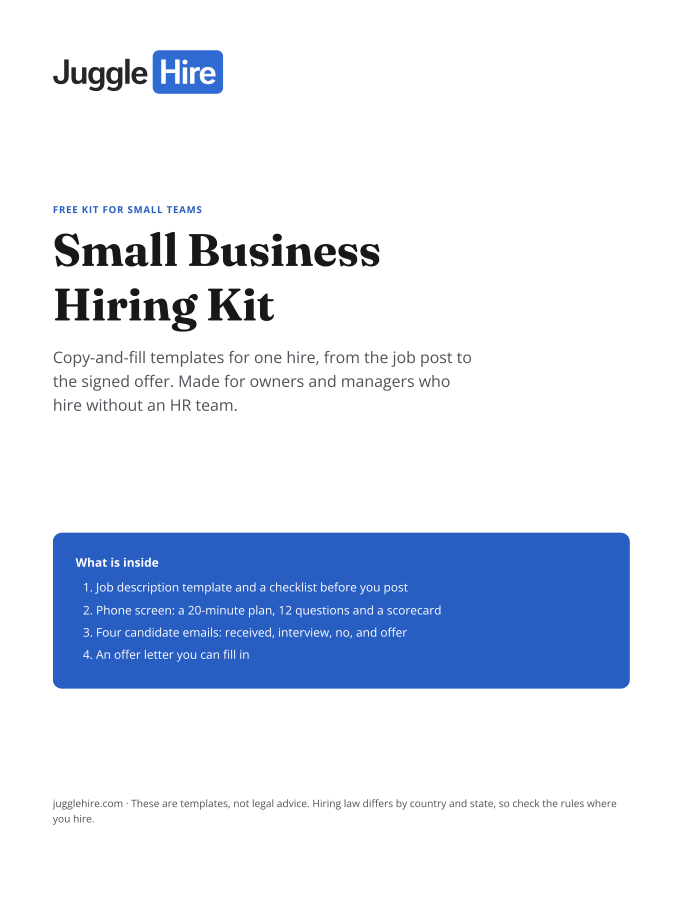
Get the Small Business Hiring Kit
- Job description template and a checklist before you post
- 20-minute phone screen: 12 questions and a scorecard
- Four candidate emails: received, interview, no, and offer
- An offer letter you can fill in
Free. We email you the kit and three short hiring tips. Unsubscribe any time.