Junior Java Developer Interview Questions
A hiring manager's question bank for entry-level Java developers. Use these to find candidates who have solid fundamentals and the attitude to grow — not the ones who can recite the most syntax.
Interviewing a junior Java developer is a different job from interviewing a senior. You are not trying to find someone who already knows everything — you are trying to find someone with sound fundamentals, clear thinking, and the coachability to become great on your team. That means the questions should stay grounded: object-oriented basics, how the common collections differ, how exceptions and `null` are handled, and whether they can talk through a small problem out loud without panicking. The goal is to see how they think, not to trip them up with edge cases a junior has no business knowing. A great junior often beats a mediocre mid-level hire because they bring energy, ask good questions, and absorb feedback fast — so weight attitude and reasoning as heavily as raw knowledge. When a candidate gets stuck, that is a feature: watch whether they freeze, guess wildly, or calmly reason toward an answer and say "I'm not sure, but here's how I'd find out." That last response is gold. The questions below are intentionally approachable, with a mix of core-language fundamentals, collections and exceptions, a light problem-solving prompt or two, and behavioral questions that reveal how they learn. Keep the tone warm; a nervous junior who would thrive on the job can look weak in a hostile interview. You are screening for trajectory, not for a finished engineer.
How to use these questions
Pick five or six questions and keep the room friendly — nerves hide real ability in juniors. When someone gets stuck, give a small hint and watch how they recover; how they handle not knowing tells you more than the answer itself.
OOP & Core Language
- In your own words, what does object-oriented programming mean, and why is it useful?
- What is the difference between a class and an object?
- Explain inheritance with a simple everyday example.
- What is the difference between `==` and `.equals()` when comparing two strings?
- What does the `static` keyword do, in plain terms?
Collections
- What is the difference between an `ArrayList` and a `HashMap`, and when would you use each?
- How would you loop over every item in a list?
- If you needed to store a list of names with no duplicates, what would you reach for and why?
- What is the difference between a `List` and an array in Java?
Exceptions & Basics
- What is an exception, and how do you handle one with try/catch?
- What is a `NullPointerException`, and how would you avoid getting one?
- What is the difference between a checked and an unchecked exception, as you understand it?
Problem-Solving & Attitude
- How would you check if a word is a palindrome? Talk me through your thinking, no need for perfect code.
- Tell me about a bug you ran into in a project and how you figured it out.
- When you get stuck on a problem you've never seen, what do you do?
- What have you taught yourself recently, and how did you go about it?
Tips for interviewing Java candidates
- Weight attitude and coachability as heavily as knowledge — juniors are hired for trajectory, not finished skill.
- Keep the room warm; a nervous junior who'd thrive on the job can look weak under pressure.
- When they get stuck, offer a hint and watch the recovery — calm reasoning beats a memorized answer.
- Reward "I don't know, but here's how I'd find out" — it predicts on-the-job success better than trivia recall.
- Ask what they've self-taught recently; genuine curiosity is the strongest signal in an entry-level hire.
Frequently asked questions
More interview question sets
Hiring junior Java developers? JuggleHire ranks, screens, and schedules candidates for you.
JuggleHire goes beyond simple job posting. Leverage custom forms, powerful screening filters, and automated social media previews to find the perfect fit for your team.
Free download
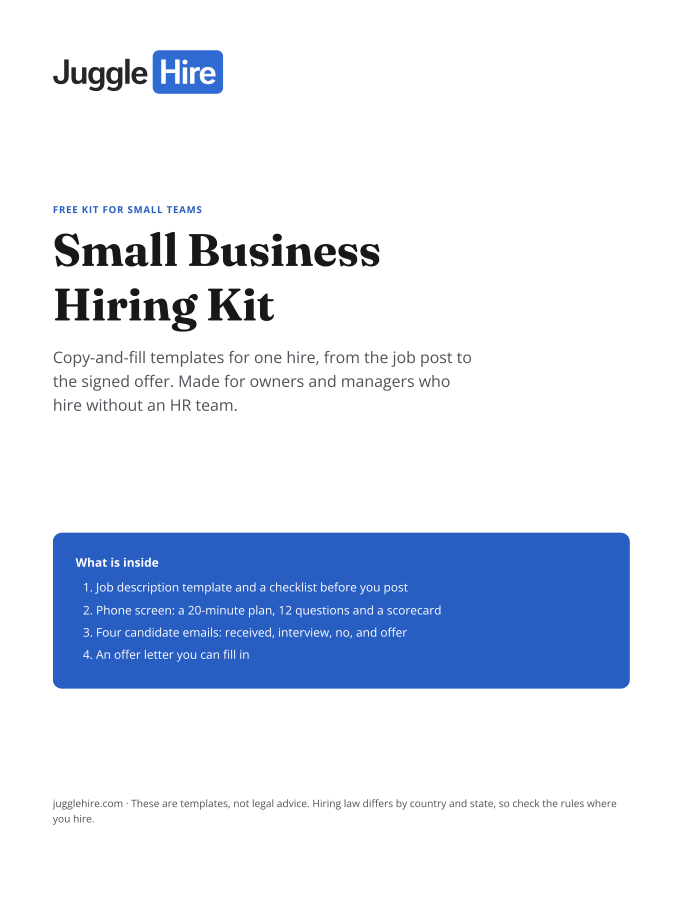
Get the Small Business Hiring Kit
- Job description template and a checklist before you post
- 20-minute phone screen: 12 questions and a scorecard
- Four candidate emails: received, interview, no, and offer
- An offer letter you can fill in
Free. We email you the kit and three short hiring tips. Unsubscribe any time.