Project Manager Interview Questions
A hiring manager's question bank for project managers — planning, scope and risk, stakeholder wrangling, and shipping on time. Built to reveal how someone delivers under pressure, not how well they recite a methodology.
The hard part of project management is rarely the Gantt chart. It is the messy middle: a scope that quietly grows, a stakeholder who changes their mind in week six, a dependency that slips and threatens the launch date. A strong project manager is the person who saw the risk coming, raised it early, and kept the team calm while they re-planned. So the best interview questions push past process trivia and into lived experience — how a candidate actually handled a slipping deadline, an unhappy executive, or two teams pointing fingers. Certifications and framework knowledge matter, but they tell you what someone has studied, not how they behave when a project is on fire. As you interview, listen for ownership. Weak candidates describe what the team did; strong ones describe the decisions they made, the trade-offs they weighed, and what they would do differently. Listen for communication instinct too, because a project manager spends most of their day translating between engineering, leadership, and the customer. The questions below are organized so you can probe planning rigor, then risk and scope discipline, then the people skills that separate a coordinator from a true delivery owner. Pair a couple of behavioral prompts with one realistic scenario and you will quickly see whether someone manages projects or merely tracks them.
How to use these questions
Pick six to eight questions across categories rather than racing through all eighteen. Lead with one planning question, then a scope-or-risk scenario, then two behavioral prompts about conflict and stakeholders. Follow every story with "what would you do differently?" — the answer reveals far more about judgement than the original anecdote.
Planning & Delivery
- Walk me through how you take a brand-new project from kickoff to a realistic plan. What do you nail down first?
- How do you estimate timelines when the team is unsure how long the work will take?
- Tell me about a project you delivered on time. What specifically kept it on track?
- Tell me about a project that slipped. When did you know, and how did you handle it?
- How do you decide what to cut when you are running out of time but not scope?
Scope & Risk Management
- A stakeholder asks for "one small addition" in week six. Walk me through how you respond.
- How do you identify and track risks before they become problems?
- Describe a time a key dependency slipped and threatened your deadline. What did you do?
- How do you keep scope creep in check without becoming the person who always says no?
- What does your status report or dashboard actually show, and who reads it?
Stakeholders & Communication
- Tell me about a time you had to deliver bad news to leadership. How did you frame it?
- Two teams you depend on are blaming each other for a delay. How do you resolve it?
- How do you keep a remote or cross-functional team aligned week to week?
- Describe a stakeholder who was hard to manage. What made it work in the end?
Methodology & Judgement
- When would you run a project Agile versus Waterfall? Give me a real example of each.
- A retrospective surfaces the same problem for the third sprint running. What do you do?
- How do you measure whether a project was actually successful, beyond hitting the date?
- Tell me about a decision you made on a project that you later regretted.
Tips for interviewing Project Management candidates
- Favor "tell me about a time" over "how would you" — past delivery behavior predicts future delivery better than hypotheticals.
- Probe ownership: strong PMs say "I decided," weak ones say "the team did." Listen for the pronoun.
- On the scope-creep scenario, reward candidates who negotiate a trade-off rather than flatly refuse or silently absorb the work.
- Do not over-index on certifications; treat PMP or Scrum credentials as a tie-breaker, not a filter.
- Watch how they describe conflict — a PM who never mentions tension is either green or sanitizing.
Frequently asked questions
More interview question sets
Hiring project managers? JuggleHire screens, ranks, and schedules candidates before you interview.
JuggleHire goes beyond simple job posting. Leverage custom forms, powerful screening filters, and automated social media previews to find the perfect fit for your team.
Free download
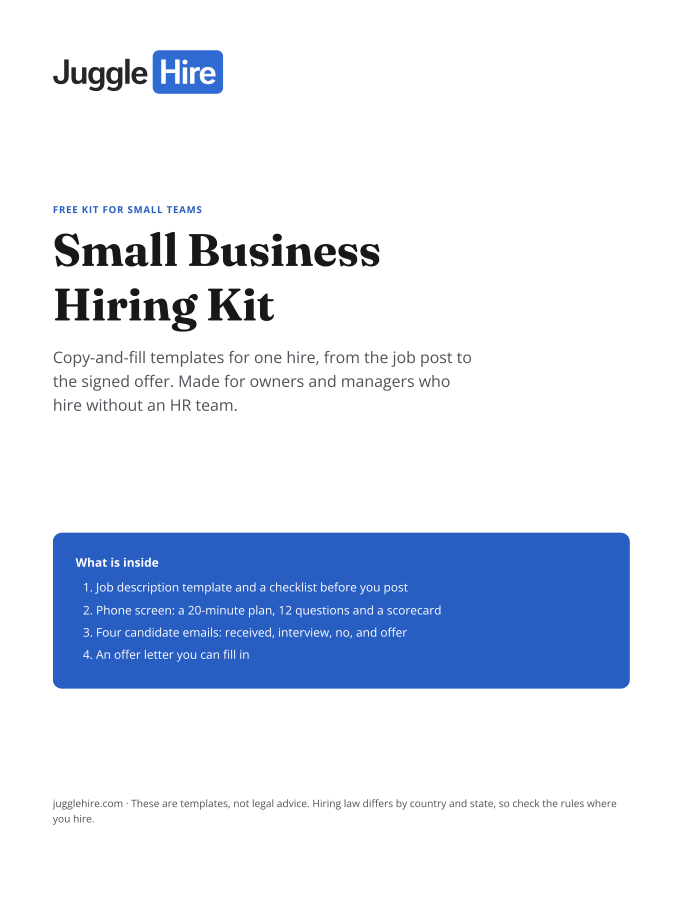
Get the Small Business Hiring Kit
- Job description template and a checklist before you post
- 20-minute phone screen: 12 questions and a scorecard
- Four candidate emails: received, interview, no, and offer
- An offer letter you can fill in
Free. We email you the kit and three short hiring tips. Unsubscribe any time.