Senior Python Engineer Interview Questions
A hiring manager's question bank for experienced Python engineers. Use these to find the people who understand how Python actually executes, not just how to write a list comprehension.
Python is easy to write and hard to write well at scale, which is exactly what a senior interview should expose. Anyone can answer "what is a list comprehension" — the interesting questions are about what happens when the codebase grows: how the Global Interpreter Lock shapes your concurrency choices, why CPU-bound work needs multiprocessing while I/O-bound work fits threads or asyncio, and how a decorator or generator can either clarify or quietly break code that depends on it. A strong senior candidate has internalized that Python gives you a lot of rope, and can explain when they chose not to be clever. The questions below are grouped so you can probe the runtime, the language's functional features, real-world performance work, and the discipline that keeps a growing Python service maintainable — testing, typing, and clean API design. For a senior role, pair one GIL or concurrency question with one performance-profiling scenario and one design or API question; that combination separates engineers who have scaled Python in production from those who have only built scripts and small services. Look for candidates who reach for profiling before optimizing, who know when `asyncio` helps and when it just adds complexity, who treat type hints and tests as load-bearing rather than decoration, and who can describe a time they made a deliberately boring choice because it was the right one for the team.
How to use these questions
Choose six to eight questions across two or three groups rather than rushing the full set. Push past first answers — when someone says "use multiprocessing," ask why, and when they'd be wrong to. Treat each question as the start of a conversation about trade-offs.
Runtime, GIL & Concurrency
- Explain the Global Interpreter Lock — what problem does it solve and what does it cost you?
- When would you reach for `multiprocessing` versus `threading` versus `asyncio`?
- How does `asyncio` achieve concurrency without multiple threads, and where does it stop helping?
- You have a CPU-bound task that needs to go faster. Walk me through your options in Python.
Language Internals: Decorators & Generators
- Explain how a decorator works under the hood and a case where you'd write one in real code.
- What is the difference between a generator and a list, and when does that difference matter for memory?
- How do context managers work, and how would you write one without `contextlib`?
- What does `*args` / `**kwargs` cost you in readability, and when is it the right call?
Performance & Design
- A Python service is slow. Walk me through how you profile it before changing anything.
- Describe a design pattern you've used in Python and one you deliberately avoided as over-engineering.
- When would you cache, and what are the failure modes of caching you've hit in production?
- How do you decide whether a hot loop should move to NumPy, C, or stay as-is?
Testing, Typing & API Design
- How do you structure tests for a service with external dependencies — what do you mock and what don't you?
- How do type hints and `mypy` change the way you write and review Python at scale?
- How would you design a clean, versioned REST or RPC API in Python, and how do you handle breaking changes?
- A junior's PR works but is hard to read and untested. How do you handle that review?
Tips for interviewing Python candidates
- Anchor concurrency questions in real scenarios — the GIL answer only matters when tied to a CPU-bound vs I/O-bound choice.
- Reward candidates who profile before optimizing; guessing at bottlenecks is a junior habit.
- Probe whether they treat type hints and tests as load-bearing, not decoration — that signals scale experience.
- Watch for over-engineering; a senior who can name a pattern they avoided is often stronger than one who lists ten they love.
- Ask for a "boring choice" they made on purpose — pragmatism is a senior trait that trivia questions never surface.
Frequently asked questions
More interview question sets
Hiring Python engineers? JuggleHire ranks, screens, and schedules candidates for you.
JuggleHire goes beyond simple job posting. Leverage custom forms, powerful screening filters, and automated social media previews to find the perfect fit for your team.
Free download
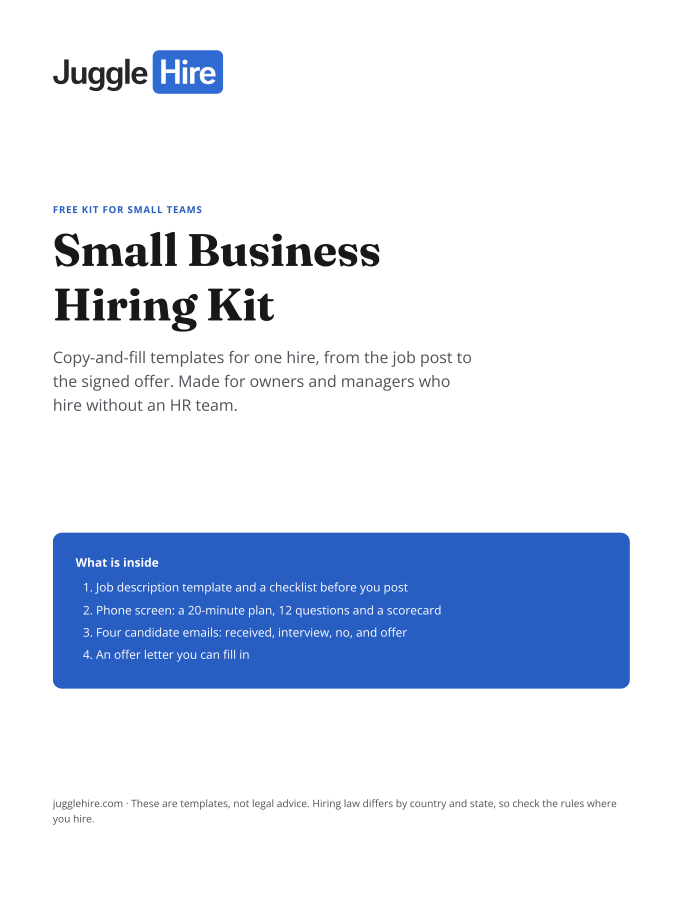
Get the Small Business Hiring Kit
- Job description template and a checklist before you post
- 20-minute phone screen: 12 questions and a scorecard
- Four candidate emails: received, interview, no, and offer
- An offer letter you can fill in
Free. We email you the kit and three short hiring tips. Unsubscribe any time.