UX/UI Designer Interview Questions
A hiring manager's question bank for UX/UI designers — design process, research, Figma craft, design systems, accessibility, and how to read a portfolio. Built to separate designers who make things look nice from designers who solve the right problem and can prove it.
Hiring a UX/UI designer is harder than hiring an engineer in one specific way: a beautiful portfolio tells you someone has taste, but it does not tell you whether they made good decisions or just inherited a good brief. So the entire interview should be aimed at one question — can this person turn a fuzzy problem into a usable, defensible design, and explain why each choice was made? The strongest signal is not the final screen; it is the story behind it. A great designer can tell you what the actual user problem was, what they tried and threw away, what the constraints were, how they knew the design worked, and what they would change now. Watch for the difference between someone who designs for users and someone who designs for their portfolio: the former talks about research, edge cases, error states, and accessibility; the latter talks mostly about aesthetics. You also want to confirm craft and collaboration, because real product work is a team sport — designers who hand engineers ambiguous files, ignore design-system consistency, or cannot take feedback create friction no matter how good their visuals are. The questions below cover process and research, craft in Figma and design systems, accessibility, and the soft skills that decide whether a designer thrives on a small team. Center the conversation on a real portfolio piece and keep asking "why" and "how did you know" — that is where genuine design thinking separates from a pretty deck.
How to use these questions
Anchor the interview on one real portfolio project and walk it end to end, pulling questions from Process & Research and Craft as you go, then cover Accessibility and Collaboration. Keep asking "why did you make that choice?" and "how did you know it worked?" — a strong designer defends decisions with users and constraints, not just taste.
Design Process & Research
- Walk me through your design process from a fuzzy problem to a shipped solution.
- How do you figure out what users actually need versus what they say they want?
- What research methods do you use, and how do you choose between them when time is short?
- Tell me about a time user research changed your design direction.
- How do you decide a design is "done" and ready to hand off?
- How do you balance user needs against business goals and technical constraints?
Craft, Figma & Design Systems
- Walk me through how you structure a Figma file so engineers and other designers can work in it.
- What is a design system, and how do you decide when to create a new component versus reuse one?
- How do you keep a product visually consistent as it grows and more people contribute?
- How do you design for all the states — loading, empty, error, and edge cases — not just the happy path?
- How do you use components, variants, and auto-layout to keep designs maintainable?
Accessibility & UX Judgement
- How do you make sure a design is accessible, and what do you check for colour contrast and keyboard use?
- How do you decide between a familiar pattern and a more original one?
- How would you redesign a confusing flow — where do you start?
- How do you simplify a screen that is trying to do too much?
Collaboration & Portfolio Critique
- Take me through one project in your portfolio — the problem, what you tried, and why the final design looks the way it does.
- Tell me about a time you got hard feedback on a design. How did you respond?
- How do you work with engineers, and what makes a handoff go smoothly or badly?
- How do you advocate for the user when a stakeholder pushes for something you think is wrong?
- What is a design decision you got wrong, and what did you learn?
Tips for interviewing UX/UI Design candidates
- Judge the story, not the screen — a strong designer explains the problem, constraints, and tradeoffs behind every choice.
- Push past aesthetics into research, edge cases, and accessibility; that is where real UX thinking lives.
- Watch how they take feedback in the room; defensiveness in an interview predicts friction on the team.
- Ask about a design they got wrong — humility and learning matter more than a flawless highlight reel.
- For small teams, weigh collaboration and Figma hygiene heavily; a great visual designer who blocks engineers still slows you down.
Frequently asked questions
More interview question sets
Hiring UX/UI designers? JuggleHire ranks, screens, and schedules candidates for you.
JuggleHire goes beyond simple job posting. Leverage custom forms, powerful screening filters, and automated social media previews to find the perfect fit for your team.
Free download
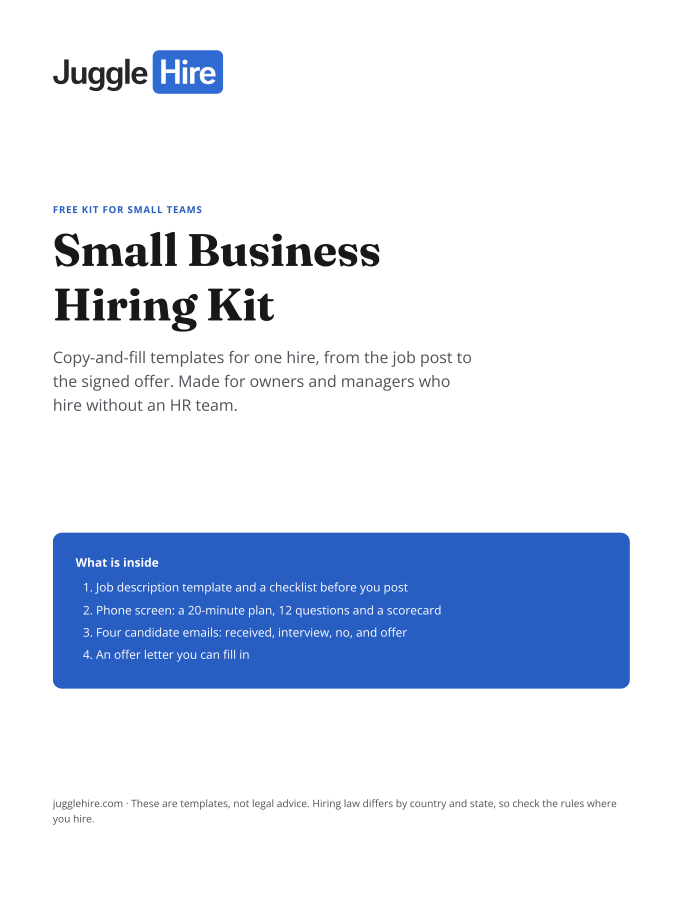
Get the Small Business Hiring Kit
- Job description template and a checklist before you post
- 20-minute phone screen: 12 questions and a scorecard
- Four candidate emails: received, interview, no, and offer
- An offer letter you can fill in
Free. We email you the kit and three short hiring tips. Unsubscribe any time.